
In London, the Ukrainian president seeks unity from the UK, France and Germany as the United States urges allies to back a recalibrated plan for ending the war.
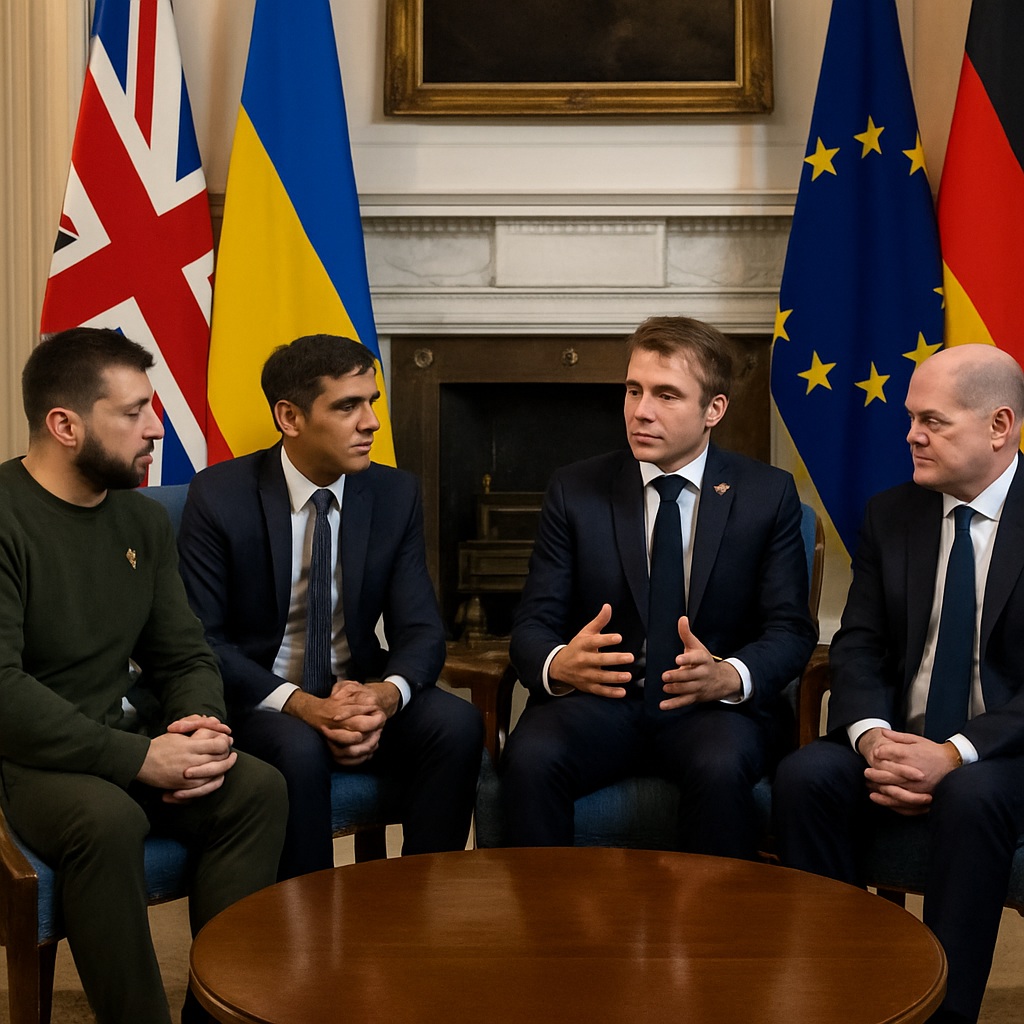
Volodymyr Zelenskyy arrived in London for a high‑stakes round of consultations with European leaders, seeking to reinforce a united Western front as the United States intensifies its push for a revised peace proposal for Ukraine. The gathering, hosted at a secure government venue in the British capital, brought together the leaders of the United Kingdom, France and Germany in a moment that could shape the next phase of the conflict.
The meetings come as diplomatic pressure mounts on Kyiv to engage with the newest iteration of a US‑supported peace outline. Although the details of Washington’s revision remain closely held, officials from multiple European capitals say it attempts to blend security guarantees with a monitored ceasefire framework, aiming to halt frontline deterioration without rewarding Russian territorial gains. Yet the plan’s reception within Europe remains cautious, and within Ukraine, deeply fraught.
Zelenskyy’s London consultations opened with a private briefing to his counterparts on Ukraine’s military outlook, which continues to be strained by limited ammunition supplies and the need to reinforce defensive lines ahead of winter’s peak. According to European officials present at the discussions, the Ukrainian president underscored the risks of any premature settlement that could freeze the conflict on Russia’s terms. His message, they said, was that unity mattered more now than at any earlier phase of the war.
For their part, European leaders sought to balance a pragmatic assessment of the battlefield with an insistence that Ukraine’s sovereignty remain non‑negotiable. While none publicly endorsed Washington’s latest blueprint, advisors to the British, French and German teams signaled a desire to avoid strategic drift. One senior diplomat described the moment as a “test of coherence”—a chance for Western allies to present a unified response rather than fragmented expectations that could weaken Kyiv’s leverage.
The United Kingdom, acting as host, focused on reassurance. British officials emphasized ongoing military support and the intention to accelerate delivery of air‑defense systems. France emphasized the importance of long‑term European security architecture, while Germany stressed the need for any peace initiative to remain firmly anchored to international law. Yet behind closed doors, all three governments pressed Zelenskyy for clarity on what conditions Ukraine would consider acceptable for entering a negotiation track, should the US proposal advance.
Washington, meanwhile, continues to frame the updated plan as a means of stabilizing the situation without abandoning Ukraine’s strategic objectives. US envoys have spent recent weeks canvassing European capitals, arguing that a coordinated approach is essential to counter Russian diplomatic maneuvers and to manage political fatigue across the West. The Biden administration’s challenge lies in ensuring that its proposal is not perceived as pressure on Ukraine but rather as an avenue for shaping a sustainable endgame.
Inside Ukraine, the debate is raw. Officials in Kyiv remain wary that any suggestion of compromise could fracture domestic morale or be portrayed by Moscow as evidence of weakening resolve. Zelenskyy’s team has been working to reassure Ukrainians that dialogue with allies does not equate to concessions. Still, political analysts note growing concern among Ukrainian lawmakers about the possibility of being cornered into choices that could undermine national confidence.
Tuesday’s meetings in London concluded without a public statement, but participants described the atmosphere as candid and serious. “This is not about deadlines or ultimatums,” said one European official familiar with the talks. “It is about aligning expectations before decisions are forced by circumstances on the ground.”
As winter deepens and global diplomatic currents shift, Zelenskyy’s efforts to hold the Western coalition together may prove as critical as any decision made on the battlefield. For European leaders, the London consultations served as a reminder that unity remains both a strategic necessity and a fragile resource. The coming weeks will reveal whether Washington’s recalibrated peace vision can bridge differing political pressures—or whether Kyiv’s allies must once again rethink their collective approach to a war that shows no sign of ending swiftly.



 The Tower Post