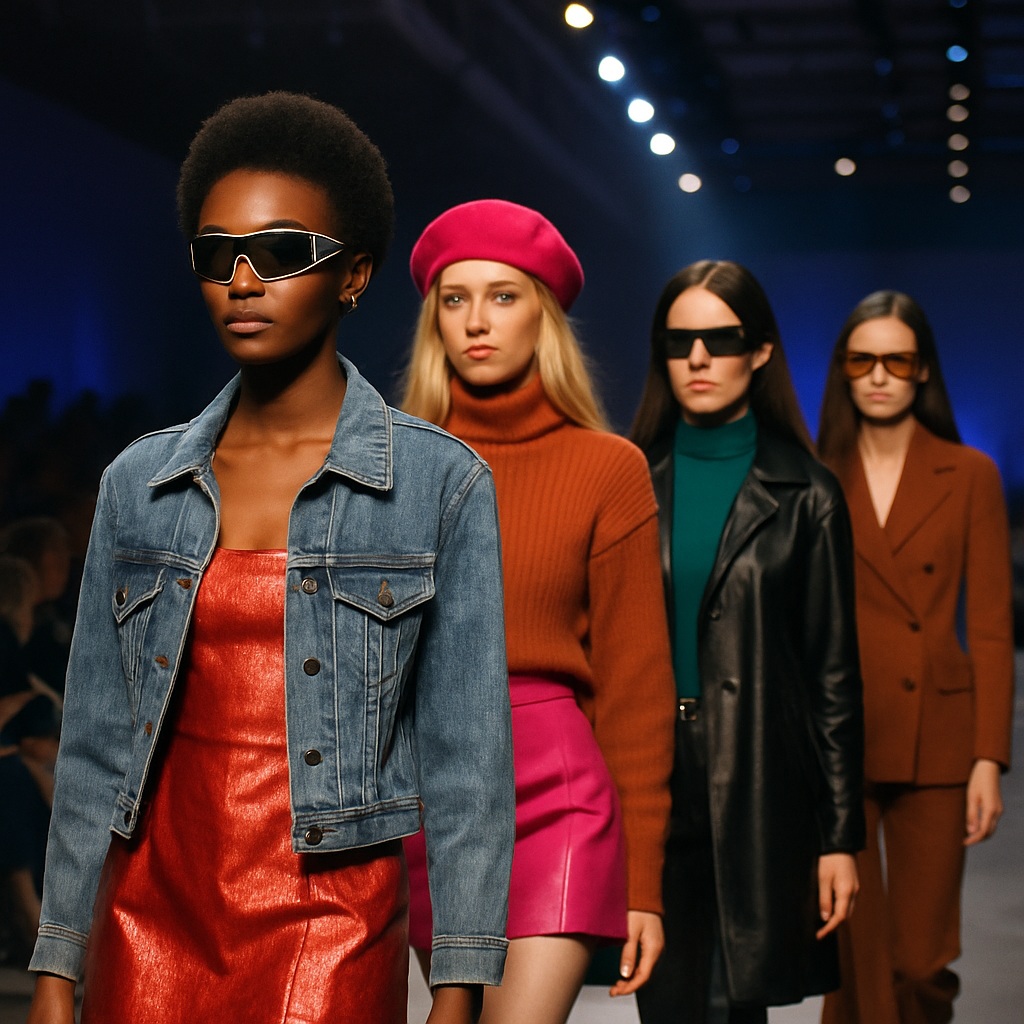
Designers blend analog memories with digital innovation, proving the future of fashion is rooted in the past—and rendered in high definition.
Fashion’s cyclical nature felt more pronounced than ever at this season’s New York Fashion Week, where the runway emerged as a portal between eras. Designers leaned deeply into retro inspirations—think glossy ’80s silhouettes, muted ’70s palettes, and early-2000s cyber aesthetics—yet the shows themselves were powered by some of the most advanced technologies the industry has ever seen.
Rather than treating nostalgia and innovation as competing forces, creative directors framed them as complementary languages. The result was a cultural conversation told in sequins, code, and memory.
NOSTALGIA AS A CREATIVE ENGINE
Many collections showcased the emotional pull of fashion’s past. A wave of labels reintroduced archival shapes, nodding to decades defined by cultural optimism and bold personal expression. The return of wide-lapel jackets, hand-beaded slip dresses, and metallic stretch fabrics evoked a familiar warmth—an aesthetic comfort that resonated strongly with attendees seeking continuity in an ever-shifting world.
Backstage, designers spoke openly about the desire to reconnect with their roots. Several described nostalgia not as a retreat but as a stabilizing lens that allows for experimentation. The collections bore this out: classic silhouettes were often deconstructed, restructured, or paired with unexpected digital elements. It was less about reliving the past and more about reinterpreting it.
Models walked to remixed soundtracks blending analog recordings with AI-generated harmonies. Lighting design referenced vintage film techniques but was programmed using dynamic motion algorithms. Even the venue décor adopted a neo-retro tone—soft neon, chrome accents, and hazy cinematic ambiance.
TECHNOLOGY TAKES THE RUNWAY
While nostalgia guided the visual language, technology shaped the experience itself. Several designers integrated augmented reality features, allowing viewers—both in-person and remote—to see evolving layers of garments through AR filters. Fabrics glowed, textures shifted, and digital embroidery appeared to animate as models moved.
AI-assisted design tools also played a major role behind the scenes. Creative directors used generative systems to prototype prints, test pattern variations, and visualize color combinations long before fabric hit the cutting table. This sped up production and reduced waste, aligning the event with the industry’s growing sustainability goals.
Perhaps the most striking technological shift was the expanded access provided by virtual runways. With immersive livestreams, volumetric capture, and multi-angle viewer controls, audiences around the world could essentially “sit” front row. The boundary between physical and virtual fashion week has eroded, evolving into a hybrid platform that prioritizes inclusivity and reach.
THE AUDIENCE EXPERIENCE, REWIRED
Showgoers this season were not just spectators—they were participants. Many were encouraged to sync their devices with runway cues, triggering synchronized lighting effects or receiving real-time behind-the-scenes commentary. Wearable tech displays, integrated into select looks, projected moving imagery that responded to audio frequencies in the venue. The clothes seemed alive, not merely worn but interacting with the environment.
Street style outside the shows reflected the same fusion. Attendees paired vintage designer pieces with smart accessories—retro sunglasses with AR overlays, analog watches worn alongside wrist-bound micro-displays. The aesthetic was playful, expressive, and increasingly fluid between physical and digital identity.
THE BALANCING ACT: HUMAN TOUCH IN A DIGITAL AGE
Amid the spectacle of innovation, many designers emphasized the importance of craftsmanship. Hand-stitching, artisanal detailing, and traditional textile work were featured prominently, reminding audiences that technology enhances rather than replaces the human element.
In some collections, garments carried visible signs of their handmade origins—raw hems, imperfect dye gradients, embroidered motifs—which contrasted deliberately with digitally generated prints. This interplay underscored a central message of the week: authenticity and technology can coexist without compromise.
WHAT THIS SEASON SIGNALS FOR THE FUTURE
New York Fashion Week closed with a clear proposition: fashion’s future lies not in abandoning the past or surrendering fully to innovation, but in weaving the two into a dynamic, living narrative. Nostalgia grounds the craft; technology expands its capacity.
As the industry continues to navigate cultural and economic change, this season’s retro-tech synergy may signal a broader movement. Fashion is becoming more interactive, more responsive, and more personal. Yet it remains anchored in the emotional power that has always defined it—the memories clothes evoke, and the stories they tell.
In blending the analog with the digital, designers have reframed the runway as a shared memory in motion. And for many who witnessed this season’s experiments, it felt like the start of a bold new chapter—one that honors where we’ve been while imagining where we might go next.


 The Tower Post