€1.7 billion investment signals shift in national security priorities as Europe confronts growing hybrid threats
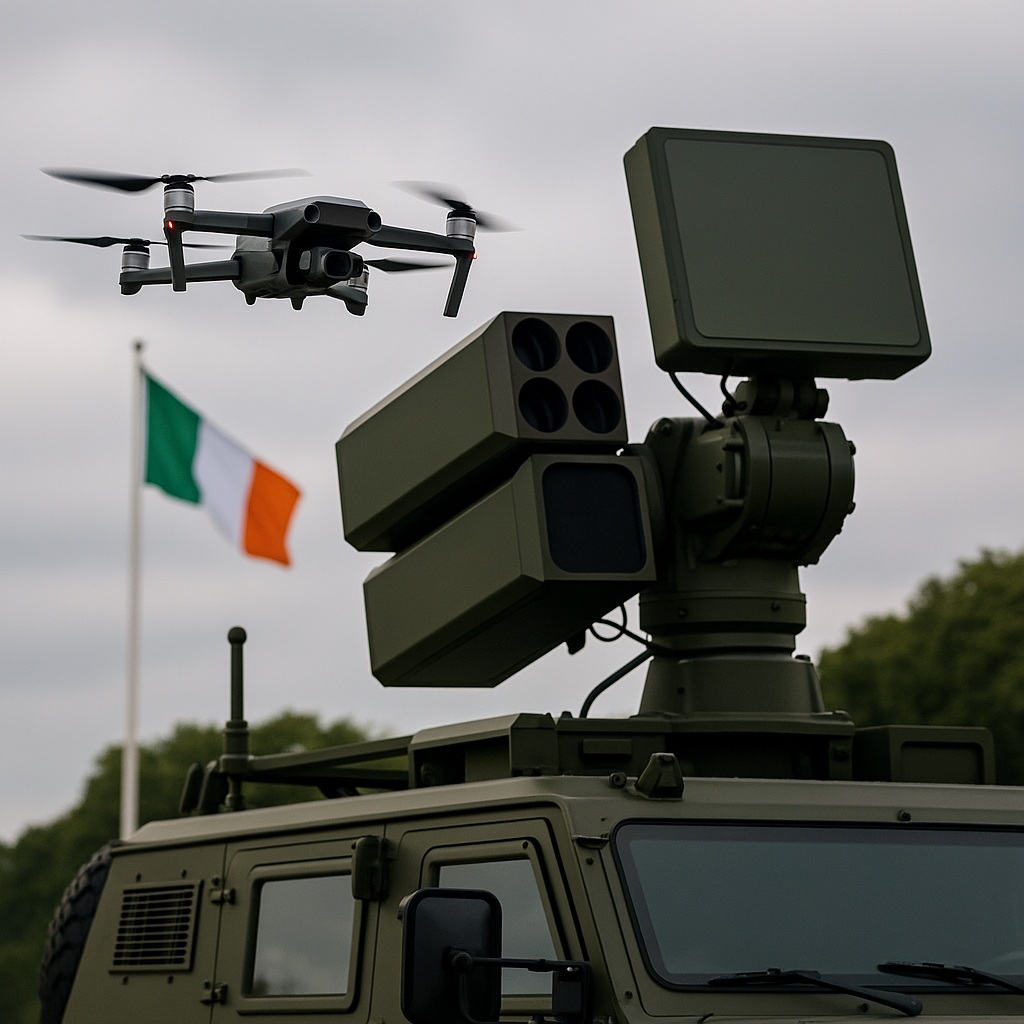
Ireland is accelerating the rollout of advanced anti‑drone defence systems as part of a €1.7 billion security investment package, a move that underscores how rapidly the strategic landscape is shifting across Europe. The decision follows a high‑profile drone incursion during a senior diplomatic visit, an episode that exposed gaps in Ireland’s air‑security posture and intensified calls for stronger national‑level capabilities.
Officials say the new funding will support a suite of counter‑uncrewed aerial system (C‑UAS) technologies, including radio‑frequency jammers, detection radars, and mobile response units designed to neutralise hostile drones near critical infrastructure. The Department of Defence emphasised that the investment is not merely reactive but forms part of a broader effort to modernise Ireland’s historically modest military toolkit.
Security analysts note that the drone incident served as a “stress test” for Ireland’s ability to respond to hybrid threats—attacks or disruptions that fall below the threshold of conventional warfare but still carry significant geopolitical implications. These threats have become more visible across Europe, shaped by cyberattacks, disinformation campaigns, and the use of low‑cost drones to surveil or intimidate political actors.
Defence intelligence officials said that although the incursion did not pose a direct physical threat, its timing during a major diplomatic engagement highlighted the symbolic power of such operations. They described it as part of a pattern observed elsewhere in Europe, where state‑linked and non‑state actors probe vulnerabilities in open societies and lightly militarised states.
The government’s investment aligns Ireland more closely with European partners that have already expanded anti‑drone measures in response to the conflict in Ukraine. While Ireland is not directly involved in the fighting, the war has accelerated a continental reassessment of security priorities, including recognition that drone warfare is now a central feature of both battlefield and off‑battlefield pressure tactics.
Senior defence sources said the new funding package will also expand joint training with EU partners, allowing Irish Defence Forces to integrate with wider European surveillance networks. This could enhance Ireland’s situational awareness over its airspace and off‑shore infrastructure, including energy installations that experts warn could be targeted in grey‑zone operations.
Critics, however, caution that procurement timelines and personnel shortages could slow implementation. Ireland faces a long‑standing recruitment challenge, and the advanced systems being acquired require highly specialised operators. Defence leadership has acknowledged the issue and is developing accelerated training programmes in anticipation of the new equipment.
Public reaction to the investment has been mixed yet increasingly pragmatic. While Ireland’s tradition of military neutrality remains a defining national characteristic, recent geopolitical turbulence has prompted broader debate about how neutrality is interpreted in an era where threats may be covert, remote, and technologically sophisticated.
Security researchers say that Ireland’s case reflects a wider European reality: states must now prepare not only for open conflict but for strategic signalling, infrastructure probes, and psychological pressure campaigns. Anti‑drone technology, once seen as niche, is becoming a core layer of national resilience.
Government officials stress that the accelerated rollout is intended to ensure such incidents cannot recur. “The landscape has changed,” one senior official said. “We are investing not just in equipment but in the credibility of our national security posture.”
As Europe continues to grapple with the evolution of hybrid threats beyond Ukraine’s battlefield, Ireland’s move signals a significant recalibration of priorities—one that blends modern technology, multinational coordination, and a renewed sense of strategic urgency.



 The Tower Post