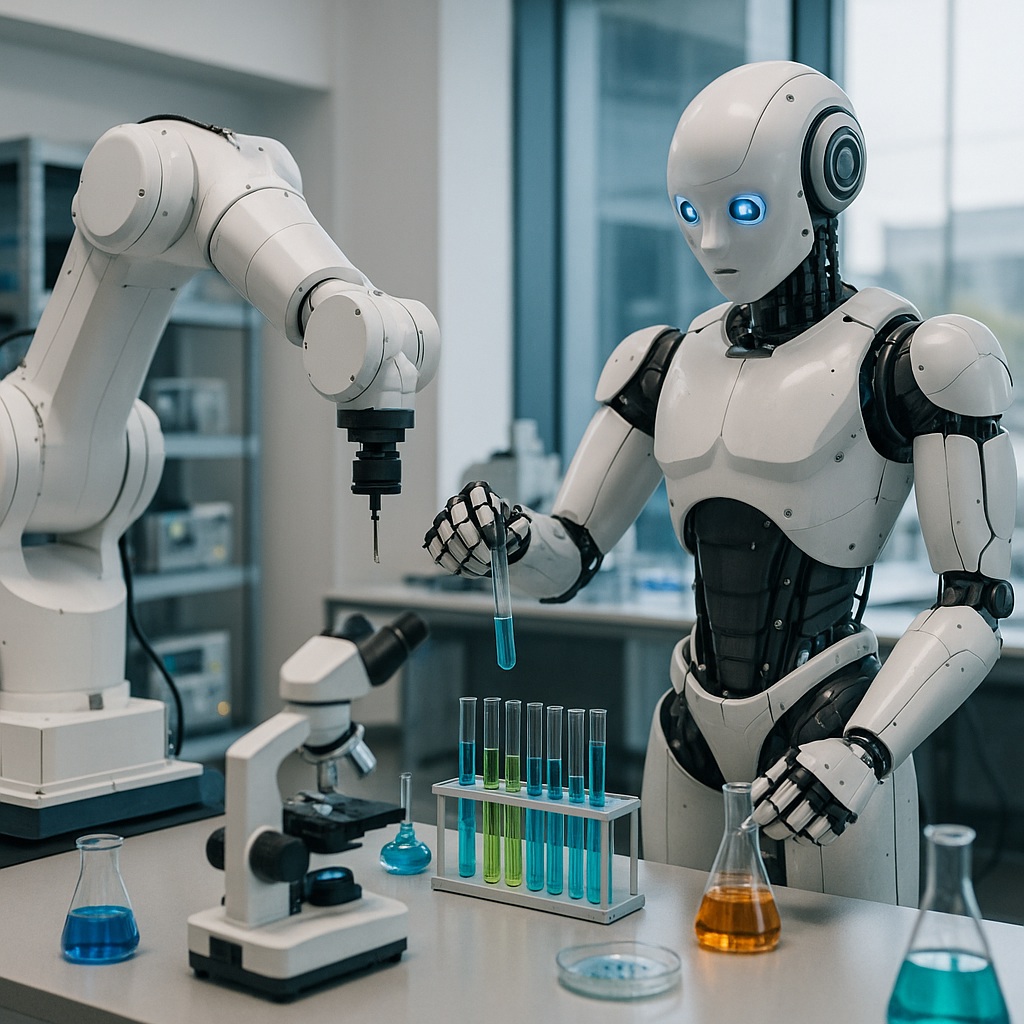
With plans for a fully autonomous research facility in the UK, Google DeepMind signals a new era in scientific discovery—one where artificial intelligence and robotics design, run, and learn from experiments with minimal human intervention.

In a move that underscores how rapidly artificial intelligence is reshaping the frontiers of science, Google DeepMind has announced plans to open what it describes as the world’s first fully automated research lab. The facility, expected to begin operations in the United Kingdom next year, represents a decisive step toward a future in which machines not only assist scientists, but independently drive the scientific process itself.
The vision is ambitious: a laboratory where advanced AI systems generate hypotheses, design experiments, run them using robotic platforms, analyze the results, and iteratively refine their own research strategies—around the clock and at unprecedented speed. For DeepMind, the project is framed not as a replacement for human researchers, but as a powerful new instrument to accelerate discovery in areas where traditional trial-and-error methods can take years or decades.
At the heart of the initiative lies materials science, a field critical to the next generation of technologies. The automated lab will initially focus on discovering and optimizing new materials, particularly superconductors and semiconductors. These materials underpin everything from clean energy infrastructure and quantum computing to consumer electronics and artificial intelligence hardware itself. Even small improvements in their performance or efficiency can have sweeping economic and environmental consequences.
DeepMind’s confidence in this approach is rooted in its recent track record. Over the past few years, the company has demonstrated how AI can solve problems long considered intractable, from predicting protein structures to optimizing complex industrial systems. The automated lab extends that philosophy into the physical world, bridging the gap between digital intelligence and hands-on experimentation.
In practical terms, the lab will combine machine-learning models with robotic arms, automated synthesis tools, and high-throughput testing equipment. AI systems will decide which experiments to run, instruct robots to carry them out, and then interpret the resulting data—often in real time. The goal is to compress research cycles that once took months into days, or even hours.
Proponents argue that this model could dramatically reduce the cost and time associated with scientific discovery. Traditional laboratories are constrained by human working hours, limited experimental throughput, and the sheer cognitive load of navigating vast design spaces. An autonomous system, by contrast, can explore thousands of experimental variations systematically, learning from each failure as efficiently as from success.
Yet the announcement also raises important questions about the future role of human scientists. DeepMind emphasizes that researchers will remain essential, particularly in setting high-level goals, interpreting broader implications, and ensuring ethical and safety oversight. Rather than eliminating jobs, the company suggests, automated labs could free scientists from repetitive tasks and allow them to focus on creativity, theory, and strategic decision-making.
There are also broader implications for how science is organized. If successful, automated research labs could democratize access to cutting-edge experimentation, allowing smaller teams—or even individual researchers—to leverage capabilities once reserved for large institutions. At the same time, the concentration of such powerful tools within a handful of technology companies may intensify debates about openness, transparency, and control in scientific research.
The UK location of the lab is itself significant. Long a hub for materials science, physics, and AI research, the country offers a dense ecosystem of universities, startups, and industrial partners. For policymakers, the project aligns with ambitions to position the UK as a leader in advanced science and technology, while also highlighting the need for updated regulatory and ethical frameworks to govern increasingly autonomous systems.
As the year draws to a close, the timing of the announcement feels symbolic. It captures a moment when AI is no longer confined to screens and servers, but is increasingly embedded in the physical processes that shape the modern world. The automated research lab is not just a technical experiment; it is a statement about how knowledge itself may be produced in the years ahead.
Whether this model will deliver on its promise remains to be seen. Scientific discovery is rarely linear, and true breakthroughs often depend on intuition, serendipity, and human judgment. Still, by giving machines the tools to explore, test, and learn at scale, DeepMind is betting that the pace of discovery can be fundamentally transformed.
If that bet pays off, the lab that never sleeps could become a blueprint for the future of research—one where human insight and machine intelligence operate in continuous partnership, pushing the boundaries of what science can achieve.



 The Tower Post