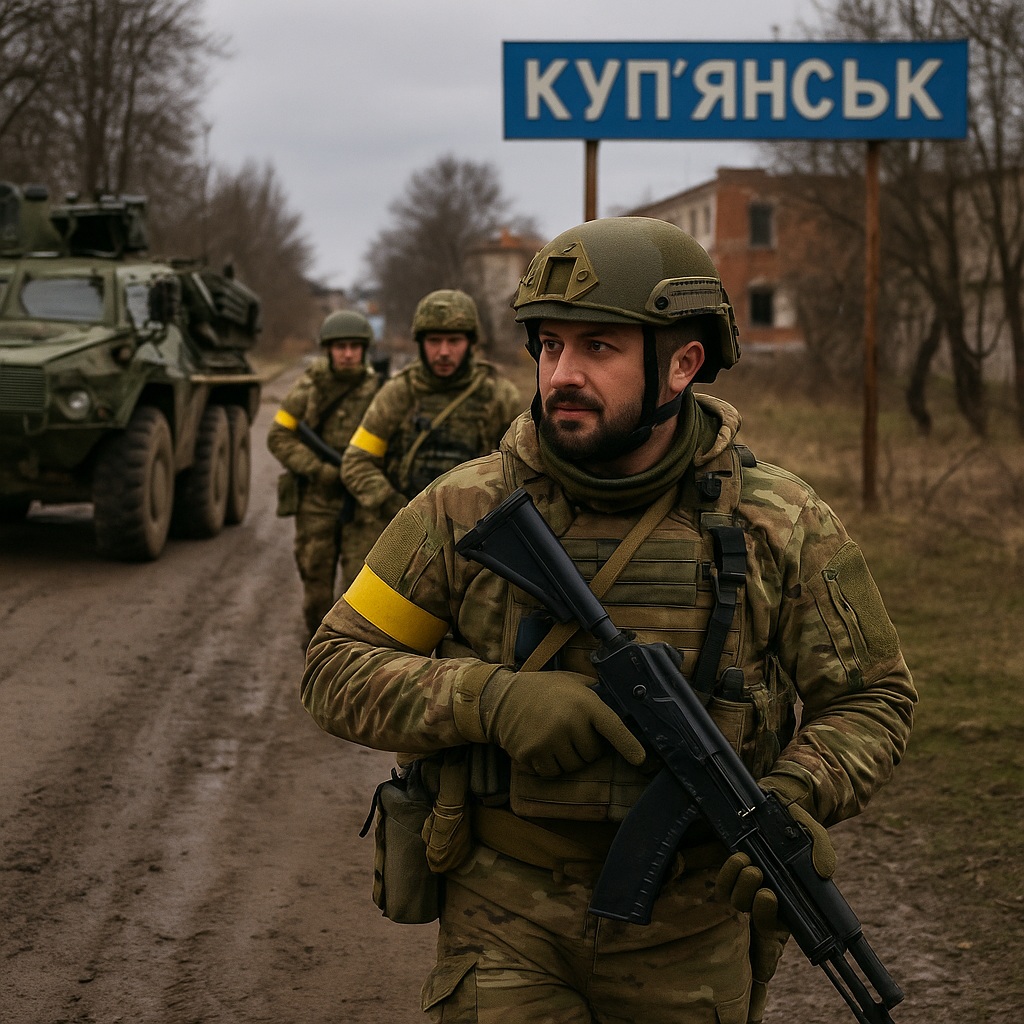
Officials say troops reclaimed sections of the northeastern hub and boxed in Russian units, while Moscow disputes the scope of the gains
Kupiansk, the northeastern railway town that has become a recurring flashpoint of the war, is once again at the center of competing battlefield narratives. Ukrainian officials say their forces have pushed back into key neighborhoods of the town and maneuvered to encircle Russian units on its outskirts, marking what Kyiv describes as a significant tactical success in a grinding campaign along the eastern front.
According to the Ukrainian General Staff, assault groups supported by artillery and drones advanced through several sectors of Kupiansk after weeks of attritional fighting. Commanders say the operation relied on rapid infantry movements, localized counterattacks, and sustained pressure on Russian supply routes feeding the area. The aim, they say, was not a dramatic breakthrough but a steady squeeze that would force Russian troops to choose between withdrawal or isolation.
President Volodymyr Zelenskiy traveled to the frontline to meet soldiers involved in the operation, praising what he called their resilience and adaptability. In remarks released by his office, Zelenskiy said the fighting around Kupiansk demonstrated Ukraine’s ability to reclaim ground even under constant aerial and artillery pressure. He framed the operation as part of a broader effort to regain control of strategically important towns that anchor logistics across northeastern Ukraine.
Kupiansk’s significance lies less in its size than in its geography. Before the war, it functioned as a major rail and road junction linking the Kharkiv region with areas further east. Control of the town allows forces to threaten supply lines and shape operations along a wide stretch of the front. That has made it a repeated target, changing hands and enduring heavy damage over the course of the conflict.
Ukrainian military spokespeople say Russian units now find themselves compressed into limited pockets on the town’s fringes, with crossing points and approach roads under fire. They describe the situation as a partial encirclement, stressing that Ukrainian forces are attempting to limit Russian mobility rather than rush into costly urban assaults. Analysts close to the military say such tactics reflect lessons learned from earlier phases of the war, when rapid advances sometimes outpaced logistical support.
Russia, however, disputes the scale of Ukraine’s claims. The Russian Defense Ministry has acknowledged intense fighting around Kupiansk but says its troops are holding defensive positions and repelling Ukrainian attacks. Pro-Kremlin military bloggers have offered mixed accounts, with some conceding local setbacks while others argue that Ukrainian advances are temporary and come at high cost.
Independent verification of battlefield claims remains difficult. Satellite imagery and open-source analysis suggest increased activity and damage in and around Kupiansk, but do not conclusively confirm full control of contested neighborhoods. Western officials, speaking cautiously, say Ukraine appears to have made incremental gains in the area, though they emphasize that the front remains fluid.
For civilians who remain in or near Kupiansk, the renewed fighting has deepened an already dire humanitarian situation. Local authorities report continued shelling, damaged infrastructure, and disruptions to electricity and heating as winter conditions bite. Evacuation efforts continue, though many residents, particularly the elderly, are reluctant or unable to leave.
The fighting around Kupiansk also underscores the evolving nature of the war. Rather than sweeping offensives, both sides are engaged in a series of localized battles aimed at improving positions ahead of future operations. Ukrainian officials argue that such pressure gradually erodes Russian capabilities, even if progress appears slow.
Military analysts say the outcome around Kupiansk could influence operations across the northeastern front. If Ukrainian forces manage to maintain pressure and prevent Russian resupply, they could force a withdrawal that reshapes the local battlefield. Conversely, a successful Russian counterattack could restore previous lines and blunt Kyiv’s momentum.
For now, Kupiansk stands as a symbol of the war’s grinding intensity: a battered town where control is measured street by street, and where each claimed gain is contested almost as fiercely in official statements as it is on the ground. As winter deepens, the struggle for Kupiansk is likely to remain a test of endurance, logistics, and political resolve for both sides.



 The Tower Post