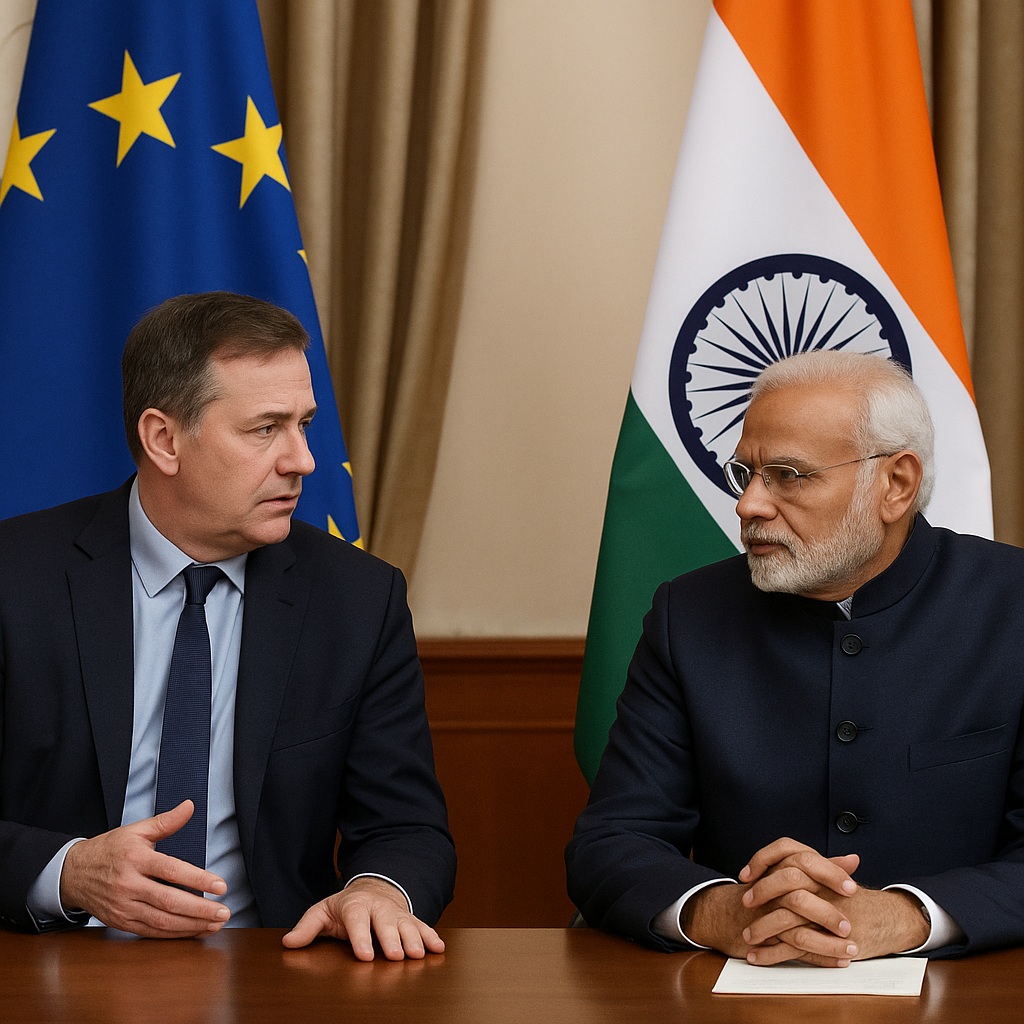
Deep Divides Stall Long-Awaited Agreement as Political and Economic Pressures Mount

Negotiators from the European Union and India are increasingly resigned to the likelihood that a long-anticipated free trade agreement will not be concluded before the end of the year, according to officials familiar with the talks. Despite months of intensified negotiations and repeated public commitments to accelerate progress, both sides now acknowledge that fundamental differences remain unresolved, slowing momentum on what was meant to be a flagship partnership between two of the world’s largest economic blocs.
The negotiations, relaunched with renewed political backing after years of stagnation, were widely seen as a strategic response to shifting global trade patterns. Brussels has been seeking to diversify its commercial relationships beyond traditional partners, while New Delhi has aimed to attract investment and secure greater access to European markets. Yet as discussions have moved from broad ambition to technical detail, entrenched disagreements have proven difficult to bridge.
At the heart of the impasse are disputes over market access, agricultural trade, and regulatory standards. European negotiators continue to push for lower tariffs on automobiles, wines, and spirits, along with stronger protections for intellectual property and geographical indications. India, for its part, remains cautious about opening sensitive domestic sectors, particularly agriculture, where millions of livelihoods depend on state support and tariff protections.
“Both sides have made progress, but not at the depth or speed that would allow a political conclusion this year,” said one EU diplomat involved in the talks. “The gaps are manageable in theory, but politically difficult in practice.”
Agriculture has emerged as one of the most contentious issues. The EU is pressing for broader access for its dairy and processed food products, while India insists on safeguarding its farmers from import surges. New Delhi has repeatedly argued that European sanitary and phytosanitary standards function as non-tariff barriers, effectively limiting Indian exports even when tariffs are reduced.
Regulatory alignment presents another major hurdle. Brussels has sought commitments on labor rights, environmental protections, and sustainability standards that reflect the EU’s broader trade policy objectives. Indian officials have expressed concern that such provisions could constrain domestic policymaking and impose compliance costs on exporters, particularly small and medium-sized enterprises.
The delay underscores the growing complexity of EU trade diplomacy at a time of mounting geopolitical and domestic pressures. Within the bloc, trade agreements face increasing scrutiny from member states, industry groups, and civil society organizations wary of globalization’s uneven impacts. Ratification processes have become longer and more politically fraught, encouraging negotiators to seek more comprehensive — and therefore more difficult — deals.
India’s position is shaped by its own internal dynamics. With economic growth remaining a top political priority, the government is focused on protecting strategic sectors while selectively opening others. Trade officials in New Delhi argue that India has already made significant concessions compared with past negotiating positions, and that expectations from European partners must remain realistic.
The broader strategic context has added urgency, but also tension, to the talks. Both sides view closer economic ties as a counterbalance to global uncertainty and supply chain disruptions. The EU sees India as a key partner in the Indo-Pacific, while India values deeper engagement with Europe as a way to reduce overreliance on any single market. Yet strategic alignment has not been enough to overcome technical and political obstacles at the negotiating table.
Business groups on both sides have expressed frustration at the slow pace of progress. European companies have long complained about India’s complex regulatory environment and high tariffs, while Indian exporters point to limited access to EU public procurement markets and concerns over carbon-related trade measures. Many had hoped that a year-end breakthrough would provide clarity and momentum for investment decisions.
Trade analysts note that missed deadlines are not unusual in negotiations of this scale, but warn that prolonged delays carry risks. “There is a danger of negotiation fatigue,” said a senior fellow at a Brussels-based think tank. “If expectations are repeatedly raised and then disappointed, political support can erode.”
Despite the setbacks, neither side is walking away. Officials stress that talks will continue into the coming year, with technical work ongoing and political engagement expected to resume at the highest levels. The current pause is being framed not as a failure, but as a recalibration of timelines in recognition of the deal’s complexity.
For the EU, the stalled talks with India reflect a broader challenge: balancing values-driven trade policy with the pragmatic need to secure access to fast-growing markets. For India, the negotiations highlight the difficulty of integrating more deeply into global trade while managing domestic sensitivities.
As the year draws to a close without a final agreement, expectations are being reset. What was once billed as an imminent breakthrough is now seen as a longer-term project, one that will require sustained political will and compromise on both sides. The ambition of an EU–India trade deal remains intact, but its realization is increasingly a matter of patience rather than deadlines.


 The Tower Post