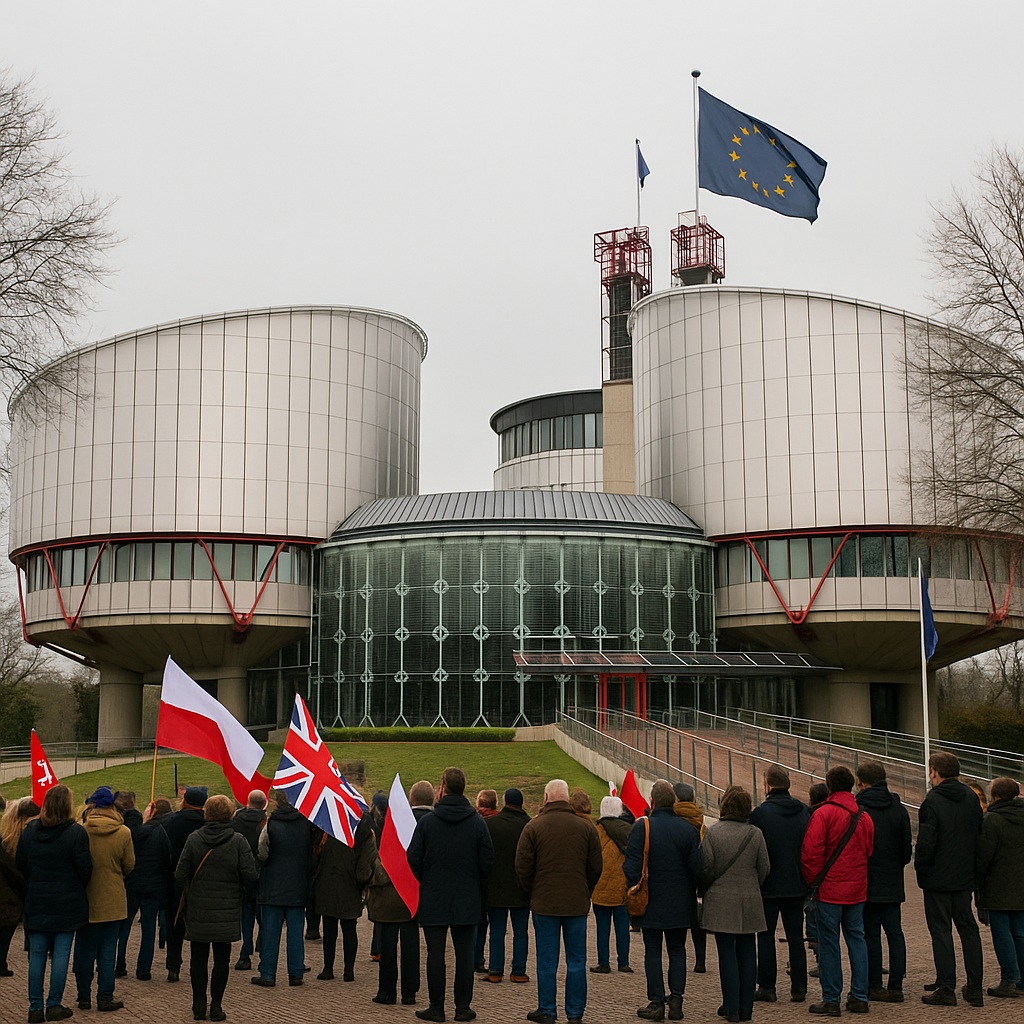
A growing backlash against the European Court of Human Rights exposes deep tensions between national sovereignty and a post-war legal order struggling to adapt to today’s political realities.
Europe’s human rights architecture, long considered one of the continent’s most ambitious moral and legal achievements, is facing one of its most intense internal debates in decades. Across the 27 member states of the European Union and beyond, political leaders, judges, and human rights experts are questioning whether the European Court of Human Rights (ECHR) is still fit for purpose in a vastly changed Europe.
The controversy does not stem from a rejection of human rights themselves. Rather, it reflects a widening disagreement over how those rights should be interpreted, enforced, and balanced against national democratic authority in an era marked by migration pressures, security concerns, digital surveillance, and cultural polarization.
At the heart of the debate lies a fundamental question: should a court conceived in the aftermath of the Second World War continue to exert binding authority over modern European states in the same way it did during the Cold War and post-communist transitions?
A Court Born of Trauma
The ECHR was established as part of a broader effort to ensure that the atrocities of the twentieth century would never be repeated. Its mission was clear: protect individuals from abuses by the state and set minimum standards for dignity, liberty, and justice across Europe.
For decades, the court has been credited with strengthening freedom of expression, safeguarding minority rights, and holding governments accountable where domestic courts failed. In many countries emerging from dictatorship or authoritarian rule, ECHR judgments helped anchor democratic norms and judicial independence.
Yet critics now argue that the historical conditions that justified strong supranational oversight no longer exist in the same form. They claim that democratic institutions in many European countries are mature enough to interpret and enforce human rights without constant external intervention.
Political Backlash Gains Momentum
The current backlash is notable not only for its intensity, but also for its breadth. It spans the political spectrum, from conservative parties emphasizing border control and public order to center-left figures concerned about democratic legitimacy and judicial overreach.
Several governments have openly questioned whether ECHR rulings sufficiently respect national legal traditions and parliamentary decisions. In some capitals, officials complain that judgments on asylum, deportations, and prison conditions place disproportionate burdens on national administrations, while limiting voters’ ability to shape policy through elections.
This sentiment has resonated with parts of the public, particularly in countries where skepticism toward supranational institutions has grown. Critics argue that when controversial decisions are perceived as imposed from abroad, they risk undermining trust not only in the court itself, but in the broader human rights project.
Experts Call for a Fundamental Rethink
Human rights scholars and legal experts have entered the debate with a more nuanced critique. Many emphasize that the problem is not the existence of the ECHR, but the rigidity of its interpretative framework.
The European Convention on Human Rights was drafted in a very different era. Concepts such as privacy, freedom of expression, and due process are now being tested by technologies and social dynamics unimaginable to the convention’s authors. Artificial intelligence, mass data collection, and online speech platforms have blurred the boundaries between public and private power.
Some experts argue that the court has responded by expanding its interpretative reach, effectively updating the convention through case law. While this approach has allowed the ECHR to remain relevant, it has also fueled accusations of judicial activism and legal uncertainty.
Calls are growing for clearer limits on the court’s interpretative authority, alongside more structured dialogue with national courts and legislatures. Proponents of reform insist that recalibrating the balance between Strasbourg and national capitals would strengthen, rather than weaken, human rights protection.
Sovereignty Versus Solidarity
The debate highlights a persistent tension at the core of the European project: how to reconcile national sovereignty with collective legal commitments. Supporters of a strong ECHR warn that loosening its authority could create a patchwork of protections, where fundamental rights depend on geography rather than universal standards.
They point out that even well-established democracies can backslide, particularly during periods of crisis. From emergency security measures to restrictions on protest, recent years have shown how quickly exceptional policies can become normalized.
At the same time, critics counter that democratic accountability must play a greater role in shaping human rights policy. They argue that courts, however well intentioned, cannot replace political debate and compromise, especially on issues that deeply divide societies.
What Comes Next
There is no consensus yet on the path forward. Proposals range from modest procedural reforms to more ambitious revisions of how the ECHR interacts with national legal systems. Some advocate formal mechanisms allowing states greater discretion in implementing judgments, while others call for updating the convention itself to reflect contemporary realities.
What is clear is that the debate has moved beyond technical legal circles and into the political mainstream. It reflects broader anxieties about governance, identity, and power in a rapidly changing Europe.
As mid-December approaches, the future of Europe’s human rights court remains uncertain. Whether this moment leads to renewal or retrenchment will depend on whether European leaders can bridge the divide between sovereignty and solidarity—without sacrificing the principles that once united a fractured continent in the name of human dignity.



 The Tower Post