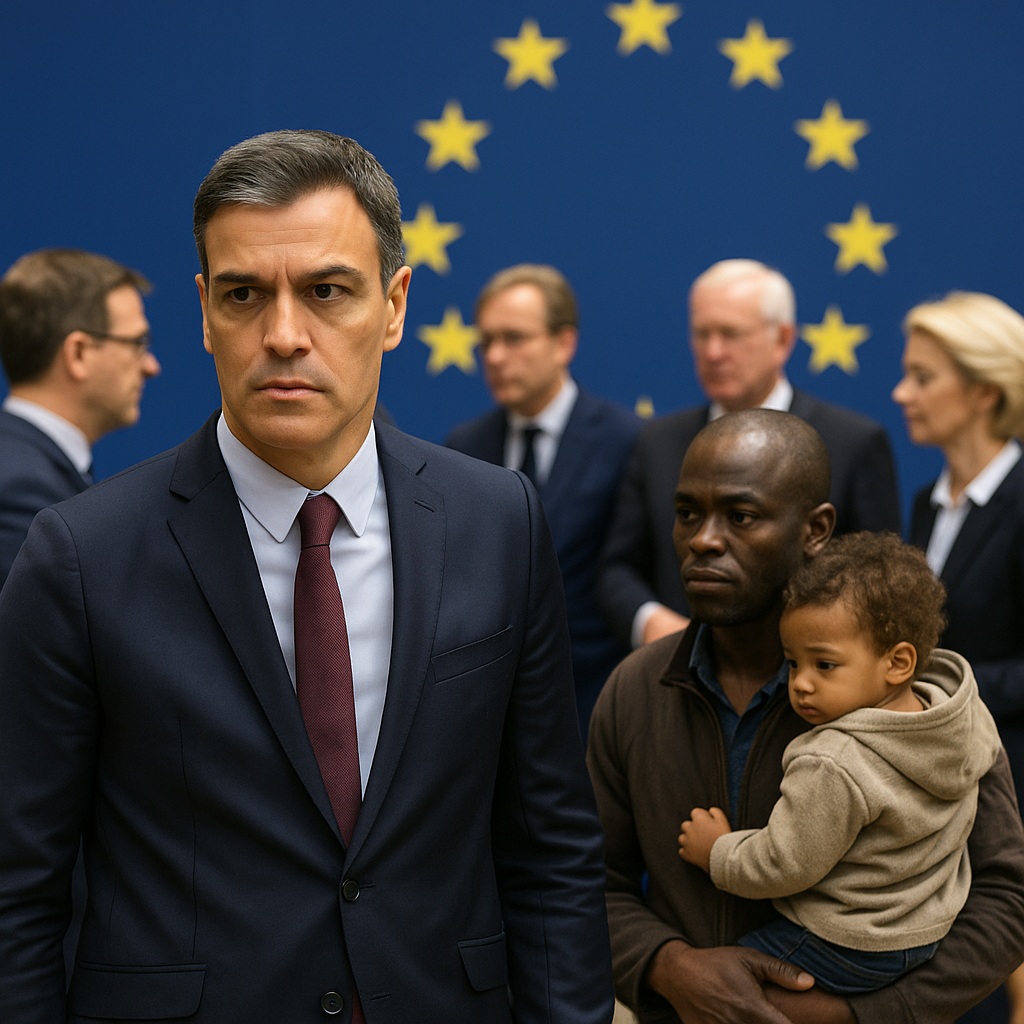
As most EU leaders harden their stance on migration, Madrid defends openness—exposing deepening fractures over borders, labor needs, and populist pressure.

In the final stretch of the year, the atmosphere in Brussels has grown markedly tenser. Around the European Council table, migration once again dominates the agenda, but consensus feels more distant than ever. While a majority of EU leaders argue for tighter controls, faster returns, and tougher deterrence, Spain’s prime minister has emerged as a conspicuous outlier—publicly defending a more open and pragmatic immigration approach at a moment when political winds across the continent are blowing sharply in the opposite direction.
The contrast has been striking. As counterparts from northern, central, and eastern Europe press for restrictive measures framed around security and sovereignty, Spain has emphasized legal pathways, integration, and the economic necessity of migration. The Spanish leader’s message is consistent: Europe is aging, labor shortages are structural, and closing doors may satisfy short-term political instincts while undermining long-term stability.
This position, however, has left Madrid increasingly isolated. During recent European Council debates, calls for reinforced external borders, expanded detention capacity, and accelerated deportations have found broad support. Spain’s resistance to this hardening line has underscored the growing fragmentation within the bloc over how migration should be governed—and who should bear responsibility.
At home, the stance is far from uncontested. Opposition parties accuse the government of naivety, arguing that a more permissive framework risks overburdening public services and fueling social tensions. Regional leaders, particularly in areas receiving high numbers of arrivals, have voiced concerns about resources and coordination. Critics point to administrative bottlenecks and uneven integration outcomes as evidence that Spain’s reforms have not kept pace with reality.
Yet the government counters that the alternative—tightening the screws without expanding legal options—would only deepen irregular flows. Officials highlight recent reforms aimed at regularizing workers already present in the country, streamlining work permits, and aligning migration policy with labor market needs. In their view, Spain’s experience shows that managed openness can reduce informality while supporting economic growth.
The broader European context complicates the debate. Across the EU, migration has become a potent accelerant for populist movements, many of which have translated electoral gains into direct influence over national policy. Leaders facing fragile coalitions or upcoming elections are acutely sensitive to public anxiety over borders, often framing tougher measures as necessary to preserve social cohesion.
Spain’s prime minister has acknowledged these pressures but warned against what he describes as a reactive spiral. He has argued that outsourcing responsibility to third countries or relying solely on enforcement risks eroding Europe’s values and international credibility. Instead, Madrid has called for genuine burden-sharing, sustained investment in origin countries, and a unified asylum system that moves beyond emergency responses.
Diplomatically, the cost of standing apart is evident. While Spain retains allies on specific technical points, it lacks a broader coalition willing to champion a more expansive vision of migration governance. Southern partners, once natural allies, have themselves shifted toward stricter rhetoric under domestic strain. The result is a sense that Spain is swimming against the tide.
Still, supporters of the government’s line argue that today’s isolation may prove temporary. Demographic realities, they say, will eventually force a recalibration across Europe. Industries from agriculture to healthcare are already struggling to recruit, and quietly expanding migrant labor has become a practical necessity even in countries with hardline public messaging.
As the year draws to a close, Spain’s prime minister remains defiant. He insists that leadership sometimes means resisting the prevailing mood and articulating uncomfortable truths. Whether this stance will translate into influence—or further marginalization—remains an open question. What is clear is that the migration debate has become a defining fault line for the European project, testing not only policy coherence but the bloc’s capacity to reconcile politics with reality.



 The Tower Post