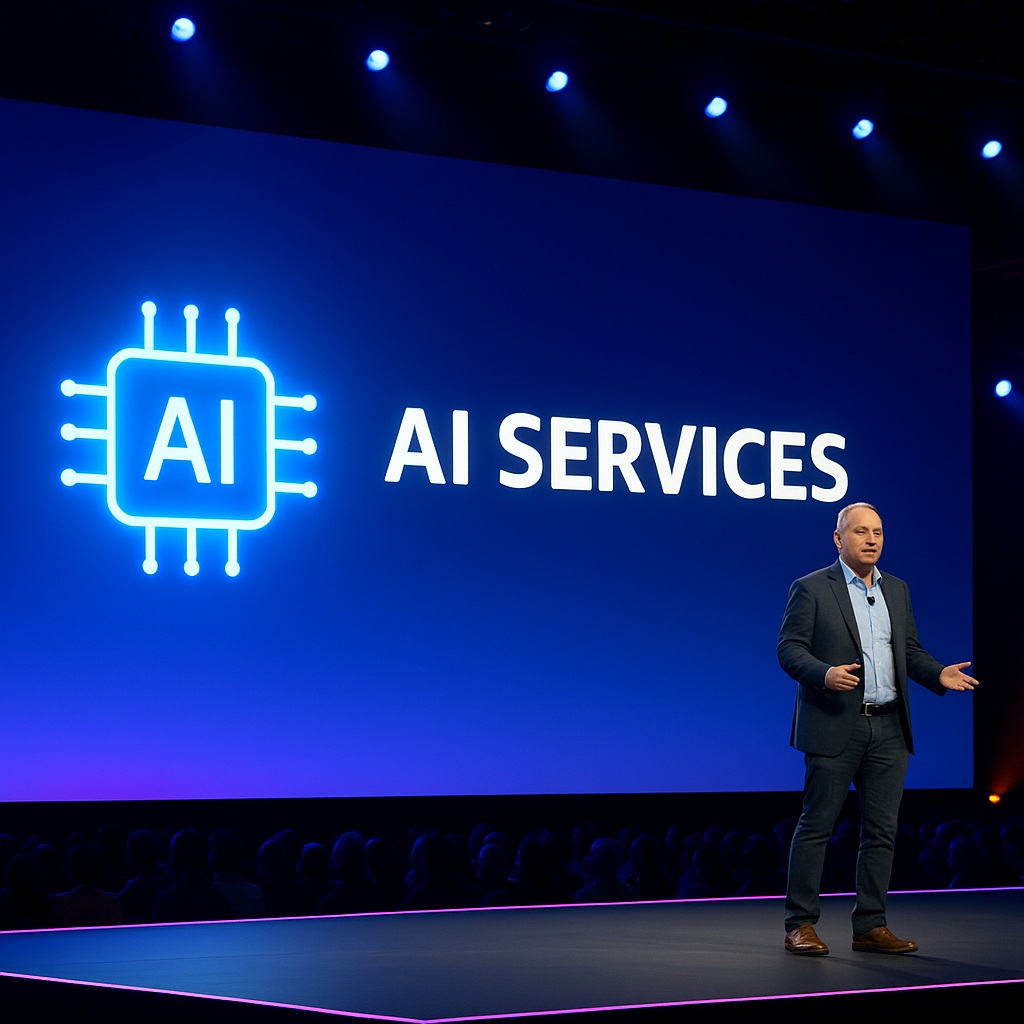
At its flagship cloud conference, Amazon Web Services unveils “frontier agents,” private AI tooling, and next-generation chips, signaling a new phase in enterprise artificial intelligence.
Amazon used the closing stretch of its annual cloud gathering to make a clear statement: the race for enterprise artificial intelligence is no longer just about models, but about control, customization, and scale. In a series of closely watched announcements, the company introduced what it calls “frontier agents,” alongside private AI development tooling and new custom silicon designed to power the next wave of cloud-native intelligence.
The moves underscore Amazon Web Services’ broader strategy as the dominant cloud provider: to position itself not merely as a host for AI, but as the underlying infrastructure where advanced, agent-based systems are built, deployed, and governed.
Frontier agents mark a notable evolution in how Amazon is framing AI for businesses. Rather than single-purpose chatbots or isolated copilots, these agents are designed to operate across complex workflows. They can reason over multiple data sources, take autonomous actions within defined guardrails, and collaborate with other agents or human operators. AWS executives described them as systems capable of handling long-running tasks such as supply chain optimization, financial reconciliation, or software operations, all while remaining auditable and secure.
Central to the pitch is control. Frontier agents are designed to run inside customers’ own cloud environments, with fine-grained permissions tied to existing identity and access frameworks. This approach aims to address growing concerns among enterprises about data leakage, regulatory compliance, and the opacity of third-party AI services. By keeping agents close to proprietary data and business logic, AWS is betting that trust and governance will become decisive differentiators.
Alongside the agents, Amazon introduced a new layer of private AI tooling focused on customization. These tools allow organizations to build, fine-tune, and deploy models using their own data, without exposing that data to shared public systems. The emphasis is on flexibility: customers can mix foundation models, proprietary algorithms, and domain-specific datasets, all orchestrated through managed services that abstract away much of the underlying complexity.
This tooling reflects a shift in enterprise demand. Early experimentation with generative AI often relied on off-the-shelf models, but companies are now seeking deeper integration with their internal systems. They want AI that understands their terminology, processes, and constraints. AWS is positioning its platform as the place where that bespoke intelligence can be engineered at scale.
Hardware, as ever, remains a crucial part of the story. Amazon also unveiled new generations of its custom AI chips, continuing its long-term investment in silicon tailored for machine learning workloads. These chips are designed to deliver higher performance per watt and lower costs compared to general-purpose processors, a key consideration as AI workloads grow more persistent and resource-intensive.
By tightly coupling its chips with its AI services, Amazon is reinforcing a vertically integrated model. The company argues that this integration allows it to optimize everything from training large models to running inference for millions of simultaneous requests. For customers, the promise is predictable performance and pricing in an era where AI compute demand can spike unpredictably.
The announcements come at a moment of intense competition among cloud providers. Rivals are rolling out their own agent frameworks, AI platforms, and custom hardware, each vying to become the default environment for enterprise AI. Amazon’s response is to lean into its strengths: global scale, deep enterprise relationships, and a mature ecosystem of tools that can be extended rather than replaced.
Analysts note that the focus on agents is particularly significant. As AI systems become more autonomous, questions of responsibility, oversight, and reliability move to the forefront. AWS’s emphasis on guardrails, observability, and integration with existing enterprise controls suggests an attempt to make autonomy palatable to risk-averse organizations.
For developers, the message is equally clear. AWS wants to lower the barrier to building sophisticated AI systems while keeping them anchored to familiar cloud primitives. Frontier agents and private tooling are presented not as experimental add-ons, but as natural extensions of the cloud services developers already use.
As the conference draws to a close, the broader implication is that AI is becoming inseparable from the cloud itself. Rather than a standalone capability, intelligence is being woven into infrastructure, tooling, and hardware. Amazon’s latest announcements suggest a future in which competitive advantage lies not just in smarter models, but in the platforms that allow those models to act, adapt, and scale responsibly.
In that future, the cloud is no longer just where software runs. It is where autonomous systems are born, trained, and trusted to operate at the heart of the global economy.




 The Tower Post