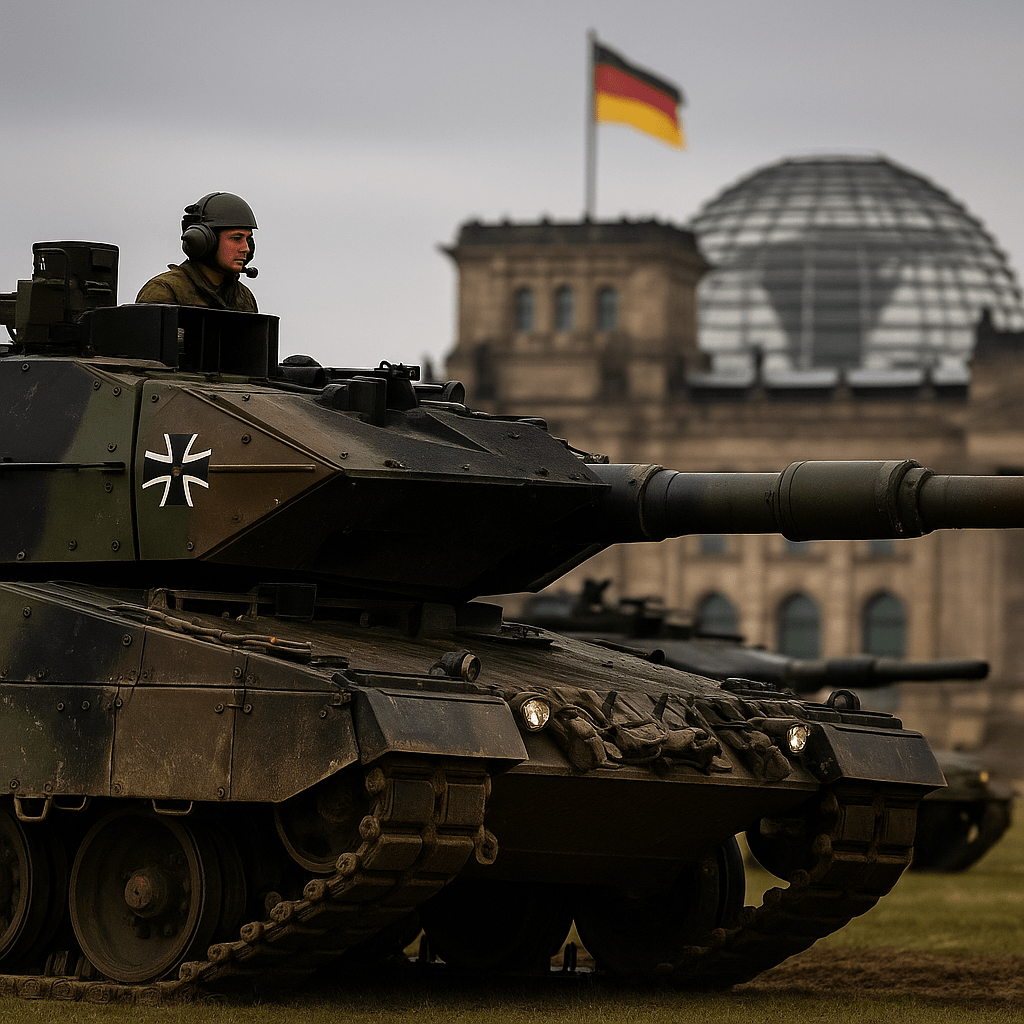
Berlin boosts military spending as fears over Russia and doubts about long-term U.S. backing reshape Europe’s security landscape.
Germany is undergoing one of the most profound shifts in its security policy since the end of the Cold War. Faced with a protracted war on NATO’s eastern flank and growing uncertainty about the future reliability of American military support, Berlin is investing heavily in its armed forces, marking a decisive break with decades of military restraint.
In the German capital, defence is no longer a marginal budget line but a central pillar of national policy. Senior officials describe the current moment as a “new normal” for European security, one in which Germany must assume far greater responsibility for its own protection and for the stability of the continent as a whole. The Bundeswehr, long criticized for outdated equipment and limited readiness, is now at the center of a broad modernization drive.
At the heart of this shift lies Russia’s continued assertiveness. The war in Ukraine has not only redrawn battle lines in Eastern Europe but has also shattered long-standing assumptions in Berlin that large-scale conventional conflict was a thing of the past. German intelligence assessments increasingly warn that Moscow’s military posture poses a long-term challenge, even beyond Ukraine, forcing NATO members to rethink deterrence and defence planning.
Germany’s response has been both political and financial. The government has pledged sustained increases in defence investment, focusing on modern equipment, ammunition stockpiles, air and missile defence, and the ability to rapidly deploy forces within Europe. New procurement programs aim to replace aging systems and close capability gaps that accumulated over decades of underfunding.
This rearmament effort reflects a deeper strategic recalibration. For years, Germany relied heavily on the United States as the ultimate guarantor of European security. While Washington remains a key ally, political debates in the U.S. about overseas commitments have resonated strongly in Berlin. German officials are careful not to question the alliance openly, but privately they acknowledge that Europe must be prepared for scenarios in which American support could be delayed, reduced, or politically constrained.
As a result, Germany is positioning itself as a cornerstone of European defence. Within NATO, Berlin is taking on a more prominent leadership role, particularly in reinforcing the alliance’s eastern flank. German troops and equipment are being integrated into multinational formations, and long-term deployments in Central and Eastern Europe are increasingly framed as permanent commitments rather than temporary reassurance measures.
The shift is not without domestic controversy. Germany’s post-war political culture has traditionally favored diplomacy and economic engagement over military power. Critics warn that rising defence spending could come at the expense of social programs, while others fear an erosion of the country’s cautious approach to the use of force. Yet public opinion has moved noticeably, shaped by images of war in Europe and a growing sense of vulnerability.
Industry has also felt the impact of the policy change. Germany’s defence sector, once constrained by limited domestic demand and strict export rules, is expanding production capacity and investing in new technologies. Companies involved in land systems, aerospace, cyber defence, and missile technology are reporting stronger order books, driven not only by national needs but also by growing demand from European partners.
For Germany’s allies, Berlin’s rearmament is largely welcomed. Eastern European states, in particular, have long urged Germany to match its economic weight with military capability. At the same time, expectations are rising. A stronger Bundeswehr brings with it pressure for Germany to act decisively in future crises, potentially testing political red lines that have held since the end of the Second World War.
As winter settles over Europe, the sense of urgency in Berlin is unmistakable. Defence planners speak openly about readiness timelines measured in years, not decades. The message is clear: Germany no longer sees security as something that can be outsourced. In an increasingly unstable world, the country is betting that sustained investment in defence is not a temporary response to crisis, but a permanent feature of its future.


 The Tower Post