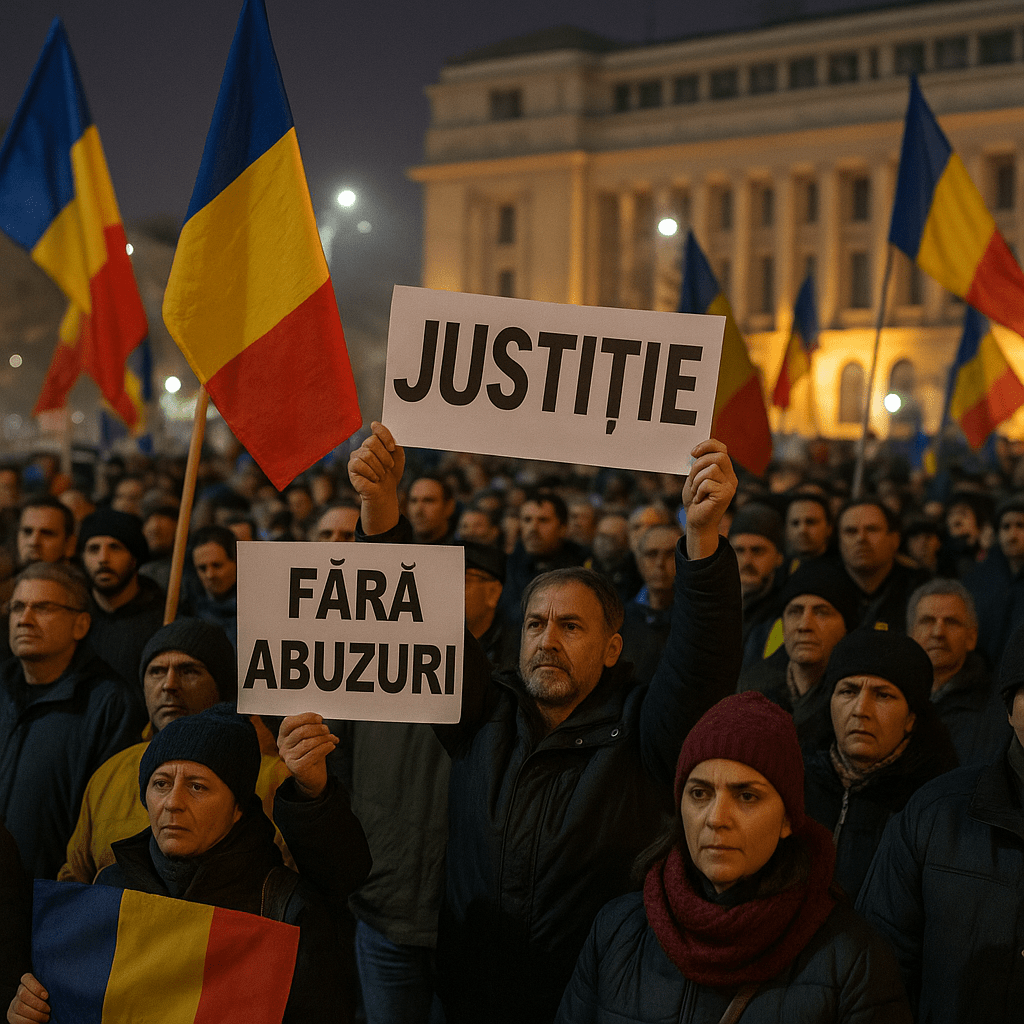
Mass demonstrations in Bucharest demand transparency and accountability, spotlighting rising public distrust in governance systems
Bucharest — A sea of flags, winter coats, and raised voices filled the heart of Romania’s capital as tens of thousands of citizens gathered to protest what they describe as persistent abuses and political interference within the country’s judicial system. The demonstrations, unfolding over several days and intensifying toward the end of the week, have become one of the most significant expressions of public discontent in recent years, reflecting a growing crisis of confidence in state institutions.
From early afternoon until well after dark, protesters occupied major boulevards and public squares, transforming Bucharest into a stage for civic resistance. Families stood alongside students, pensioners marched next to legal professionals, and first-time demonstrators mingled with seasoned activists. Romanian tricolor flags fluttered above the crowd, while banners and hand-painted signs called for justice, integrity, and equal application of the law.
At the heart of the protests lies anger over a series of controversial judicial decisions, delayed investigations, and allegations of selective prosecution involving prominent political and economic figures. Critics argue that these cases illustrate a deeper structural problem: a judiciary perceived as vulnerable to political pressure and lacking sufficient transparency. For many demonstrators, the issue is no longer about isolated rulings, but about a pattern that undermines the principle of justice itself.
“Trust is built on consistency and fairness,” said one protester, a middle-aged engineer who traveled from outside the capital to attend. “When people see the law applied differently depending on who you are, that trust collapses.” Similar views were echoed throughout the crowd, often amplified through chants demanding accountability and independence for judges and prosecutors.
Civil society organizations, watchdog groups, and informal citizen networks have played a crucial role in organizing the demonstrations. Using social media platforms and encrypted messaging apps, organizers coordinated meeting points, shared legal information about the right to protest, and urged participants to remain peaceful. Their messaging emphasized nonviolence and civic responsibility, a strategy that appears to have helped maintain order despite the size and intensity of the gatherings.
Legal scholars and former magistrates have added their voices to the debate, warning that prolonged public distrust in the justice system carries long-term risks. According to several experts, perceptions of judicial abuse can discourage citizens from seeking legal recourse, weaken foreign investor confidence, and strain Romania’s relationships with international partners who monitor rule-of-law standards. Some analysts describe the current moment as a crossroads, where reforms could restore confidence—or inaction could deepen skepticism.
Government officials have responded cautiously. Statements released by senior figures acknowledge citizens’ right to protest and emphasize the importance of judicial independence, while also rejecting accusations of systemic wrongdoing. Authorities insist that oversight mechanisms are in place and that ongoing evaluations will address any proven irregularities. Protesters, however, remain unconvinced, arguing that previous promises have not resulted in meaningful change.
The demonstrations have also sparked broader conversations beyond the justice system. Many participants link judicial transparency to wider governance issues, including corruption, administrative opacity, and limited public consultation in policymaking. In interviews, protesters frequently described a sense of exclusion from decisions that directly affect their lives, fueling a perception that democratic participation ends at the ballot box.
As evening temperatures dropped, the atmosphere shifted from energetic chanting to solemn reflection. Thousands of mobile phone lights illuminated the square, creating a silent display of unity and resolve. For some, it was a symbolic reminder that civic pressure, when sustained and collective, can still shape national conversations.
Whether these protests will lead to concrete legislative or institutional reforms remains uncertain. What is clear, however, is that a significant segment of Romanian society is no longer willing to accept ambiguity in matters of justice. The demonstrations signal not only dissatisfaction, but also an insistence on accountability and transparency as foundational elements of democracy. As the crowds dispersed into the winter night, their message lingered: trust in governance must be earned, and the demand for fairness is far from fading.



 The Tower Post