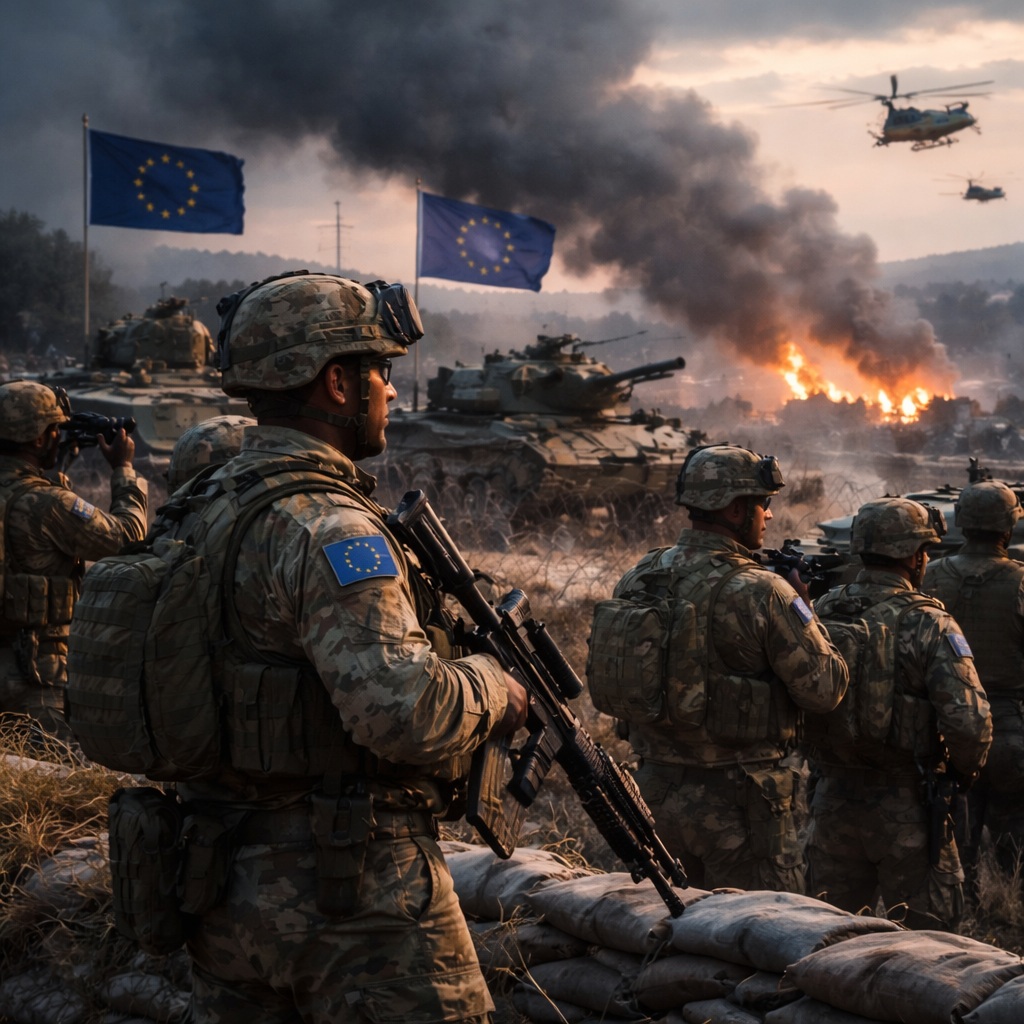
As diplomatic efforts inch forward, European leaders warn that the continent faces a new era of insecurity, with Russia seen as a persistent and adaptable threat.
For much of the past generation, war in Europe was something remembered, commemorated, and studied rather than anticipated. Open borders, integrated markets, and shared institutions fostered a belief that large-scale conflict on the continent had been consigned to history. Today, that assumption is being publicly challenged by Europe’s own leaders.
Across capitals from the Baltic to the Mediterranean, officials are delivering an unusually blunt message to their citizens: peace can no longer be taken for granted. Even as diplomatic channels remain open and discussions aimed at reducing violence continue elsewhere, governments warn that the risk of a wider confrontation involving Russia has not disappeared. In some assessments, it has merely changed shape.
Security briefings presented to national parliaments describe a Russia that, despite years of war and sanctions, has adapted its economy and military to prolonged confrontation. European intelligence agencies caution that Moscow could test the resolve of the European Union and NATO through cyber operations, disinformation campaigns, sabotage of critical infrastructure, or limited military pressure on vulnerable regions.
The warnings mark a sharp tonal shift. For decades, Europe focused on crisis management abroad, from the Balkans to the Middle East, while defense spending at home steadily declined. Armed forces were streamlined, heavy equipment mothballed, and readiness levels reduced. The assumption was that diplomacy, trade, and international law would act as reliable shock absorbers.
That strategic comfort has now eroded. Leaders argue that the conflict to the east has demonstrated how quickly assumptions can collapse. Even if active fighting elsewhere were to subside, they say, the underlying confrontation between Russia and the Euro-Atlantic community would remain unresolved.
“We are not at war, but we are no longer at peace in the old sense,” is how one senior European official summarized the moment, speaking on condition of anonymity. “The space between those two realities is where the risks lie.”
As a result, pressure is growing on EU member states to accelerate defense investments and improve civilian preparedness. Several governments have announced plans to rebuild ammunition stockpiles, modernize air defenses, and strengthen border surveillance. Others are revisiting civil defense concepts that had faded from public memory, including emergency shelters, resilience of energy grids, and continuity of government planning.
The European Union, traditionally cautious on military matters, is also stepping into unfamiliar territory. Joint procurement initiatives aim to reduce fragmentation among national armies, while new funding mechanisms seek to support the defense industry’s ability to scale up production. Officials argue that collective action is essential, as no single European country can address the full spectrum of threats alone.
Yet the push to prepare for war sits uneasily with societies shaped by decades of peace. Public opinion surveys reveal a mix of concern and skepticism. Many citizens support helping allies and strengthening security, but fewer are comfortable with the idea of sustained militarization or personal sacrifice. Governments face the challenge of mobilizing support without fueling panic or normalizing the expectation of conflict.
Russia, for its part, rejects claims that it plans to attack European countries, framing such warnings as fearmongering. Nonetheless, its military posture and rhetoric continue to keep European planners on edge. Exercises near NATO borders, nuclear signaling, and hybrid activities below the threshold of open war reinforce the sense that pressure could be applied selectively and unpredictably.
Analysts note that the danger may not lie in a dramatic invasion, but in miscalculation. A cyberattack that spirals out of control, an incident at sea or in the air, or unrest stoked in a fragile region could escalate faster than diplomats can contain it. In that context, preparedness is presented not as provocation, but as insurance.
The renewed focus on defense also raises questions about Europe’s long-term identity. For years, the EU defined itself as a peace project, built to prevent the return of the continent’s darkest chapters. Now, leaders argue that safeguarding that achievement requires a harder edge.
Preparing for war, they insist, is not about abandoning diplomacy. It is about ensuring that diplomacy is backed by credibility. Whether European societies accept that logic may determine how secure the continent remains in the years ahead.

 The Tower Post