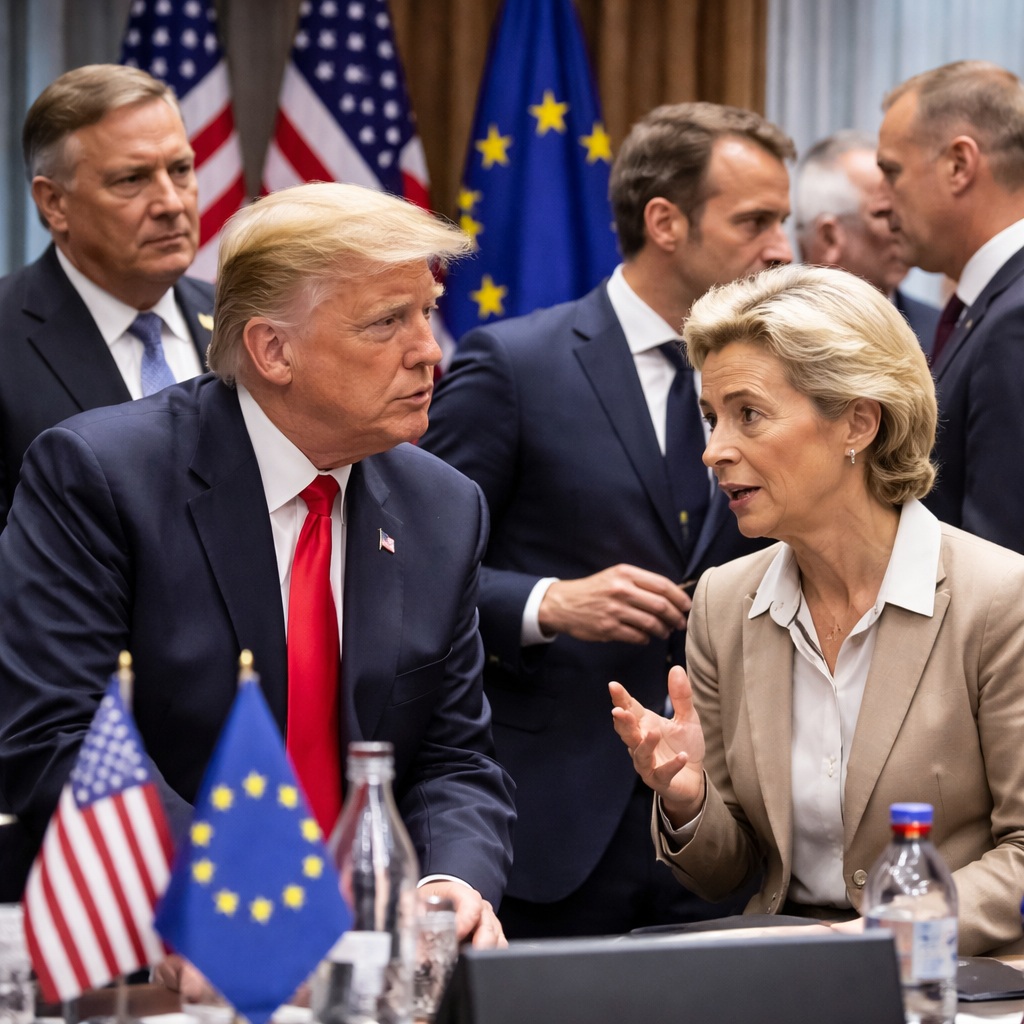
After months of uncertainty, European capitals recalibrate ties with Washington amid cooperation, friction, and a quieter push for strategic autonomy.

BRUSSELS — European leaders are learning, sometimes reluctantly, to live with a Washington that feels both familiar and unsettlingly changed. One year into Donald Trump’s return to the White House, officials across the European Union say the relationship with the United States has entered a phase of constant adjustment, marked by tactical cooperation, sudden reversals, and a renewed European debate about how dependent the continent should remain on its closest ally.
Behind closed doors in Brussels and national capitals, diplomats describe a mood that oscillates between pragmatism and unease. The transatlantic bond has not broken, they insist, but it has become more transactional and more unpredictable. For the EU, the past year has been less about dramatic ruptures than about managing volatility — learning to absorb shocks while quietly reshaping long-term assumptions.
At NATO headquarters, the alliance continues to function, at least outwardly, as it always has. Joint exercises proceed, intelligence sharing remains robust, and public statements stress unity. Yet European officials acknowledge that cooperation now comes with sharper edges. Washington’s demands for higher defense spending and more visible European contributions are delivered with less diplomatic cushioning than in previous administrations.
Several EU governments have accelerated military investment, partly in response to ongoing security threats on Europe’s eastern flank, but also as a hedge against American unpredictability. “The message from Washington is clear,” said one senior European defense official. “Support exists, but it is conditional, and it can be questioned at any moment.”
Trade has proven even more contentious. Over the past year, the White House has revived a muscular approach to tariffs and industrial policy, framing economic relations through the lens of domestic political gain. European exporters have faced renewed uncertainty, particularly in sectors tied to green technology, automotive manufacturing, and steel. Retaliatory measures have been discussed in Brussels, though often held back in favor of negotiation.
The result has been a delicate balancing act. EU officials want to avoid a full-scale trade confrontation with their largest partner, but they also fear appearing weak or divided. “There is cooperation, but it is increasingly transactional,” said a diplomat involved in trade talks. “You gain ground on one issue, and you may lose it the next day with a single announcement.”
Despite the tension, the year has not been devoid of progress. On climate and energy security, pragmatic cooperation has continued, driven less by shared vision than by overlapping interests. Europe’s push to reduce reliance on unstable energy suppliers has aligned, at times uneasily, with American ambitions to expand its role as a global energy exporter. Joint projects and regulatory dialogues have moved forward, even as broader political rhetoric remained confrontational.
Foreign policy coordination has followed a similar pattern. On major global crises, Europe and the United States still find themselves broadly aligned, but the process is messier. European leaders complain of limited consultation and abrupt shifts in tone. American officials, for their part, argue that Europe must learn to act faster and speak with one voice if it wants to be taken seriously.
This tension has reinvigorated a long-running debate inside the EU about strategic autonomy. Once a phrase that divided member states, it has gained quieter acceptance over the past year. The idea is no longer framed as distancing Europe from the United States, but as making the partnership more balanced and resilient.
France has continued to champion a stronger European defense and industrial base, while countries traditionally closer to Washington, including several in northern and eastern Europe, have begun to hedge more openly. Even those governments remain wary of moves that could weaken NATO or signal disunity to adversaries.
Publicly, EU leaders are careful with their language. Statements emphasize shared values and historic ties, even as private conversations reflect a more sober assessment. “We are adapting,” said one senior EU official. “This is not about panic. It is about realism.”
The political calendar in Washington looms large over European thinking. Officials know that U.S. policy could shift again, either through domestic pressures or international crises. That uncertainty has become a planning assumption rather than an exception. European institutions are investing more in scenario planning, crisis response mechanisms, and internal coordination.
For many in Brussels, the lesson of the past year is not that the transatlantic relationship is failing, but that it is changing faster than Europe once expected. Dependence that once felt comfortable now carries political and economic risk. At the same time, no European capital seriously contemplates a clean break from Washington.
As winter settles over Europe, the prevailing mood is one of cautious adaptation. Cooperation with the United States continues because it must, but it is accompanied by a quieter determination to build alternatives and buffers. The relationship, EU officials say, has entered a more adult phase — less idealistic, more conditional, and undeniably more complex.
Whether this recalibration will strengthen or strain the alliance in the long run remains an open question. For now, European leaders appear resigned to a simple reality: the old certainties are gone, and navigating the new U.S. landscape requires flexibility, patience, and a thicker diplomatic skin.



 The Tower Post