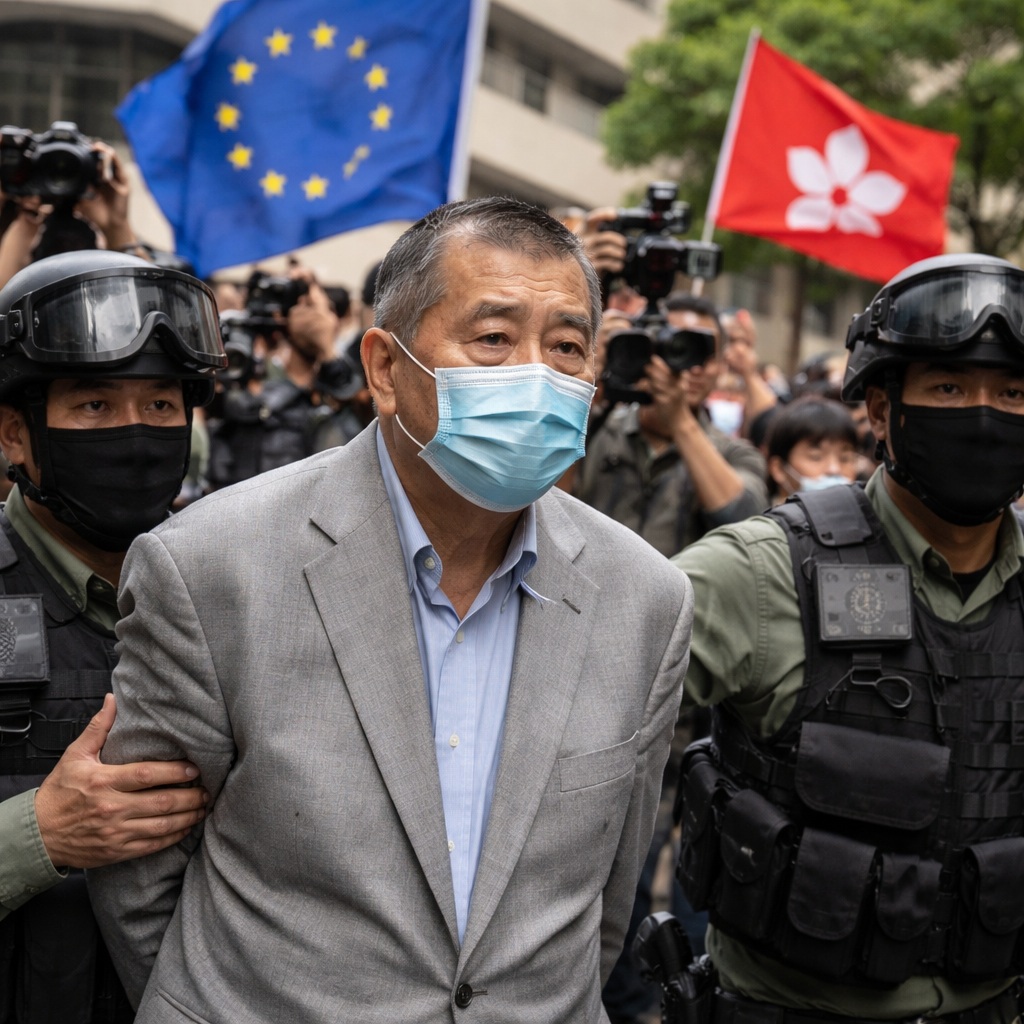
Brussels condemns a Hong Kong court ruling, warning it underscores wider global concerns over rights, rule of law, and press freedom.

Brussels — The European Union has condemned the conviction of Hong Kong media entrepreneur and pro-democracy advocate Jimmy Lai, describing the ruling as emblematic of a broader erosion of democratic norms and fundamental freedoms in the territory. EU officials said the decision reflects mounting concerns over judicial independence, freedom of expression, and the shrinking space for civil society under the current political framework governing Hong Kong.
In a statement circulated among member states, the EU said the verdict sends a “deeply troubling signal” not only to Hong Kong’s residents but also to the international community. According to European diplomats, the case illustrates how the legal system is increasingly being used to constrain dissent and silence critical voices, particularly those associated with independent journalism and political pluralism.
Jimmy Lai, founder of the now-defunct Apple Daily newspaper, has long been a prominent figure in Hong Kong’s pro-democracy movement. His prosecution and conviction have been closely watched by foreign governments, rights groups, and media organizations worldwide. For the EU, the case has become a touchstone in assessing the state of autonomy and freedoms promised to Hong Kong under its unique constitutional arrangement.
EU officials stressed that their criticism is not limited to a single individual case. Rather, they view the ruling as part of a wider pattern that includes the curtailment of free media, the disbanding of opposition parties, and the prosecution of activists under sweeping national security provisions. “This judgment is emblematic of a systematic narrowing of civic space,” one senior EU official said, speaking on condition of anonymity due to diplomatic sensitivities.
The conviction has prompted renewed debate within EU institutions about how to recalibrate relations with Hong Kong and, by extension, with Beijing. While the EU has maintained economic and trade ties with the region, lawmakers in the European Parliament have urged a more values-driven approach, calling for stronger diplomatic pressure and targeted measures to defend human rights.
Several members of the European Parliament described the ruling as a blow to press freedom, noting that Apple Daily once served as one of the most outspoken platforms for dissent in Hong Kong. Its closure, following legal and financial pressure, marked a turning point in the city’s media landscape. The conviction of its founder, they argue, cements that shift.
Human-rights organizations echoed the EU’s concerns, warning that the case could have a chilling effect on journalists, lawyers, and activists who remain in Hong Kong. International watchdogs say the legal reasoning used in the verdict risks setting precedents that further restrict lawful expression and peaceful political activity.
The Hong Kong authorities, for their part, have consistently defended the court’s decision, insisting that the rule of law remains intact and that the judiciary operates independently. Officials argue that national security laws are necessary to ensure stability and prosperity, and that no one is above the law regardless of political views.
The EU has rejected that framing, emphasizing that respect for human rights and fundamental freedoms is an essential component of stability. In its statement, Brussels reiterated its call for the protection of judicial independence and urged the authorities to uphold international commitments related to civil and political rights.
Diplomats say the timing of the ruling has added urgency to internal EU discussions. With global attention focused on democratic resilience and the defense of liberal values, the bloc is under pressure to demonstrate consistency between its rhetoric and its foreign policy actions. Some member states have pushed for coordinated responses with like-minded partners, including public diplomacy initiatives and support for civil society actors abroad.
As the year draws to a close, the Jimmy Lai case stands as a stark reminder of the fragile state of freedoms in Hong Kong. For the EU, it has become a symbol of the broader challenges facing democracy and the rule of law in an increasingly polarized world—challenges that Brussels says it cannot afford to ignore.

 The Tower Post