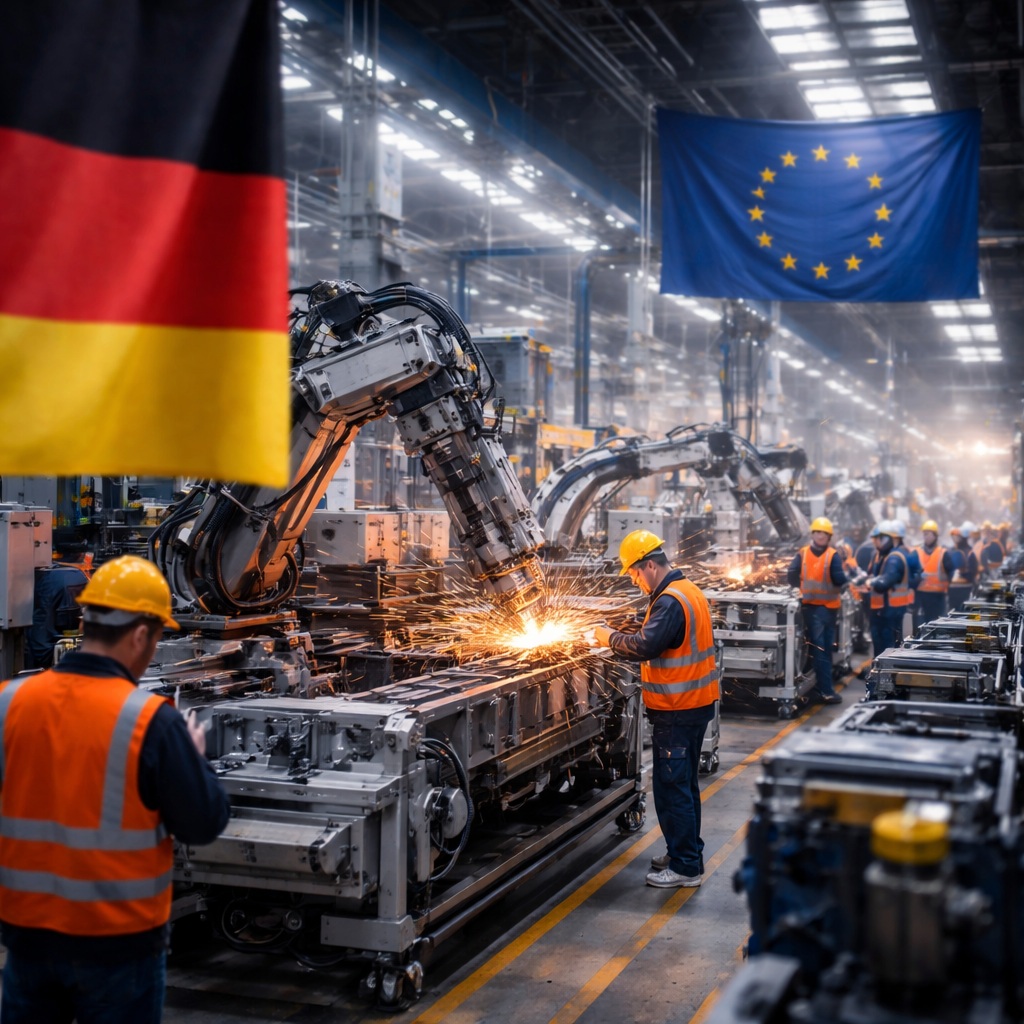
A strong rebound in German output helps offset softness elsewhere, reinforcing the bloc’s economic resilience amid global uncertainty.

As the year draws toward its close, the euro zone’s industrial sector is showing renewed signs of life. After months marked by uneven performance and fragile confidence, recent data point to a pickup in activity that economists say reflects a more resilient economic core than many had expected. The improvement is not uniform across the bloc, but the renewed strength in Germany’s industrial engine has provided a stabilizing counterweight to weaker readings in France and Italy.
The latest figures indicate that industrial growth across the currency union has edged higher, supported by stronger manufacturing output, improving supply conditions, and a gradual normalization of energy markets. While the pace of expansion remains modest by historical standards, the direction of travel has reassured policymakers and investors alike, who have been bracing for sharper slowdowns driven by geopolitical tensions, trade fragmentation, and tighter financial conditions.
Germany once again stands at the center of the picture. Industrial output there rose strongly in October, with gains spread across capital goods, automotive manufacturing, and advanced machinery. Factory managers report a firmer flow of orders, particularly from within Europe, suggesting that regional demand is holding up better than feared. The improvement has helped offset declines seen in France and Italy, where production has been constrained by softer domestic demand and lingering structural challenges.
For the euro zone as a whole, the renewed momentum underscores a key feature of the bloc’s economy: its capacity to absorb shocks through internal diversification. When one major economy falters, another can partially take up the slack. Economists say this balancing effect has been crucial in preventing a deeper industrial contraction at a time when global trade growth remains subdued.
“Germany’s performance matters disproportionately for the region,” said one euro area economist. “When German factories are running closer to capacity, it provides stability to supply chains and confidence to neighboring economies. That doesn’t eliminate weaknesses elsewhere, but it does reduce the risk of a broad-based downturn.”
In France, industrial output has struggled to gain traction. Energy-intensive sectors and consumer-oriented manufacturing have faced headwinds from cautious spending and slower export growth. Italy’s factories, meanwhile, have been affected by weaker investment demand and tighter credit conditions, particularly for small and medium-sized firms that form the backbone of its industrial base. Despite these challenges, the setbacks have so far been contained rather than systemic.
The broader context remains complex. Global uncertainties continue to weigh on decision-making, from ongoing geopolitical tensions to the recalibration of supply chains and trade relationships. Higher interest rates have dampened investment appetite, while households across Europe remain sensitive to price pressures, even as inflation has eased from its peaks. Against this backdrop, the recent industrial uptick stands out as a sign of steadiness rather than exuberance.
Energy has been a critical factor in the sector’s stabilization. Compared with the volatility seen in previous years, energy prices have become more predictable, allowing manufacturers to plan production with greater confidence. This has been particularly important for Germany, where energy-intensive industries had borne the brunt of earlier shocks. Improved efficiency measures and diversified energy sourcing have also begun to pay dividends.
Another supportive element has been the gradual easing of supply-chain disruptions. Delivery times have shortened, inventories have normalized, and companies are better able to align production with demand. While global logistics remain vulnerable to sudden disruptions, the worst bottlenecks appear to be behind the region’s manufacturers.
Policymakers are watching these developments closely. For the European Central Bank, signs of industrial resilience complicate the debate over the appropriate path of monetary policy. On one hand, steady growth reduces the urgency for aggressive stimulus. On the other, uneven performance across countries argues for caution, particularly as tighter financing conditions risk amplifying divergences within the bloc.
National governments, too, face a delicate balancing act. Many are seeking to support industrial competitiveness through investment incentives, green transition funding, and skills development, while also managing strained public finances. The recent pickup in output provides some breathing room, but it does not eliminate the need for structural reforms, particularly in countries where productivity growth has lagged.
Looking ahead, economists expect the euro zone’s industrial sector to remain on a narrow but positive trajectory. Much will depend on external demand, especially from key trading partners, and on the evolution of global risks. A sharp escalation of geopolitical tensions or a renewed surge in energy prices could quickly undermine the fragile recovery. Conversely, a stabilization of global trade and continued easing of inflation could allow the sector to build on its recent gains.
For now, the message from the factory floor is one of cautious optimism. The euro zone’s industry is not roaring back, but it is proving more adaptable than many had feared. Germany’s rebound has highlighted the bloc’s capacity for internal support, even as France and Italy work through their own challenges. As the region approaches the end of the year, this resilience offers a measure of reassurance in an uncertain global economic landscape.


 The Tower Post