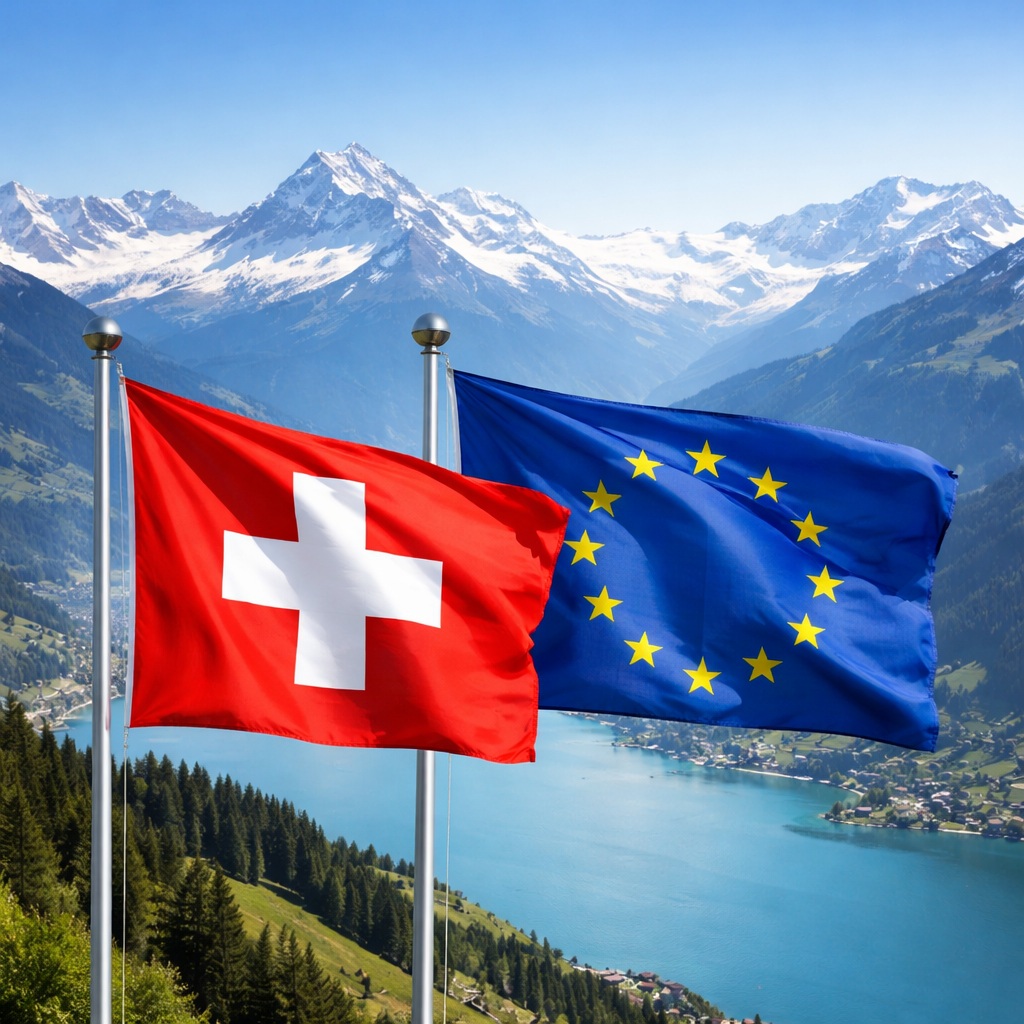
A new cooperation framework points to a pragmatic European path beyond full membership

By late December, Switzerland has entered a pivotal moment in its long and often delicate relationship with the European Union. After years of stop-start negotiations and domestic hesitation, the federal government has won broad backing from political parties, business associations, trade unions and regional leaders for a renewed framework designed to deepen cooperation with the bloc. The initiative, still subject to parliamentary scrutiny and potential popular approval, signals a more confident Swiss approach to Europe at a time of shifting continental priorities.
The proposed package seeks to stabilize and modernize relations with the EU, Switzerland’s largest trading partner, without crossing the red line of full membership. Instead, it reinforces bilateral agreements that underpin access to the single market while introducing clearer mechanisms for dispute resolution, regulatory alignment and institutional dialogue. Supporters say the move reflects economic reality and geopolitical necessity, while preserving the country’s tradition of sovereignty and direct democracy.
At the heart of the plan is a recalibration rather than a revolution. Swiss exporters, especially in pharmaceuticals, machinery, finance and precision manufacturing, rely heavily on predictable access to EU markets. In recent years, gaps in agreements and regulatory uncertainty have begun to weigh on competitiveness, research cooperation and labor mobility. Business groups have been among the strongest advocates of a reset, arguing that fragmentation carries growing costs in an increasingly competitive global economy.
Trade unions and social partners, often wary of closer ties, have also expressed cautious support. Their endorsement rests on safeguards aimed at protecting Swiss wage levels and labor standards, long a sensitive issue in cross-border employment. The government has emphasized that domestic protections remain non-negotiable, framing the deal as a balance between openness and social stability.
Politically, the initiative has drawn backing across much of the center and left, as well as from pragmatic voices on the right. While eurosceptic factions continue to warn against “creeping integration,” the tone of the debate has shifted. Rather than revisiting old arguments about identity and autonomy, the current discussion focuses on governance, legal clarity and Switzerland’s ability to shape rules that already affect its economy.
The broader European context has played a role in this shift. The EU, facing its own internal and external pressures, has shown greater willingness to engage with close partners outside formal membership. For Brussels, a stable and cooperative Switzerland offers continuity in a fragmented geopolitical landscape. For Bern, the arrangement provides a structured way to remain plugged into European systems on energy, transport, research and security.
Analysts describe the moment as a new phase of continental cooperation, one that sits between full membership and loose association. Switzerland’s model, if successful, could serve as a reference for other non-member states seeking structured engagement without accession. It underscores a Europe increasingly defined by variable geometry, where integration takes multiple forms.
Public sentiment remains a decisive factor. Switzerland’s system of direct democracy means that any far-reaching agreement must withstand scrutiny not only in parliament but also among voters. Early indicators suggest a pragmatic mood, shaped by economic concerns and a desire for stability. The government has been careful to frame the deal as a tool for safeguarding prosperity rather than a symbolic embrace of Brussels.
Critics, however, caution that the details will matter. Questions remain about the role of European courts, the scope of regulatory alignment and the long-term implications for domestic lawmaking. Past attempts at institutional agreements faltered on similar issues, and opponents are preparing to challenge what they see as excessive concessions.
Yet the current effort differs in tone and timing. Rather than seeking a sweeping institutional overhaul, negotiators have opted for incrementalism, bundling sectoral solutions into a coherent framework. This approach reflects lessons learned from previous failures and an acknowledgment of political limits at home.
As the year draws to a close, Switzerland finds itself at a crossroads that is less dramatic than in past European debates, but potentially more consequential. The emerging consensus suggests that the country is ready to move beyond defensive postures toward a more strategic engagement with its neighbors. In doing so, it may be redefining what partnership with the EU looks like in the middle of the decade.
Whether the agreement ultimately succeeds will depend on trust, transparency and the ability to translate technical compromises into a narrative that resonates with citizens. For now, the broad backing achieved marks a notable shift. It points to a Switzerland that is neither retreating into isolation nor rushing toward membership, but charting a distinctly Swiss course through a changing Europe.


 The Tower Post