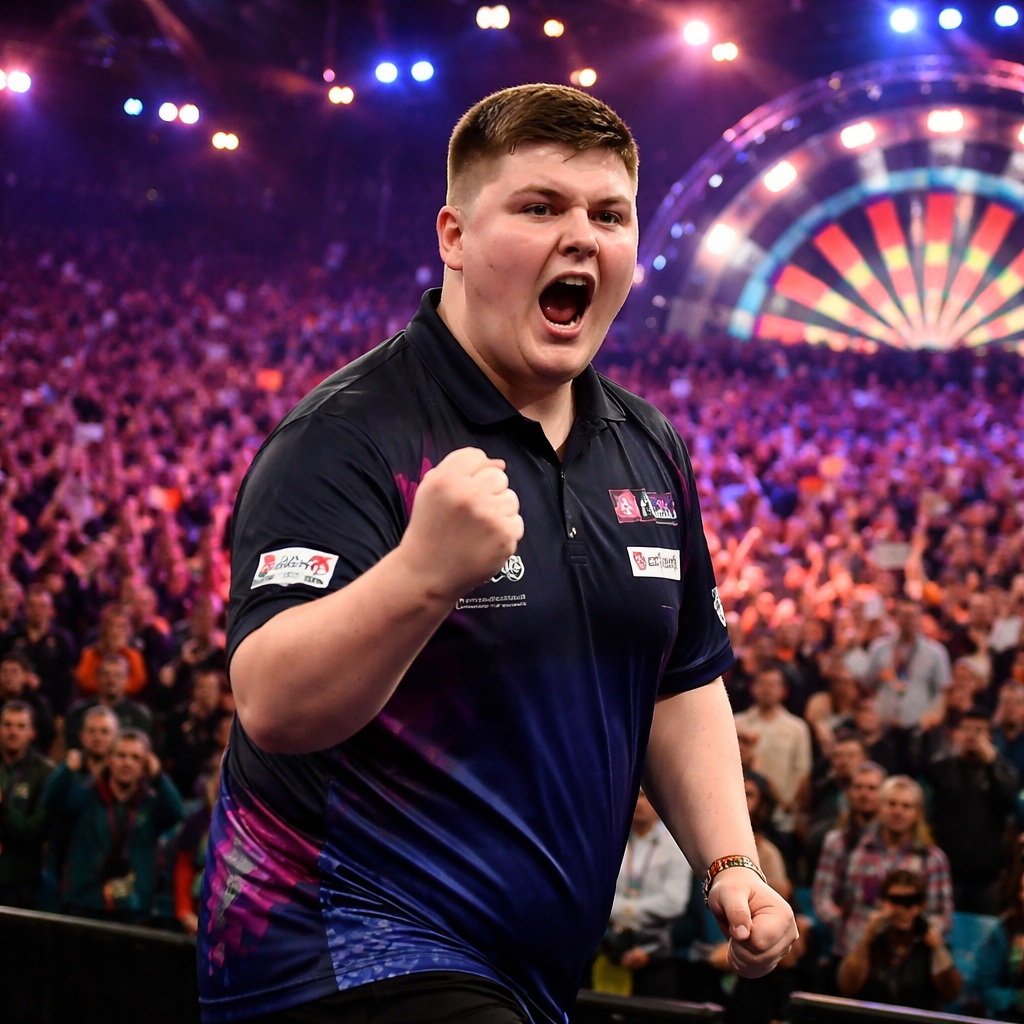
The reigning world champion opens his title defense as the PDC World Darts Championship lights up Alexandra Palace once again
Alexandra Palace is alive with its familiar winter hum. The walk-on music thumps through the vast hall, the crowd is already in full voice, and the unmistakable scent of anticipation hangs over North London. As the PDC World Darts Championship returns to its spiritual home, one name dominates the conversation: Luke Littler.
Still remarkably young and already carrying the weight of a world title, Littler begins his campaign to defend the Sid Waddell Trophy under brighter lights and heavier scrutiny than ever before. The championship, the most prestigious event in professional darts, is once again the centerpiece of the sporting calendar, blending festive spectacle with elite competition in a way no other tournament quite manages.
Littler’s rise has been nothing short of extraordinary. From prodigious talent to global name, his journey has reshaped expectations about age, composure, and longevity in the modern game. Last season’s triumph did more than crown a champion; it signaled a shift. Darts, long dominated by seasoned professionals, suddenly had a new standard-bearer whose fearlessness and fluency on the big stage seemed to defy tradition.
Returning to London as the defending champion, Littler faces a challenge that goes far beyond his opening match. Every opponent now measures themselves against him. Every missed double is magnified. Every maximum is met with an expectation rather than surprise. This is the burden of success at Ally Pally, where history is celebrated but never guaranteed to repeat itself.
The atmosphere inside Alexandra Palace remains unrivaled. Costumed fans from across Europe and beyond fill the stands, transforming matches into communal events that blur the line between sport and celebration. Yet beneath the carnival exterior lies a tournament of unforgiving intensity. The long format rewards resilience as much as scoring power, and the margin for error shrinks with every passing round.
Littler’s game appears built for these demands. His scoring phases are relentless, his rhythm unshaken by noise or occasion. Perhaps most impressively, his temperament suggests a player who understands that winning at Ally Pally is as much about surviving difficult moments as producing highlights. Defending a title here requires patience, adaptability, and the ability to reset after nights that stretch late into the winter air.
Still, the field assembled in London is deep and dangerous. Former champions, emerging challengers, and unseeded threats all arrive believing this is their moment. The draw offers no easy paths, and history shows that even favorites can fall swiftly if focus wavers. For Littler, each match represents a fresh examination, not of potential, but of consistency.
Beyond the oche, the championship continues to reflect darts’ growing global profile. Broadcast to millions, followed obsessively on social platforms, and debated across pubs and living rooms, the event stands as a showcase of how far the sport has traveled. Littler, willingly or not, has become central to that story — a symbol of a new generation raised under the glare of instant fame.
As the tournament unfolds, the question is not simply whether Luke Littler can retain his crown. It is whether he can evolve once more, adapting to the expectations that accompany greatness. Alexandra Palace has a way of revealing truths. Over the coming nights, amid the roar of the crowd and the glare of the stage lights, it will do so again.
For now, the reigning champion steps forward, darts in hand, ready to test whether lightning can strike twice on the sport’s grandest stage.




 The Tower Post