EU enlargement momentum returns as North Macedonia advances and Albania meets resistance

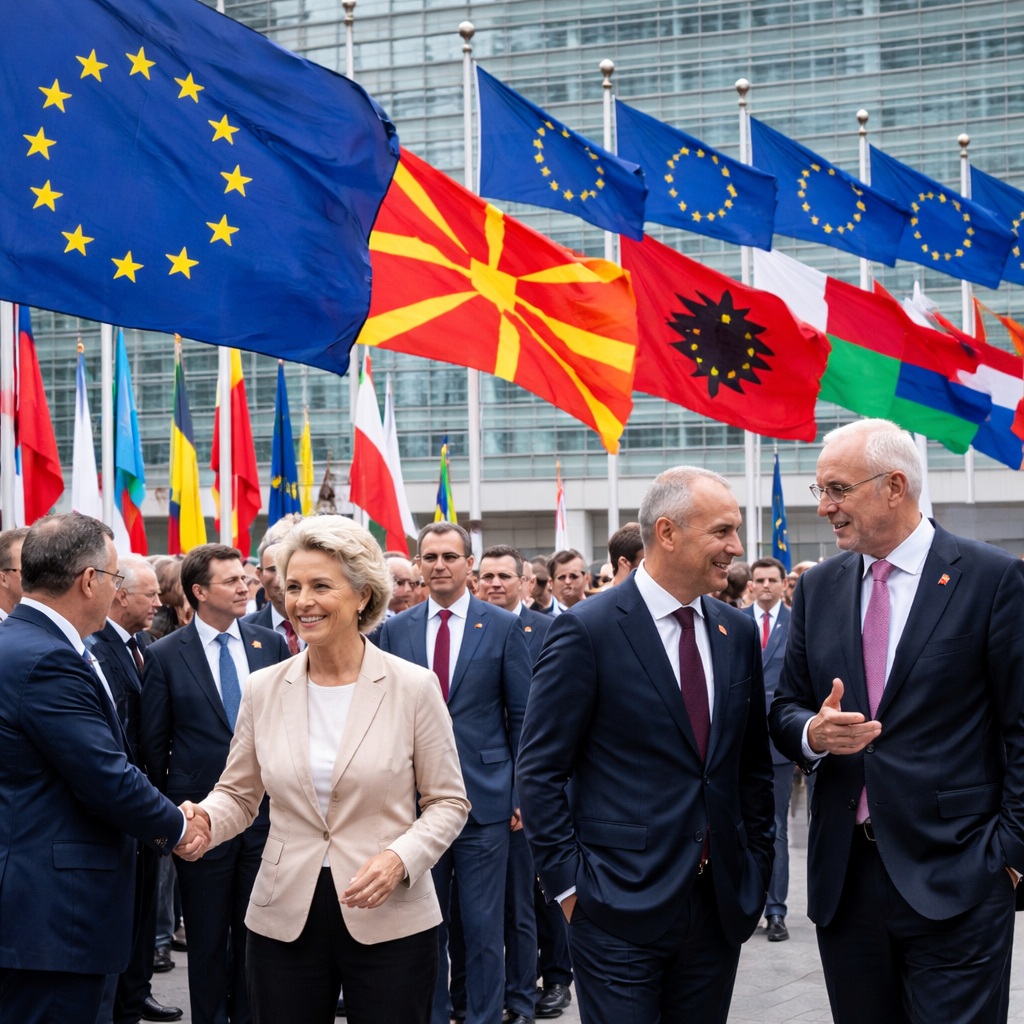
Brussels — The European Union’s long-running conversation with the Western Balkans has returned to center stage, as leaders, diplomats and commissioners gather in Brussels for a high-level summit that once again places enlargement on the political agenda. Against a backdrop of geopolitical uncertainty and renewed debates about the future of Europe, the bloc is signaling continued engagement with a region that has spent decades knocking at the EU’s door.
At the heart of the latest developments are two neighboring countries whose paths toward Brussels have diverged in telling ways. North Macedonia appears poised to receive fresh political backing from the Union to move forward with the opening of membership negotiations, while Albania is encountering renewed hesitation from several member states, underscoring the uneven and often fragile nature of the enlargement process.
For North Macedonia, the moment carries particular symbolic weight. After years of stalled progress, name disputes, constitutional reforms and diplomatic compromises, Skopje has once again emerged as a test case for the EU’s credibility in the Western Balkans. Senior EU officials have indicated that the country’s recent reform efforts, particularly in the rule of law and public administration, have been met with a more favorable assessment in Brussels.
Diplomats familiar with the discussions say the prevailing mood among many member states is that North Macedonia should not be left waiting indefinitely. “The message is that reforms must be rewarded,” said one EU official involved in enlargement talks. The push to advance negotiations reflects a broader concern that prolonged delays risk eroding public trust in the European project across the region.
Albania’s situation, however, illustrates how fragile that consensus can be. Despite progress acknowledged by the European Commission in areas such as judicial reform and anti-corruption measures, Tirana continues to face resistance from a group of member states skeptical about the pace and depth of implementation. Their concerns range from governance standards to migration pressures, issues that have taken on heightened political sensitivity within the EU itself.
This divergence does not mark a break with Albania, but rather a reminder of how enlargement remains hostage to domestic politics inside the Union. Enlargement decisions require unanimity, giving individual capitals significant leverage. In practice, this means that even positive technical assessments can be overshadowed by broader political calculations.
The developments unfold alongside a wider diplomatic push by Brussels to reassert its influence in the Western Balkans. The region has become a focal point of strategic competition, with the EU keenly aware of the growing presence of other global actors. For European leaders, maintaining momentum on integration is increasingly seen not just as a matter of values, but of security and stability.
At the summit in Brussels, officials have emphasized the idea of “gradual integration” — a framework that would allow candidate countries to benefit earlier from certain EU policies and funding, even before full membership. Supporters argue that this approach could keep reform incentives alive while delivering tangible benefits to citizens.
Critics, however, warn that partial integration risks creating a second-tier status for aspiring members. Civil society groups in the Western Balkans have repeatedly cautioned that without a clear and credible path to accession, reform fatigue could deepen, particularly among younger generations already skeptical of political promises.
For North Macedonia, the current signals from Brussels are being closely watched at home. Political leaders have framed EU support as validation of difficult reforms, while opposition voices remain wary, pointing to past instances where progress was later slowed by new conditions. Public opinion, long supportive of EU membership, has shown signs of strain after years of uncertainty.
In Albania, the reaction has been more muted but no less significant. Analysts note that continued delays risk fueling frustration and strengthening voices that question the value of aligning domestic reforms so closely with EU expectations. “The danger is not a sudden rupture,” said a regional analyst, “but a gradual loss of enthusiasm.”
Despite these challenges, EU officials insist that the door remains open. The language coming out of Brussels stresses partnership, shared responsibility and long-term commitment. Enlargement, they argue, is not a favor granted by the Union, but a process grounded in mutual obligations.
As leaders conclude their meetings in Brussels, the immediate outcomes may fall short of dramatic breakthroughs. Yet the symbolism matters. By placing the Western Balkans firmly back on the agenda, the EU is sending a signal — to candidate countries and to its own citizens — that the project of a united Europe remains unfinished.
Whether that signal translates into sustained momentum will depend on what follows once the summit lights dim and delegations return home. For North Macedonia and Albania alike, the coming months will test whether political promises can be converted into concrete steps, and whether the European Union can reconcile its strategic ambitions with the realities of internal consensus.
For now, the Western Balkans remain at the crossroads of Europe, their future intertwined with a Union still debating how far, and how fast, it is willing to grow.


 The Tower Post