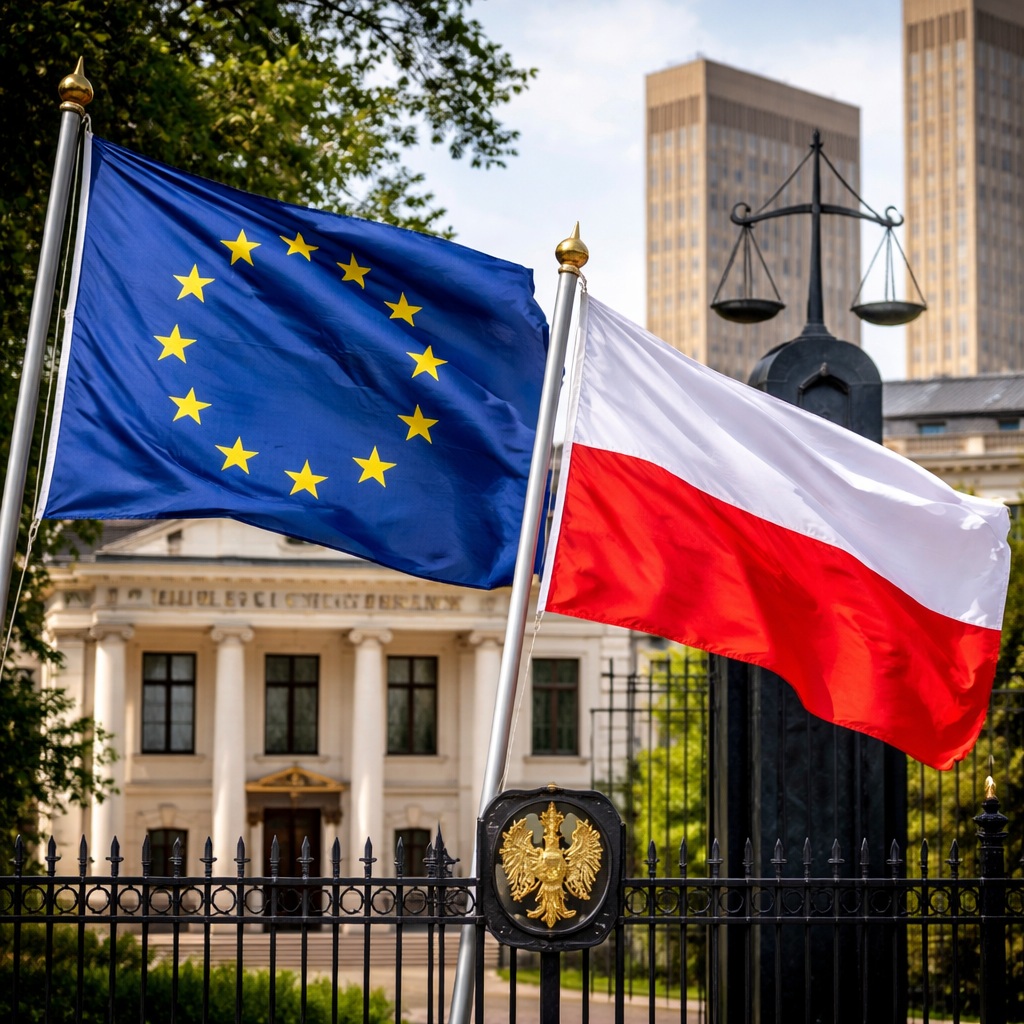
Ruling deepens rule-of-law clash as judges find politicized appointments undermine judicial autonomy
The European Union’s highest court has delivered a blunt assessment of Poland’s Constitutional Tribunal, concluding that the body tasked with safeguarding the country’s constitution does not meet the standards of judicial independence required under EU law. The ruling marks a pivotal moment in the long-running confrontation between Brussels and Warsaw over the rule of law, and it sends fresh tremors through a legal system already under intense scrutiny.
In its judgment, the European Court of Justice found that the composition and functioning of Poland’s Constitutional Tribunal have been compromised by a pattern of politically driven appointments. According to the court, these practices erode the separation of powers and strip the tribunal of the independence necessary to act as a neutral arbiter between the state and its citizens. The decision reinforces the EU’s position that judicial independence is not a domestic preference but a binding obligation flowing from membership in the bloc.
The case stems from questions referred to the Luxembourg-based court by national judges who sought clarity on whether decisions of the Polish Constitutional Tribunal could be relied upon when EU law was at stake. The ECJ’s answer was unequivocal: where a court’s independence is in doubt, its rulings cannot automatically be treated as authoritative within the EU legal order.
At the heart of the judgment lies the method by which several judges were appointed to the Constitutional Tribunal during a period of sweeping judicial reforms. The ECJ concluded that these appointments were marred by irregularities and political influence, undermining public confidence in the tribunal’s impartiality. Independence, the court stressed, is not a matter of appearances alone but of structural guarantees that shield judges from external pressure.
The ruling carries significant practical consequences. National courts across the EU may now feel empowered to question whether judgments from Poland’s Constitutional Tribunal should be applied, particularly in cases touching on EU law. Legal experts warn that this could deepen legal uncertainty and fragment the application of law within the bloc, as courts weigh loyalty to national institutions against obligations under EU treaties.
For the European Commission, the decision bolsters years of warnings that Poland’s judicial reforms crossed a red line. The Commission has repeatedly argued that changes to the judiciary weakened checks and balances and placed courts under political influence. With the ECJ’s backing, Brussels is likely to intensify pressure on Warsaw to restore judicial independence, potentially linking compliance to access to EU funds.
Polish authorities, for their part, have consistently rejected accusations of political capture, framing the reforms as a necessary overhaul of an inefficient and unaccountable system inherited from the past. Government officials have argued that the EU is overstepping its competences and intruding into national sovereignty. The latest ruling is unlikely to soften that rhetoric, even as it narrows Poland’s room for maneuver within the EU legal framework.
Beyond Poland, the judgment resonates across the European Union at a time when the rule of law has become a defining issue for the bloc’s identity. The ECJ emphasized that mutual trust between member states depends on the assurance that courts are independent and impartial. Without that trust, the legal glue holding the EU together begins to weaken.
As the year draws to a close, the decision underscores a broader reckoning for the EU: how to enforce its core values when member states push back. For Poland’s Constitutional Tribunal, the ruling casts a long shadow over its authority. For the European Union, it is a reaffirmation that the rule of law remains non-negotiable, even when enforcement tests the limits of political unity.




 The Tower Post