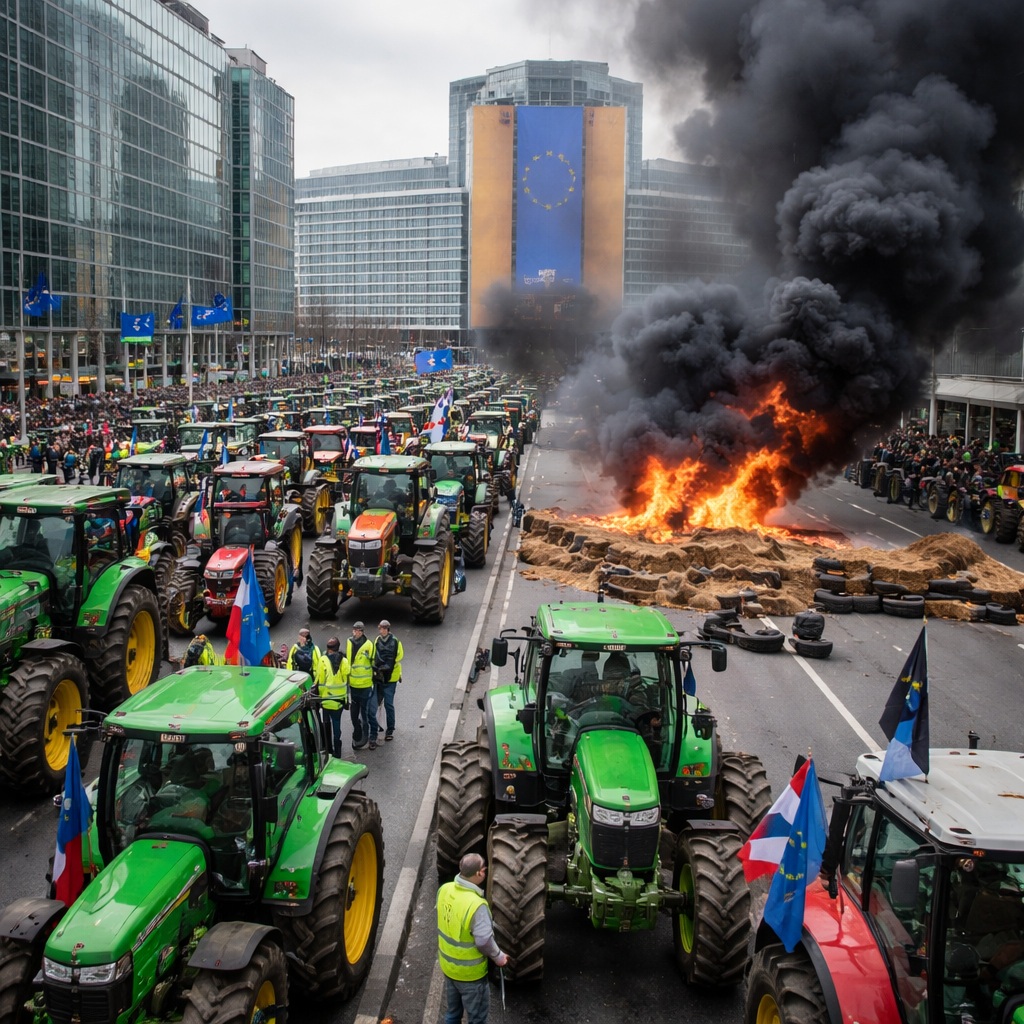
Farmers encircle Brussels to oppose the EU–Mercosur trade deal as leaders meet, reigniting a debate over agriculture, sovereignty, and the future of free trade.

Brussels awoke under a low winter sky to the rumble of engines and the smell of diesel as convoys of tractors rolled toward the city’s main arteries. By dawn, key roads around the European quarter were blocked, traffic ground to a halt, and the message from farmers across the continent was unmistakable: the proposed EU–Mercosur trade agreement has crossed a red line.
The demonstration unfolded as European leaders gathered for a high-level summit, lending the protest both symbolism and urgency. Farmers from several member states converged on the Belgian capital, many driving through the night, to express their opposition to a deal they say threatens their livelihoods and undermines the European Union’s own environmental and social standards.
At the heart of the dispute is the long-negotiated free-trade agreement between the EU and the Mercosur bloc of South American countries. Supporters argue it would open markets, boost exports, and strengthen geopolitical ties at a moment of global uncertainty. For many European farmers, however, the pact represents an uneven bargain—one that exposes them to competition from agricultural imports produced under rules they consider far less stringent.
Along the ring roads and access routes leading to the summit venue, tractors were parked bumper to bumper, their massive tires forming improvised barricades. Protesters waved national and regional flags, while banners denounced what they called “unfair trade” and “double standards.” Police diverted traffic and maintained a heavy presence, but the atmosphere, while tense, remained largely orderly.
Farmers interviewed on site voiced a shared sense of frustration that has been building for years. They pointed to rising production costs, stricter environmental regulations, and volatile markets that have already squeezed margins. The prospect of increased imports of beef, poultry, sugar, and soy from Mercosur countries, they argue, could push many family farms beyond the breaking point.
“This is not about rejecting trade,” said one farmer who had driven from northern France. “It’s about survival. We are asked to meet high standards for animal welfare, climate protection, and food safety. If imports don’t meet the same standards, then the competition is not fair.”
Agricultural unions echoed these concerns, warning that the deal could accelerate the decline of rural communities. They argue that while the agreement includes sustainability chapters and safeguards, enforcement remains uncertain. Past trade deals, they say, have shown that promises on paper do not always translate into meaningful protection on the ground.
European officials, for their part, insist that the agreement contains mechanisms to protect sensitive sectors and uphold environmental commitments. They emphasize that the deal could benefit European exporters of industrial goods and services, while also giving consumers access to a wider range of products. Some leaders have framed the pact as a strategic necessity, positioning Europe as a champion of rules-based trade in a fractured global economy.
Yet the timing of the protest underscored the political sensitivity of the issue. With elections looming in several member states and rural discontent increasingly visible, governments face mounting pressure to balance trade ambitions with domestic realities. In some countries, farm protests have already reshaped political debates, forcing leaders to reconsider policies perceived as detached from life beyond major cities.
Environmental groups have also entered the fray, though not always in alignment with farmers. While some share concerns about deforestation and climate impacts linked to Mercosur agriculture, others worry that blocking the deal could weaken incentives for sustainable practices abroad. The result is a complex coalition of opposition, united more by skepticism than by a single vision for the future of trade.
As the summit continued behind closed doors, the sound of horns and engines outside served as a constant reminder of the stakes. Delegates arriving at the venue were met with images that quickly spread across social media and news outlets, reinforcing the sense of a widening gap between policy-makers and those who feel most exposed to their decisions.
By late afternoon, negotiations inside had yet to produce clear signals about the agreement’s fate. What was evident, however, was that the road to ratification—if it remains open at all—will be politically fraught. The protests in Brussels added another chapter to a growing story of resistance, one that extends beyond borders and speaks to broader questions about how Europe feeds itself, trades with the world, and supports those who work the land.
As tractors slowly began to disperse at dusk, many farmers promised to return if their concerns are not addressed. For now, the blocked roads around Brussels stand as a powerful image of a sector demanding to be heard—at the very gates of European power.
 The Tower Post