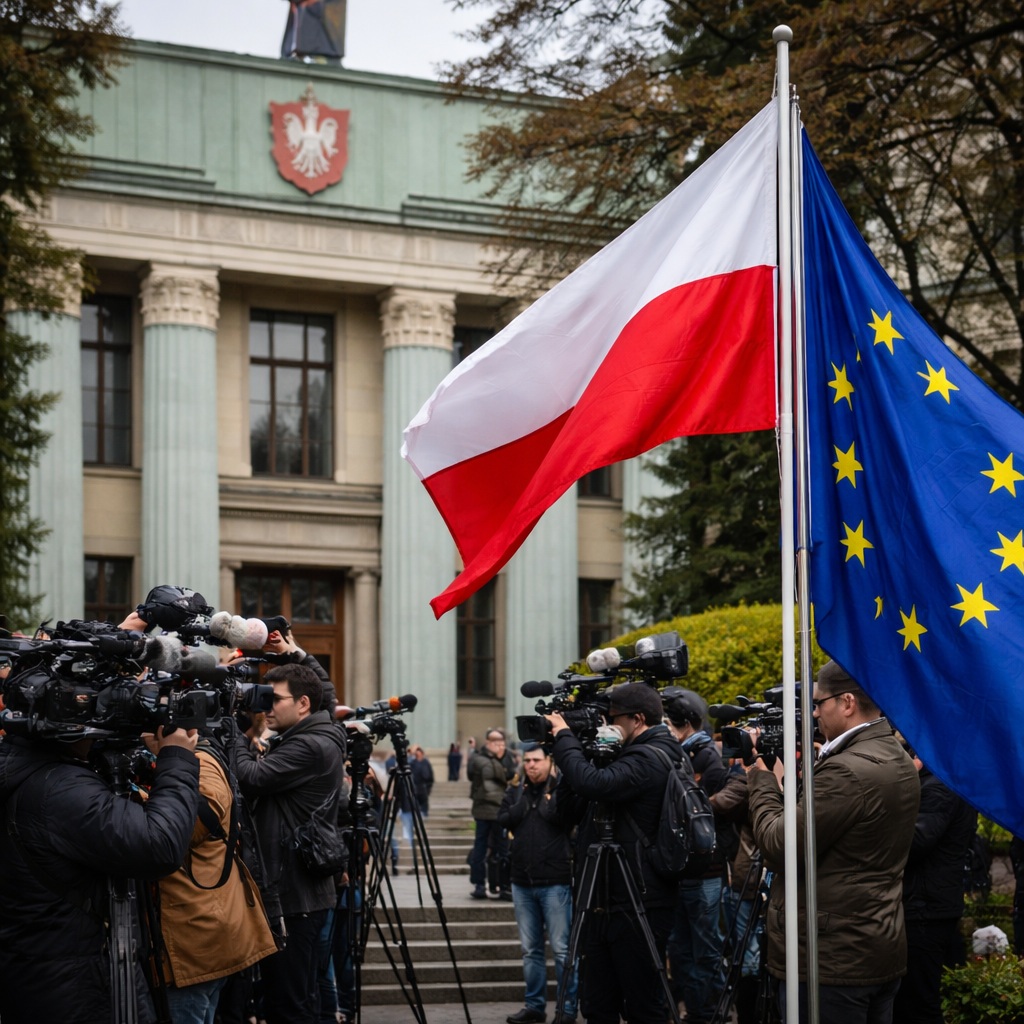
Judges find Poland’s highest court influenced by political appointments, reigniting debates on rule-of-law standards in the European Union
BRUSSELS — Europe’s top court has delivered a far-reaching judgment that cuts to the heart of a long-running confrontation between Brussels and Warsaw, ruling that Poland’s Constitutional Tribunal no longer meets the standards of independence required under European Union law. The decision, handed down as the year draws to a close, is likely to intensify political and legal tensions across the bloc, while reviving fundamental questions about how the EU enforces its core values.
In a sharply worded ruling, judges at the Court of Justice of the European Union concluded that the composition and functioning of Poland’s Constitutional Tribunal have been compromised by political interference. According to the court, a series of appointments made under disputed circumstances, combined with changes to internal procedures, have undermined the tribunal’s ability to act as an impartial guardian of the constitution.
The judgment represents one of the most direct assessments yet by the EU’s highest judicial authority of the state of Poland’s judiciary. It goes beyond earlier concerns about disciplinary regimes for judges and reforms of ordinary courts, placing the country’s highest constitutional body under scrutiny.
At the core of the ruling is the principle of judicial independence, a cornerstone of EU law. The Luxembourg-based court emphasized that national courts, especially constitutional tribunals, play a critical role in ensuring that EU law is applied uniformly across all member states. When doubts arise about a court’s independence, the judges said, the entire legal architecture of the Union is put at risk.
Poland’s Constitutional Tribunal has been at the center of controversy for years. Successive governments introduced reforms that altered how judges are appointed and how the tribunal operates. Critics, including opposition parties, civil society groups, and international organizations, have argued that these changes allowed the executive and legislature to exert undue influence over the court.
The EU court found that several judges sitting on the tribunal were appointed in a manner that failed to respect basic legal safeguards. In particular, it pointed to appointments made despite existing judicial rulings that questioned their legality. This, the court said, created a lasting structural defect that could not be ignored when assessing the tribunal’s independence.
The ruling is significant not only for Poland but for the European Union as a whole. It underscores the EU’s claim that respect for the rule of law is not an abstract political ideal but a binding legal obligation. Member states, the court reiterated, cannot invoke national constitutional identity to justify practices that weaken judicial independence while remaining part of the Union’s legal order.
Reaction in Warsaw was swift and divided. Government representatives rejected the ruling, arguing that judicial organization falls within national competence and accusing EU institutions of overreach. They maintained that the tribunal reflects the democratic will expressed through parliamentary majorities.
Opposition figures and legal experts, however, welcomed the decision as long-overdue recognition of what they describe as a systemic erosion of checks and balances. For them, the ruling provides powerful legal backing for claims that the tribunal has been transformed into a political instrument rather than an independent court.
Beyond Poland’s borders, the judgment is expected to influence ongoing debates about how the EU responds to rule-of-law backsliding. Brussels has already linked access to EU funds to respect for judicial independence, and the latest ruling may strengthen the hand of those calling for tougher enforcement.
Legal scholars note that the decision could have practical consequences in courts across Europe. Judges in other member states may now feel justified in questioning whether rulings issued by Poland’s Constitutional Tribunal can be relied upon in cases involving EU law. Such doubts could complicate judicial cooperation, particularly in sensitive areas such as extradition and cross-border civil disputes.
At a political level, the ruling arrives at a delicate moment for the Union. With enlargement, security, and economic competitiveness high on the agenda, divisions over the rule of law threaten to sap trust among member states. The court’s intervention serves as a reminder that the EU’s legal foundations are inseparable from its political project.
As the year closes, the question remains how Poland will respond. Previous judgments from Luxembourg have sometimes led to partial adjustments but rarely to a full reversal of contested reforms. Whether this latest ruling will prompt meaningful change or deepen the standoff between Warsaw and Brussels is uncertain.
What is clear is that the EU’s top court has drawn a firm line. By declaring that Poland’s Constitutional Tribunal lacks the independence required under EU law, it has reaffirmed the central role of judicial autonomy in the European project—and signaled that challenges to that principle will not go unanswered.




 The Tower Post