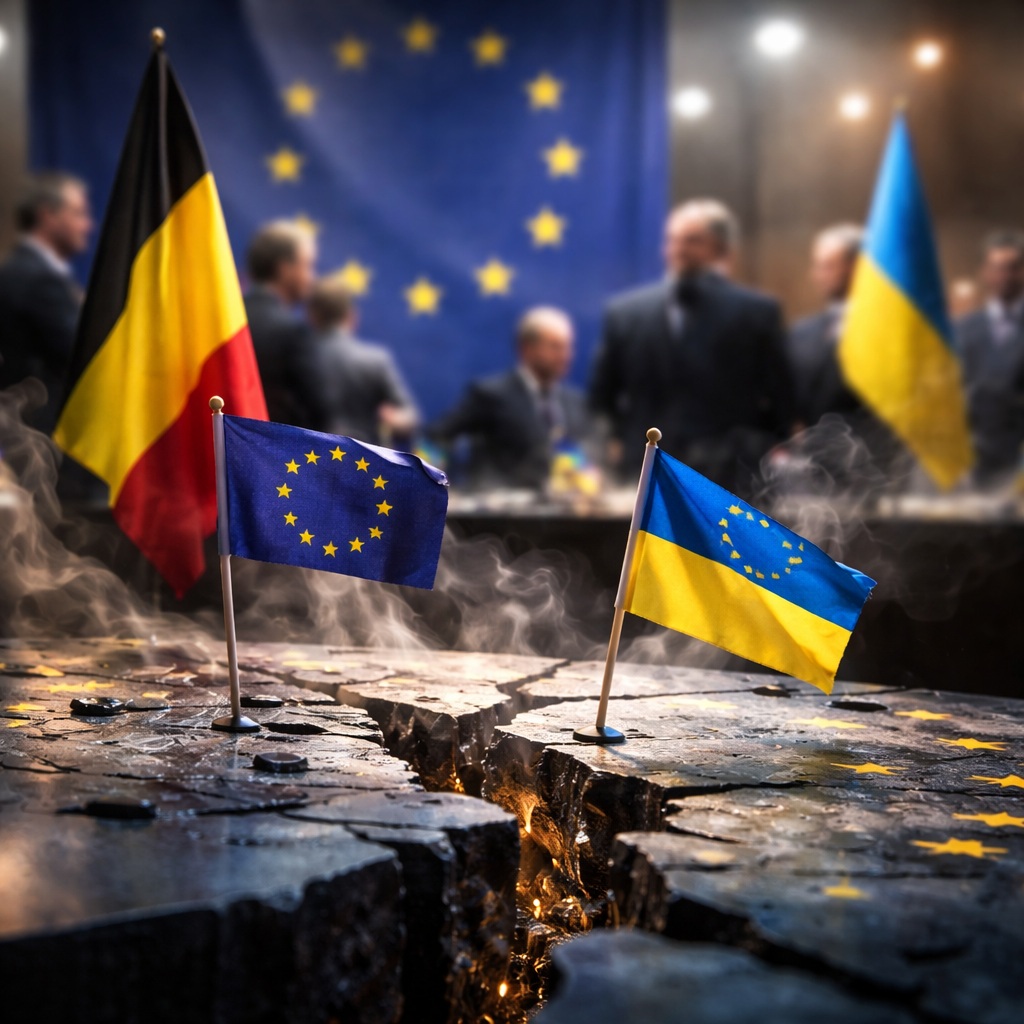
A standoff over Ukraine funding exposes deepening fractures in EU unity as capitals debate shared fiscal burdens and the future of solidarity.

Brussels — As winter settles across Europe, the political temperature inside the European Union has risen sharply. Belgium’s resistance to elements of new EU-level funding arrangements for Ukraine has triggered a broader reckoning: who ultimately pays for Russia’s war, and how far collective solidarity can stretch when national interests collide.
At the center of the dispute is a familiar but unresolved question. Should Europe respond to the prolonged conflict in Ukraine through shared fiscal mechanisms, or should support continue to rely on national contributions negotiated case by case? Belgium’s veto on parts of the proposed framework has stalled momentum toward deeper financial integration, leaving other member states to shoulder uncertainty and, in some cases, higher immediate costs.
Belgian officials insist their position is being misread. Privately and publicly, they frame their objections not as opposition to Ukraine, but as caution against open-ended financial commitments without stronger oversight and guarantees. With public debt already under scrutiny at home, Brussels argues that Europe must balance solidarity abroad with fiscal responsibility at home.
Yet in many European capitals, patience is wearing thin. Diplomats from Eastern and Northern member states see the Belgian stance as emblematic of a wider reluctance among some Western governments to institutionalize long-term support for Kyiv. For countries geographically closer to the conflict, the war is not an abstract geopolitical challenge but an existential security threat.
The impasse comes at a delicate moment for Ukraine. As fighting continues and the country presses ahead with a difficult counter-offensive, European support remains critical. Military aid may dominate headlines, but financial assistance underpins everything from soldier salaries to energy infrastructure repairs. Delays in funding decisions ripple quickly through Kyiv’s planning.
Inside EU institutions, frustration is palpable. Officials warn that repeated vetoes and carve-outs weaken the bloc’s credibility, both with Ukraine and with international partners. The image of a divided Europe, they argue, risks emboldening Moscow while complicating diplomatic efforts elsewhere.
The debate has also reopened old wounds from previous crises. During the eurozone debt turmoil and the pandemic, the EU took unprecedented steps toward shared borrowing and collective spending. Those moments were hailed as breakthroughs for European integration. Today, critics of Belgium’s position ask why similar ambition seems harder to muster when security, not just economic stability, is at stake.
Supporters of Belgium counter that the comparison is flawed. They argue that emergency tools created for financial or health crises cannot simply be repurposed for a war with no clear endpoint. Without a defined horizon, they warn, shared debt risks becoming permanent by default, fueling political backlash in skeptical electorates.
Public opinion adds another layer of complexity. Across Europe, voters continue to express sympathy for Ukraine, but concerns about inflation, energy prices, and public spending are growing louder. Governments face the challenge of sustaining foreign commitments while managing domestic pressures that show little sign of easing.
As discussions drag on, ad hoc solutions are emerging. Coalitions of willing states explore bilateral or mini-lateral funding arrangements, sidestepping unanimity rules. While these stopgaps keep money flowing, they also underscore the fragmentation Belgium’s veto has laid bare.
For European leaders, the stakes extend beyond Ukraine. The outcome of this debate will shape how the EU responds to future geopolitical shocks, testing whether unity remains a principle or becomes a slogan invoked only when convenient.
As the year draws to a close, the question confronting Europe is stark. Can the Union translate its rhetorical support for Ukraine into durable, shared financial action, or will national red lines continue to define the limits of solidarity? Belgium’s veto has not created this dilemma, but it has forced Europe to confront it in full view.



 The Tower Post