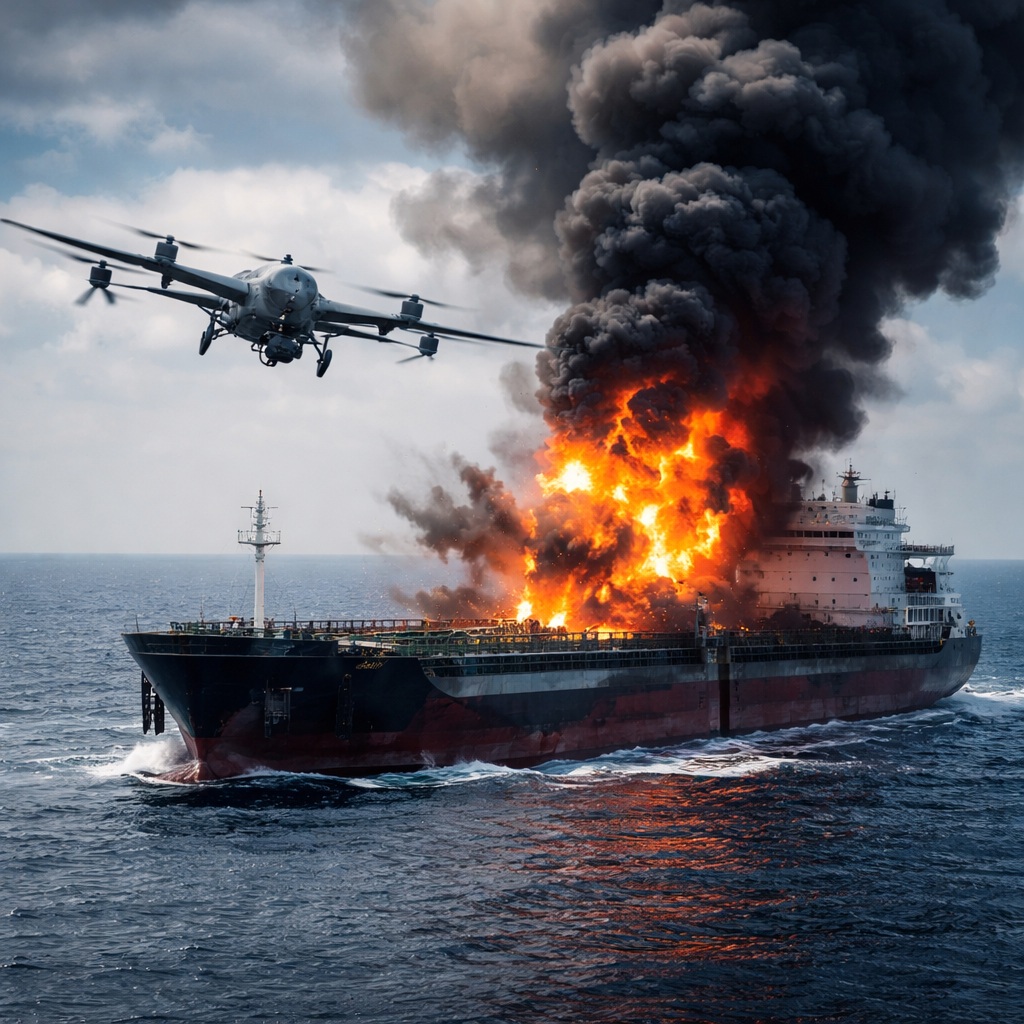
Footage of a Ukrainian drone strike on a Russian tanker intensifies maritime tensions as Moscow vows retaliation and Europe reassesses its support for Kyiv.
Grainy nighttime footage circulating widely on social media and later amplified by Ukrainian officials has placed the Black Sea once again at the center of the war between Russia and Ukraine. The video, filmed from the perspective of an unmanned aerial vehicle, appears to show a Ukrainian drone striking a Russian oil tanker transiting waters used for energy exports. Flames briefly illuminate the hull before the feed cuts out, leaving analysts, diplomats, and markets to assess the broader implications of yet another escalation in a conflict that has increasingly spilled beyond land battlefields.
The incident comes amid heightened maritime tensions in the Black Sea, where commercial shipping, military patrols, and energy infrastructure now operate under constant threat. Ukrainian officials have framed the strike as part of a broader campaign to disrupt Russia’s logistical and economic lifelines, particularly its ability to export oil and refined products despite international sanctions. Kyiv has not officially confirmed all operational details, but senior figures have suggested that targeting vessels supporting Russia’s war economy is both legitimate and necessary.
Moscow’s response has been swift and uncompromising in tone. Russian state television broadcast images of President Vladimir Putin convening security officials, during which he pledged retaliation for what he described as “provocations and attacks on civilian-linked infrastructure.” While details of any response remain vague, the message was unmistakable: Russia intends to reassert deterrence in the Black Sea and beyond.
Russian authorities have sought to downplay the physical damage to the tanker, with transport officials insisting that the vessel remained afloat and that no major oil spill occurred. Nevertheless, the symbolism of the strike has resonated far beyond the immediate incident. Energy traders reacted nervously, insurance premiums for Black Sea routes ticked upward, and shipping companies quietly reviewed contingency plans that many had hoped would remain on paper.
For Ukraine, the release of the video serves both military and political purposes. Militarily, it underscores Kyiv’s growing proficiency in long-range and maritime drone operations, a capability that has allowed it to challenge a larger and better-equipped adversary. Politically, it reinforces Ukraine’s narrative that the war cannot be confined to trenches and front lines while Russia continues to finance its campaign through energy exports.
Western military analysts note that Ukraine’s drone strategy reflects a broader evolution in the conflict. Unable to match Russia ship-for-ship or missile-for-missile, Ukraine has leaned heavily on asymmetric tools that are cheaper, harder to intercept, and psychologically disruptive. The Black Sea, once dominated by Russia’s fleet, has become a contested space where even high-value assets must assume they are being watched.
In Moscow, officials warn that such attacks risk dragging the conflict into a more dangerous phase. Commentators close to the Kremlin have argued that strikes on shipping blur the line between military and civilian targets, potentially inviting harsher reprisals. Some have openly questioned whether Russia should expand its list of legitimate targets to include Ukrainian port infrastructure or energy facilities with renewed intensity.
The episode has also reignited debate in European capitals, where governments are weighing how long and how robustly they can sustain support for Ukraine’s counter-offensive efforts. While public backing for Ukraine remains strong in many countries, concerns are growing about escalation, economic blowback, and the security of energy supplies. The sight of a burning tanker in the Black Sea has sharpened those anxieties.
Diplomats in Brussels and key national capitals have emphasized that continued support for Ukraine is essential to uphold international law and deter aggression. At the same time, there is a quiet recognition that each new strike carries risks that must be managed carefully. Some officials worry that sustained attacks on shipping could provoke retaliatory measures affecting European trade or trigger incidents involving third-country vessels.
Energy security remains a particularly sensitive issue. Although Europe has significantly reduced its dependence on Russian oil and gas, global markets remain interconnected. Any disruption in Black Sea exports has the potential to ripple outward, affecting prices and supply chains well beyond the region. For governments already grappling with inflation and political pressure at home, such risks are not theoretical.
The Black Sea itself has become a microcosm of the wider war: a space where military innovation, economic warfare, and geopolitical signaling collide. From drone boats to aerial strikes, the conflict has transformed the maritime domain into an extension of the front line. International efforts to establish stable shipping corridors have repeatedly faltered, undermined by mistrust and shifting military realities.
As winter deepens, neither side shows signs of backing down. Ukraine continues to argue that pressure must be maintained until Russia’s capacity to wage war is fundamentally weakened. Russia, for its part, insists that it will respond forcefully to any challenge to its interests and sovereignty. Between these positions lies a fragile maritime environment where miscalculation could have consequences far beyond the Black Sea.
For now, the video of the drone strike stands as both evidence and warning. Evidence of how far the war has evolved from its early days, and a warning that the boundaries of the conflict remain fluid. As leaders in Moscow, Kyiv, and European capitals chart their next moves, the waters of the Black Sea remain tense, crowded, and perilously unpredictable.



 The Tower Post