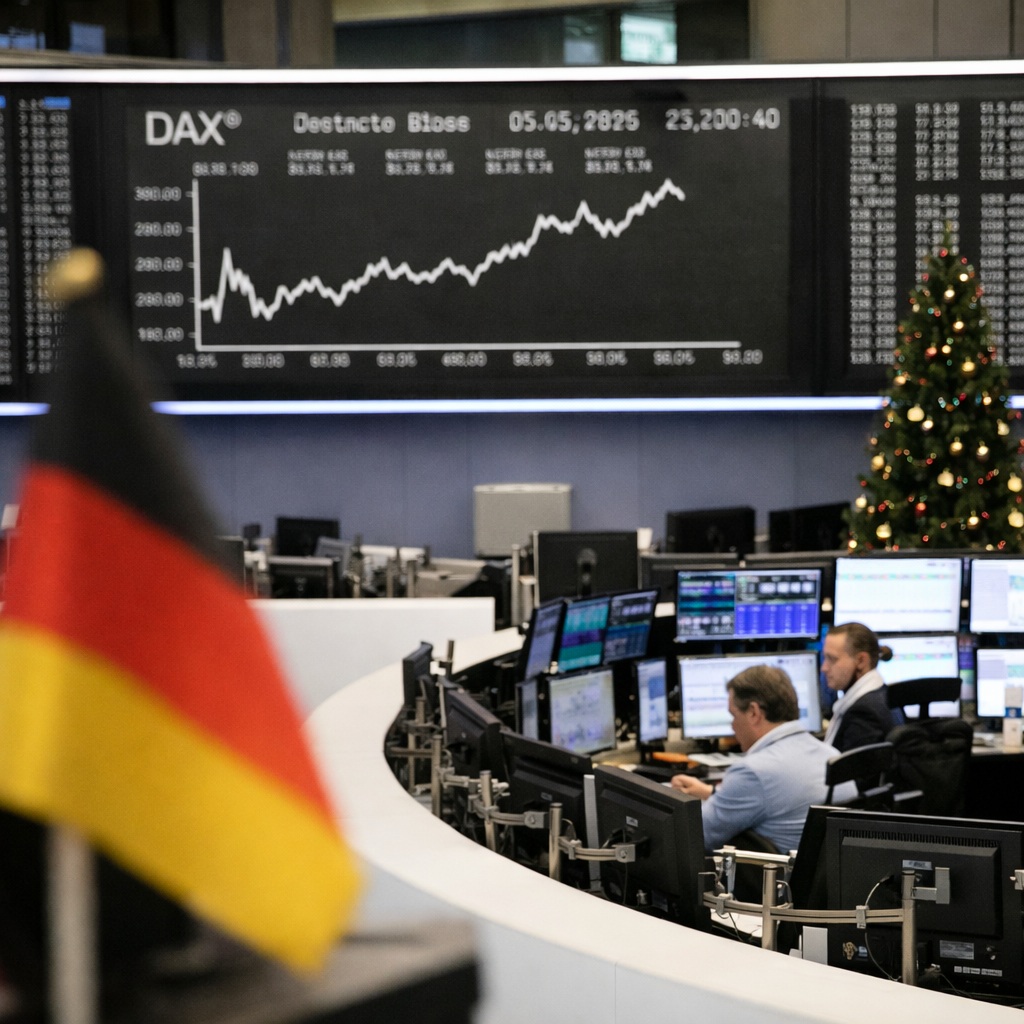
Resilient blue chips and evolving market structures underscore cautious confidence across Europe as year-end trading thins
European equity markets are moving into the final stretch of the year with a calm, almost deliberate tone, as investors weigh optimism about corporate resilience against lingering macroeconomic uncertainties. At the center of this quiet steadiness stands Frankfurt’s benchmark index, which has been hovering near the psychologically important 24,300 level, signaling that Europe’s largest economy remains a pillar of stability for regional markets even as trading volumes thin ahead of the holidays.
The DAX’s ability to hold its ground has become a reference point for investors scanning the continent for direction. In recent sessions, the index has fluctuated within a narrow range, reflecting a balance between profit-taking after a strong year and continued confidence in export-oriented industrials, technology suppliers, and global brands that dominate the German market. This equilibrium has helped anchor broader European equities, preventing sharper swings that often characterize the final days of the trading calendar.
Across Europe, the mood is best described as cautiously constructive. Major indices in Paris, Milan, Madrid, and Amsterdam have shown modest movements, often tracking sector-specific news rather than broad macro shocks. Financial stocks have benefited from expectations that interest-rate normalization is approaching its later stages, while industrials and energy-related names have found support from stable global demand and disciplined cost structures. Meanwhile, consumer-focused stocks have seen more selective interest, reflecting uneven spending patterns across the euro area.
Frankfurt’s resilience carries symbolic weight. Germany’s economy has faced well-documented headwinds in recent years, from energy price volatility to shifting global supply chains. Yet the composition of the DAX, with its heavy exposure to multinational firms earning revenues well beyond Europe, has allowed the index to act as a buffer against domestic weakness. For international investors, this reinforces the perception that European blue chips remain globally competitive, even in a slower-growth environment.
While index levels tell part of the story, market participants are increasingly focused on structural changes shaping Europe’s trading landscape. Euronext, which operates major exchanges across several countries, has been at the center of discussions about how capital markets will evolve in the coming year. Forecasts for 2026 are beginning to reflect diverging views among investors, particularly regarding sector leadership, cross-border capital flows, and the balance between growth and value strategies.
Some investors anticipate that technology-linked and green-transition themes will regain momentum as policy clarity improves and investment cycles lengthen. Others are positioning more defensively, favoring dividends, balance-sheet strength, and predictable cash flows. These differing expectations are now being incorporated into forward-looking market splits, highlighting a more nuanced outlook than the broad-based rallies of previous years.
Year-end trading conditions amplify these dynamics. With many institutional desks operating on reduced schedules, price movements can appear muted, yet they often mask meaningful portfolio adjustments beneath the surface. Fund managers are fine-tuning allocations, locking in gains where appropriate, and positioning for potential volatility in the early months of the new year. In this context, the DAX’s steady performance serves as a barometer of confidence rather than complacency.
Currency and bond markets have also played a role in shaping the equity narrative. A relatively stable euro has removed one source of uncertainty for exporters, while sovereign bond yields have settled into narrower ranges. This backdrop has reduced pressure on equity valuations, allowing stocks to trade more on earnings prospects than on macro fears. For European companies planning capital expenditures or cross-border deals, such stability is quietly supportive.
Looking ahead, investors are aware that the calm of late December rarely sets the tone for the entire year to come. Political developments, fiscal debates, and global growth signals will soon return to the forefront. However, the current steadiness suggests that European markets are entering the new year from a position of balance rather than stress. The DAX’s hold near a key technical level encapsulates this sentiment: not exuberant, but firmly grounded.
As trading draws toward its seasonal pause, Europe’s equity markets appear content to consolidate. The focus is shifting from short-term fluctuations to longer-term structure—how exchanges evolve, how sectors diverge, and how capital is allocated in a changing economic landscape. In that sense, the quiet around Frankfurt’s benchmark may prove less a moment of indecision and more a pause before the next chapter in Europe’s market story.



 The Tower Post