
As French influence wanes, Germany’s chancellor steps forward amid turbulence at home and across the EU.
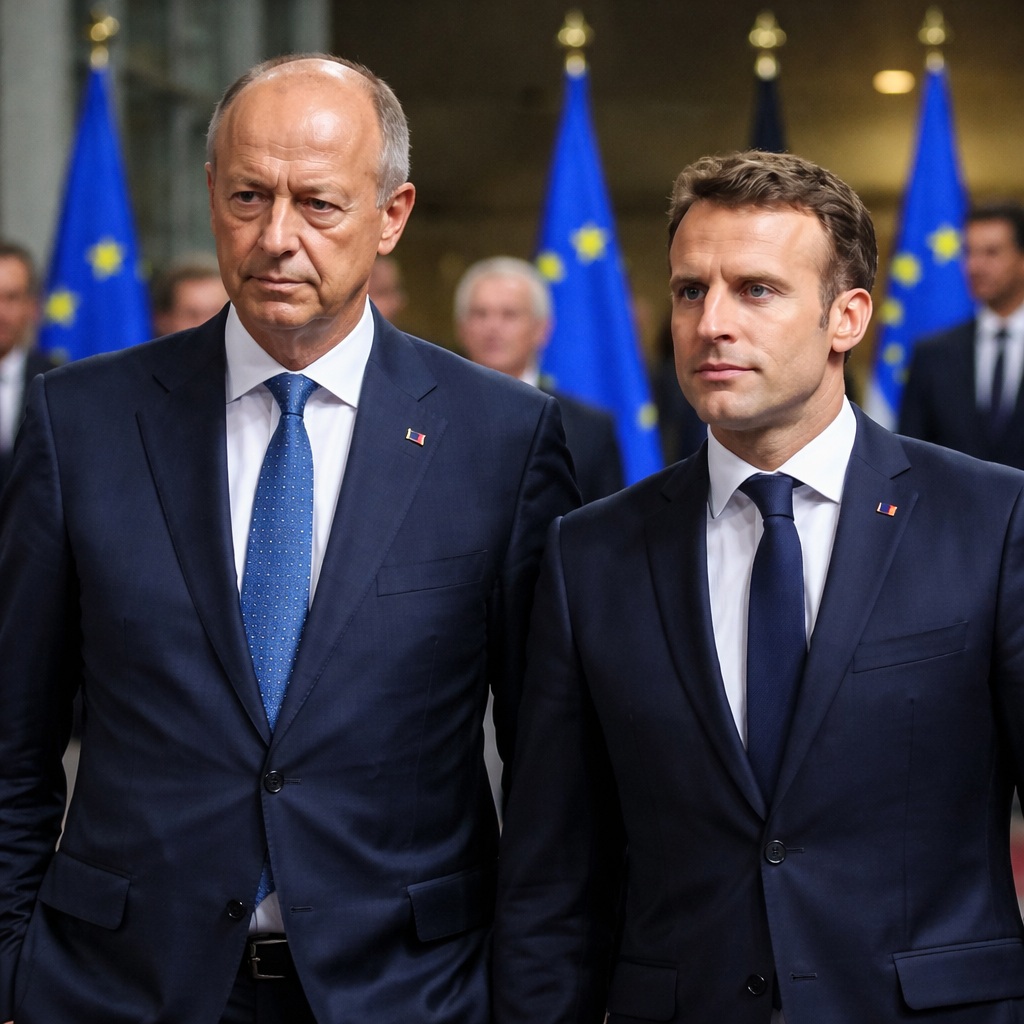
Berlin and Brussels — Europe’s political center of gravity is shifting again. German Chancellor Friedrich Merz is moving decisively to place himself at the forefront of European leadership, testing the long‑standing dominance of France and its president, Emmanuel Macron. The effort comes at a moment of unusual fragility for the European Union, when war on its borders, economic unease, and internal political fragmentation are forcing leaders to redefine authority and direction.
For much of the past decade, Paris set the tone of Europe’s strategic debate. Macron’s vision of European “strategic autonomy,” his activism on defense and industrial policy, and his readiness to speak when others hesitated made France the Union’s most vocal power. Today, that voice carries less weight. Domestic constraints in France, coupled with diplomatic fatigue among partners, have opened space for Berlin to step forward.
Merz, a conservative with a reputation for bluntness and discipline, is exploiting that opening. Since taking office, he has emphasized reliability over rhetoric, positioning Germany as the anchor of European stability at a time when predictability has become scarce. In private meetings with EU leaders and in public interventions, he has framed Germany as the indispensable broker between east and west, north and south — a role Berlin historically embraced but rarely advertised.
At the heart of Merz’s strategy is a recalibration of power. Where Macron has often favored bold proposals and grand visions, the German chancellor is focusing on execution: defense procurement that actually delivers equipment, fiscal rules that can survive political pressure, and migration policies that respond to voter anxiety without fracturing the Union. This pragmatic tone has resonated with governments exhausted by permanent crisis management.
Security policy is the most visible arena of competition. Germany’s push for deeper coordination of European defense industries, combined with its growing military commitments, has begun to rival French influence in shaping the continent’s strategic posture. Merz has argued that leadership in Europe must be earned through capacity, not charisma — a pointed contrast with Paris’s more theatrical diplomacy.
Economic policy offers another opening. As growth slows and social tensions rise, Merz has presented Germany as the guardian of fiscal credibility. While critics accuse him of reviving austerity under a different name, supporters say his insistence on discipline reassures markets and smaller member states alike. In Brussels, officials increasingly note that when Berlin speaks, capitals listen — even if they do not always agree.
Yet Merz’s ambitions face serious constraints at home. Germany itself is politically divided, with regional elections exposing voter frustration over energy prices, immigration, and the pace of reform. Coalition tensions limit how far the chancellor can move without risking domestic backlash. Every European initiative must first survive scrutiny from a skeptical electorate wary of open‑ended commitments.
Across the EU, the environment is no less volatile. Populist parties are stronger than at any point in recent memory, complicating consensus‑building. Southern states fear renewed fiscal rigidity, eastern members demand tougher security guarantees, and northern governments remain cautious about shared liabilities. In this fragmented landscape, leadership is less about command than endurance.
Macron, for his part, has not relinquished the field. France remains a nuclear power with global diplomatic reach, and the president continues to advocate for a Europe capable of acting independently on the world stage. But the contrast is increasingly stark: where Macron proposes, Merz consolidates; where Paris inspires, Berlin stabilizes.
Whether Merz can truly unseat Macron as Europe’s leading voice remains uncertain. Leadership in the EU has always been situational, shaped by crises as much as by personalities. Still, the momentum is unmistakable. As Europe approaches another winter of geopolitical and economic strain, many governments appear more inclined to follow the steady hand from Berlin than the visionary calls from Paris.
The rivalry is not a zero‑sum game, but it is redefining the balance of power at the heart of Europe. If Merz succeeds, the Union’s future may be guided less by soaring ambition and more by hard‑nosed pragmatism — a shift that could mark a new chapter in European leadership.



 The Tower Post