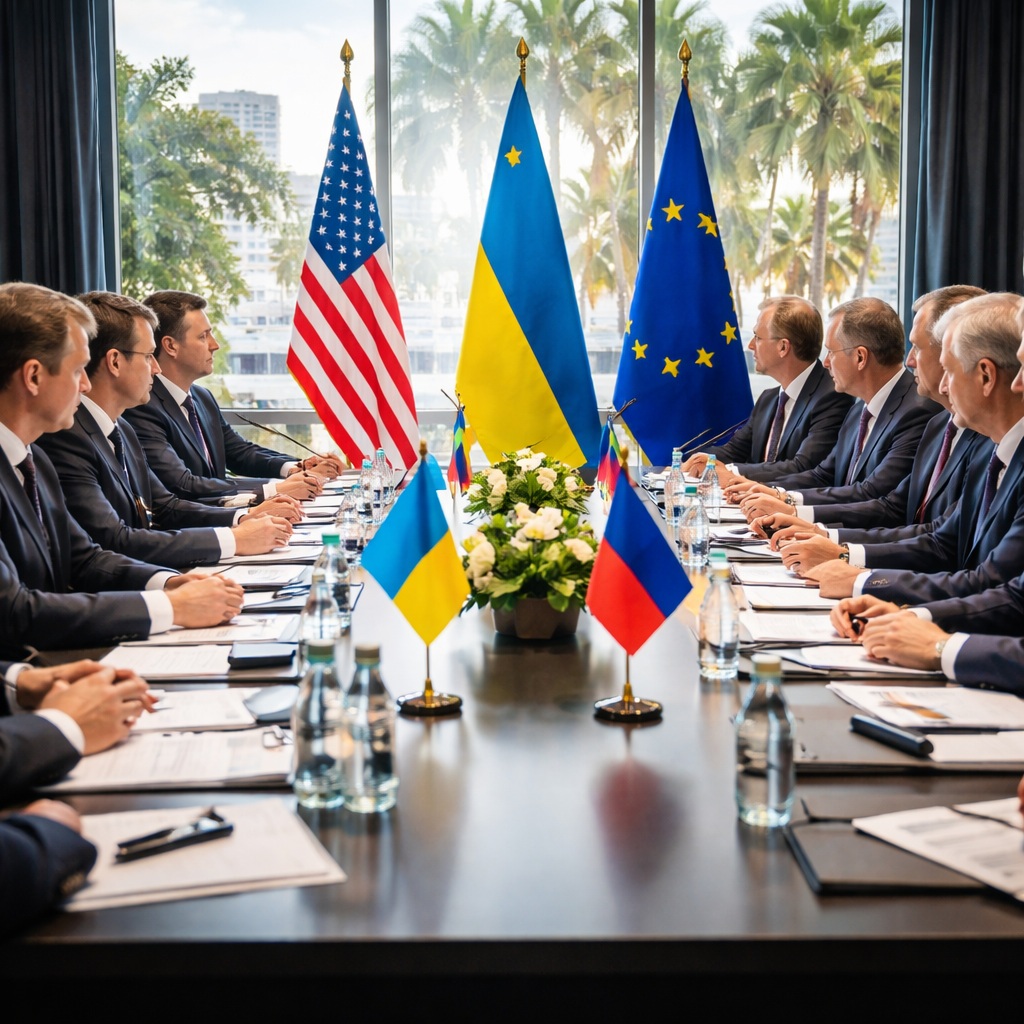
Russian envoy says U.S.-proposed negotiations are proceeding constructively as diplomacy unfolds alongside ongoing war
Miami — Diplomatic efforts aimed at ending the war in Ukraine edged forward this week as negotiations around a U.S.-proposed peace framework continued in Miami, with Russian officials describing the atmosphere as constructive and serious.
Kirill Dmitriev, a senior Russian envoy involved in the discussions, said talks with American interlocutors were moving ahead in a “pragmatic and professional” manner. According to Dmitriev, delegations remained engaged through the weekend, signaling a rare moment of sustained dialogue after months of limited contact between Washington and Moscow.
The talks, held away from traditional diplomatic centers, reflect a broader attempt by the United States to reassert a mediating role in a conflict that has settled into grinding warfare across multiple fronts. While no breakthroughs were announced, participants emphasized the importance of maintaining open channels at a time when battlefield dynamics and political pressures continue to evolve.
Ukrainian President Volodymyr Zelenskyy acknowledged that the diplomatic track may proceed in stages. Speaking to journalists, he noted that U.S. negotiators could hold parallel discussions with Russian representatives and later widen the format to include European envoys. Such an expansion, Ukrainian officials argue, would be essential to address security guarantees, reconstruction commitments, and the broader regional balance.
Despite the cautious tone, expectations remain tightly managed. The war continues to exact a heavy toll, with intense fighting reported along eastern and southern lines. Neither side has softened its public stance on territorial questions, which remain the most contentious obstacle to any comprehensive settlement.
Western diplomats familiar with the Miami discussions describe them as exploratory rather than decisive. The U.S. proposal under review reportedly outlines phased steps toward de-escalation, humanitarian access, and eventual ceasefire mechanisms, without prescribing immediate political outcomes. This approach, officials say, is designed to test whether limited consensus can be built before tackling core disputes.
For Moscow, participation in the talks offers an opportunity to reframe engagement with Washington amid strained relations. Dmitriev suggested that constructive dialogue could help “reduce strategic miscalculations,” even if fundamental disagreements persist. Russian officials, however, continue to insist that any peace plan must reflect what they describe as “new realities on the ground,” a phrase Kyiv firmly rejects.
Ukraine’s leadership has reiterated that sovereignty and territorial integrity remain non-negotiable. Zelenskyy’s aides caution that diplomacy cannot come at the expense of international law, and they stress that any process must include Ukraine as an equal party, not merely as the subject of great-power bargaining.
European governments are watching closely. Several have signaled readiness to support an expanded negotiating format, provided it aligns with Kyiv’s positions. Analysts note that Europe’s eventual involvement would be critical, both to lend legitimacy to any agreement and to shoulder long-term security and economic commitments.
As the year draws to a close, the Miami talks underscore a familiar tension: diplomacy advancing incrementally while the war grinds on. Whether these discussions mark the beginning of a sustained peace process or another tentative opening remains uncertain. For now, officials on all sides emphasize continuity over conclusion, keeping the door open to dialogue even as the conflict shows few signs of immediate resolution.



 The Tower Post