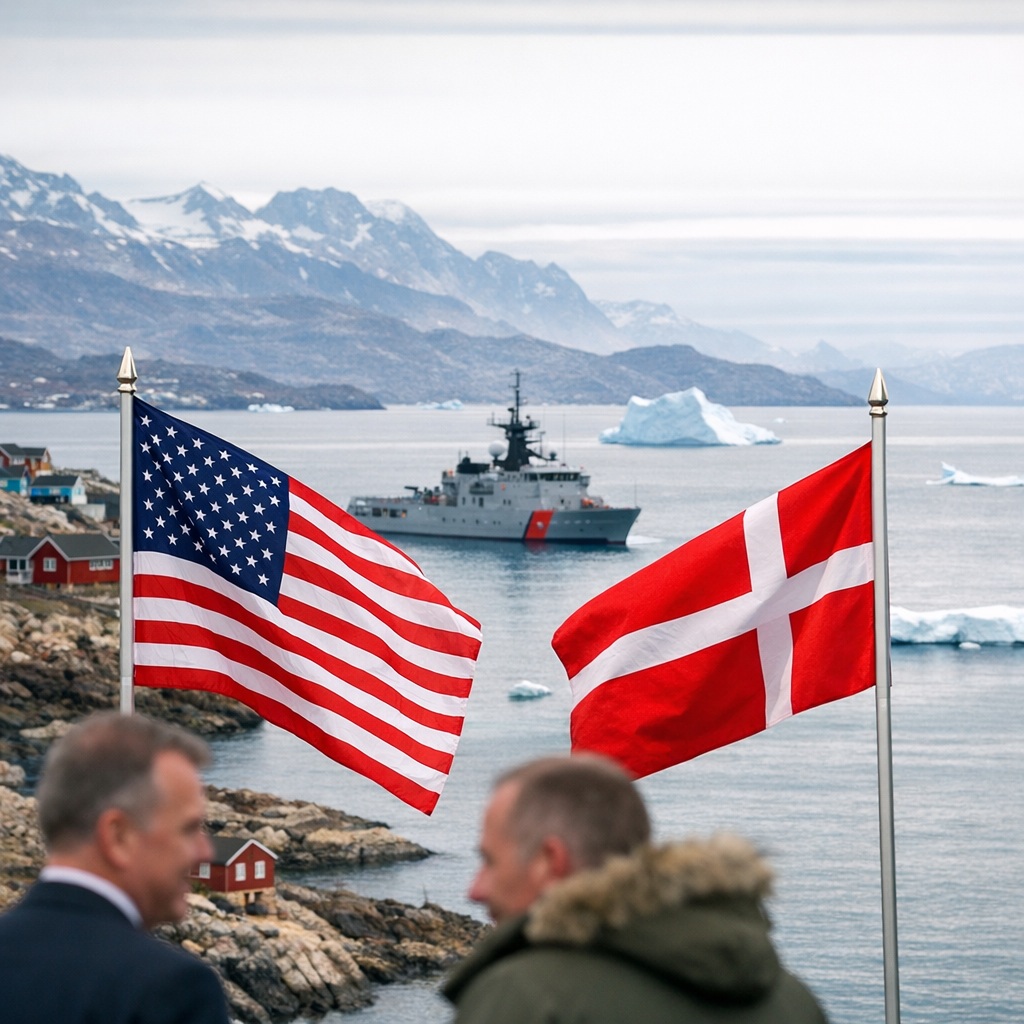
Copenhagen says the move signals renewed American focus on the Arctic, while stressing that Greenland’s future remains a matter of Danish sovereignty and international law.
Copenhagen woke to a familiar unease as Washington announced the appointment of a dedicated United States envoy to Greenland, a move that Danish officials describe as politically loaded even if diplomatically framed. The reaction from Denmark was swift, measured, and unmistakably firm: interest is welcome, interference is not.
In public statements, Danish leaders underlined that the decision reflects sustained American attention toward the Arctic and the North Atlantic, a region whose strategic value has grown dramatically in recent years. Yet they also made clear that Greenland, while enjoying extensive self-rule, remains part of the Kingdom of Denmark, and that any engagement by foreign powers must respect that constitutional reality.
The announcement has reopened a sensitive chapter in transatlantic relations. Greenland, the world’s largest island, has long occupied a quiet corner of international politics. That has changed. Melting ice, emerging shipping routes, rare-earth resources, and military positioning have pushed the Arctic from the margins to the center of geopolitical planning in both Washington and Brussels.
For Denmark, the appointment of a US envoy is interpreted less as a surprise than as a continuation of an established pattern. American interest in Greenland has intensified over successive administrations, driven by security concerns and economic calculations. What differs now is the symbolism: naming a specific envoy elevates Greenland from a regional issue to a standing item on Washington’s diplomatic agenda.
Danish officials have been careful to strike a diplomatic tone. They acknowledge the United States as a close ally within NATO and emphasize the importance of cooperation on defense, climate research, and Arctic stability. At the same time, Copenhagen insists that dialogue with Greenland must proceed through agreed frameworks, not unilateral initiatives that could be read as bypassing Danish authority or Greenlandic institutions.
Greenland’s own leaders have responded with caution. While welcoming international investment and cooperation, they are wary of becoming a pawn in great-power competition. The island’s political discourse increasingly balances aspirations for greater autonomy with pragmatic concerns about economic dependency and security guarantees. The appointment of a US envoy adds another layer to that delicate equation.
Within European Union and NATO circles, the development is being closely watched. The Arctic is no longer perceived as a remote frontier but as a strategic corridor linking North America, Europe, and Asia. As tensions persist elsewhere in the world, policymakers fear that the High North could become a theater of competition rather than cooperation.
Denmark, which often acts as the EU’s Arctic voice through its relationship with Greenland, has quietly urged partners to remain engaged. European officials see the region as critical for climate monitoring, energy security, and the protection of indigenous communities. There is also concern that a fragmented Western approach could leave space for other global actors to expand their influence.
Security analysts point out that Greenland already hosts significant military infrastructure tied to transatlantic defense. Early-warning systems, satellite tracking, and airspace monitoring are central to NATO’s northern posture. From Washington’s perspective, a dedicated envoy could streamline coordination and reinforce commitments. From Copenhagen’s perspective, however, it risks creating parallel channels of influence.
The timing of the announcement has amplified its resonance. As the year draws to a close, governments are taking stock of shifting alliances and unresolved crises. In Denmark, the news landed amid broader debates about national security spending, Arctic policy, and the balance between sovereignty and globalization.
Public opinion in Denmark remains divided. Some commentators argue that closer US engagement strengthens deterrence and benefits Greenland’s economy. Others warn that excessive American visibility could fuel tensions with other powers and undermine Denmark’s role as a responsible steward of Arctic governance.
For Washington, the message has been cautiously optimistic. Officials emphasize partnership, respect, and shared values, framing the envoy’s role as a bridge rather than a wedge. Yet the memory of past controversies lingers, making Danish leaders keen to set clear boundaries early.
What emerges from Copenhagen’s response is a careful balancing act. Denmark does not reject American interest; it seeks to manage it. By reaffirming sovereignty while acknowledging geopolitical realities, Danish officials aim to keep Greenland anchored within a cooperative Western framework rather than at the center of rivalry.
As winter settles over the Arctic, the diplomatic climate remains anything but frozen. Greenland’s rising profile ensures that it will remain a focal point in strategic discussions, not only between Denmark and the United States, but across Europe and the broader alliance system. For now, Copenhagen’s message is clear: engagement must come with respect, and attention must not eclipse sovereignty.

 The Tower Post