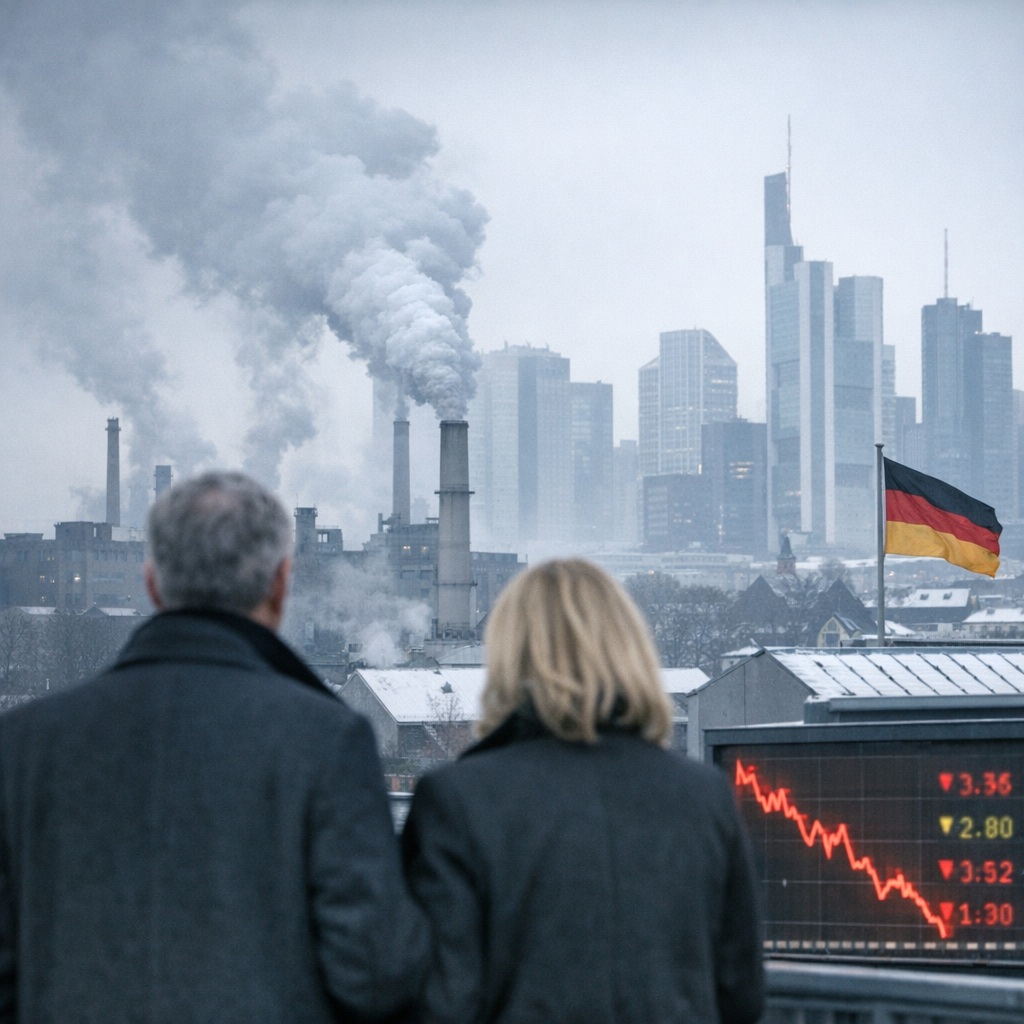
A December survey from the Ifo Institute shows confidence among German firms weakening again, highlighting persistent economic stagnation, delayed reforms and policy uncertainty as the country heads into the winter break.
As Germany moves into the final days of the year, a familiar unease has settled over its corporate sector. Business confidence has softened once more, according to the latest survey from the Ifo Institute, underlining the sense that Europe’s largest economy remains stuck in low gear despite repeated hopes of a turnaround.
The closely watched sentiment indicator shows that German companies are growing more cautious about the months ahead. While assessments of current conditions have held up slightly better, expectations for the future have deteriorated, reflecting a mix of weak demand, high costs and frustration over political indecision. The picture that emerges is not one of acute crisis, but of a prolonged malaise that has become increasingly difficult to ignore.
Manufacturing, the backbone of the German economy, remains at the centre of concern. Export-oriented firms report subdued order books, squeezed margins and little sign that global demand will provide quick relief. Rising competition from abroad, particularly in energy-intensive and high-technology sectors, has added to the pressure. Many executives say that even when orders come in, uncertainty over energy prices, regulation and supply chains makes long-term planning risky.
The service sector, which has offered some stability in recent quarters, is also showing signs of fatigue. Companies in logistics, retail and business services point to cautious consumers and clients who are delaying spending decisions. Inflation has eased from its peak, but higher interest rates continue to weigh on investment and big-ticket purchases. As a result, confidence is eroding even in areas that had previously been more resilient.
Construction remains one of the weakest links. High financing costs and stricter lending conditions have dampened demand for new projects, while public infrastructure investment has been slow to gain momentum. Firms in the sector report that order pipelines are thinning, reinforcing fears that the downturn in building activity could persist well into the coming year.
Beyond sector-specific challenges, the Ifo survey highlights a broader source of unease: policy uncertainty. Business leaders repeatedly cite a lack of clear direction from Berlin on key economic issues, from energy strategy and climate policy to taxation and labour market reform. While the need for structural reforms is widely acknowledged, progress has been uneven, and compromises within the governing coalition have often resulted in delayed or diluted measures.
This sense of drift is weighing on expectations. Executives say that without clearer signals on future policy, they are reluctant to commit to major investments, particularly those linked to the green transition or digital transformation. The result is a self-reinforcing cycle: weak confidence curbs investment, which in turn limits growth and reinforces pessimism.
Germany’s economic stagnation has broader implications for Europe. As the bloc’s largest economy, its subdued performance acts as a drag on regional growth at a time when external risks remain elevated. Geopolitical tensions, fragile global trade and uncertain financial conditions continue to cloud the outlook, making a swift rebound increasingly unlikely.
Still, some analysts caution against excessive gloom. Labour markets have remained relatively robust, and many firms have adapted to recent shocks better than expected. There is also hope that easing inflation and gradual improvements in global demand could provide modest support in the months ahead. Yet few see these factors as sufficient on their own to restore strong momentum.
As the year comes to a close, the latest Ifo results serve as a reminder that Germany’s economic challenges are structural as well as cyclical. Businesses are not calling for short-term stimulus alone, but for a clearer, more coherent strategy to address competitiveness, energy costs and innovation. Until that emerges, confidence is likely to remain fragile.
For now, the mood across boardrooms is one of cautious endurance rather than optimism. With factories quieting for the holidays and offices preparing for a brief pause, many executives are hoping that the new year will bring not just renewed activity, but the decisive policy action needed to break the cycle of stagnation.
 The Tower Post