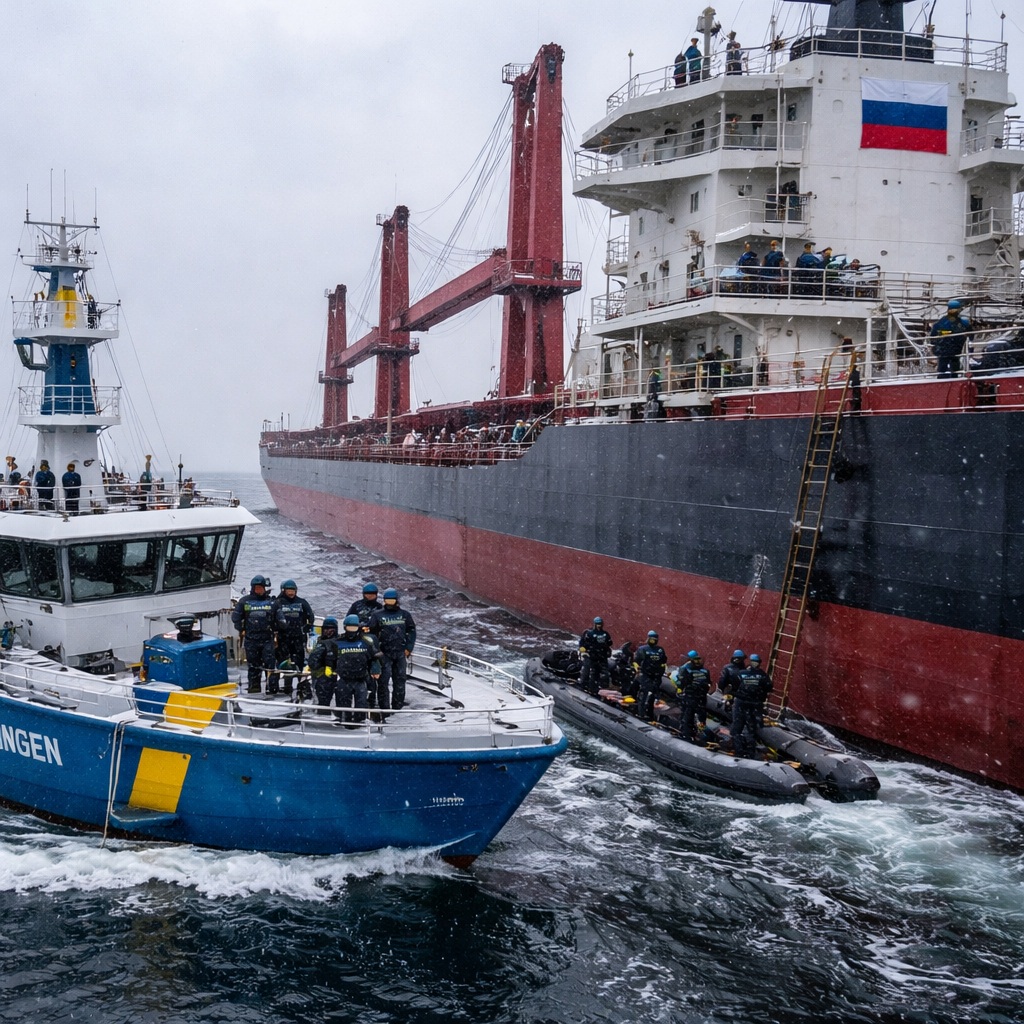
Stockholm Signals Resolve as EU Maritime Sanctions Are Put to the Test
In the muted light of a Nordic winter, Swedish authorities took a step that resonated far beyond the icy waters of the Baltic Sea. Customs and maritime officials boarded a Russian-flagged vessel transiting Swedish territorial waters, a ship already listed under European Union sanctions. The operation, conducted calmly but decisively, sent a clear signal: EU measures are not symbolic, and enforcement does not pause for the season.
The boarding unfolded against a backdrop of heightened geopolitical tension, as Europe continues to navigate security concerns, trade restrictions, and the complex realities of maritime enforcement. While Swedish officials refrained from theatrical displays, the message was unmistakable. The vessel’s presence in national waters triggered a response rooted in law, coordination, and a growing determination across EU member states to uphold sanctions integrity.
A ROUTINE INSPECTION WITH STRATEGIC WEIGHT
According to Swedish authorities, the operation followed established procedures. The ship was intercepted in accordance with national jurisdiction and EU regulations, with customs officers verifying documentation, cargo manifests, and compliance with restrictive measures imposed on Russian-linked maritime assets. No dramatic confrontation was reported, but the inspection itself carried significant symbolic and legal weight.
Sanctions targeting Russian shipping have become a critical component of Europe’s broader response to security threats and contested trade practices. Maritime routes, long seen as opaque and difficult to police, have increasingly moved to the center of enforcement strategies. Swedish officials emphasized that the boarding was neither arbitrary nor exceptional, but part of an expanded monitoring effort in regional waters.
BALTIC SEA UNDER CLOSER SCRUTINY
The Baltic Sea has emerged as a focal point in the EU’s sanctions architecture. Dense commercial traffic, proximity to sensitive infrastructure, and the presence of vessels operating under complex ownership structures have made the region a testing ground for regulatory resolve. Swedish customs, working alongside coast guard and intelligence counterparts, have intensified surveillance in response to concerns over sanctions evasion and dual-use cargoes.
Analysts note that sanctioned vessels often rely on legal grey zones, flags of convenience, or indirect ownership to continue operating. Boarding operations, even when no violations are immediately uncovered, disrupt those strategies. They also reinforce the principle that national waters are not safe corridors for ships seeking to sidestep EU law.
TRADE, SECURITY, AND LEGAL AUTHORITY
Sweden’s action reflects a broader EU effort to link trade enforcement more closely with security policy. Sanctions are no longer confined to financial institutions or export controls; they extend to logistics chains, ports, insurers, and shipping operators. By asserting control over its waters, Sweden demonstrated how national authorities serve as the frontline of a collective European framework.
Legal experts underline that such boardings require careful calibration. Authorities must balance freedom of navigation with sovereign rights and international law. In this case, Swedish officials stressed that the operation complied fully with maritime conventions, reinforcing its legitimacy and limiting diplomatic friction.
A SEASONAL MOMENT, A STRATEGIC MESSAGE
The timing of the boarding, as Europe moves into the winter holidays, added a quiet poignancy. While much of the continent slows down, enforcement agencies remain active, underscoring that sanctions regimes are continuous by design. For policymakers in Brussels and national capitals alike, the incident offered reassurance that measures adopted on paper are being applied on the water.
For Moscow, the message was equally clear. Even routine transits through EU waters can invite scrutiny when vessels fall under restrictive regimes. The days of unchallenged passage for sanctioned ships appear increasingly limited.
LOOKING AHEAD
Swedish authorities have indicated that inspections and monitoring will continue, particularly in strategically sensitive maritime zones. The boarding of the sanctioned Russian vessel may not result in immediate penalties or seizures, but its broader impact lies in deterrence and precedent.
As the year draws to a close, the episode stands as a reminder that Europe’s sanctions policy is not abstract. It is enforced ship by ship, port by port, and patrol by patrol. In the cold waters of the Baltic, Sweden has shown that vigilance remains very much alive.




 The Tower Post