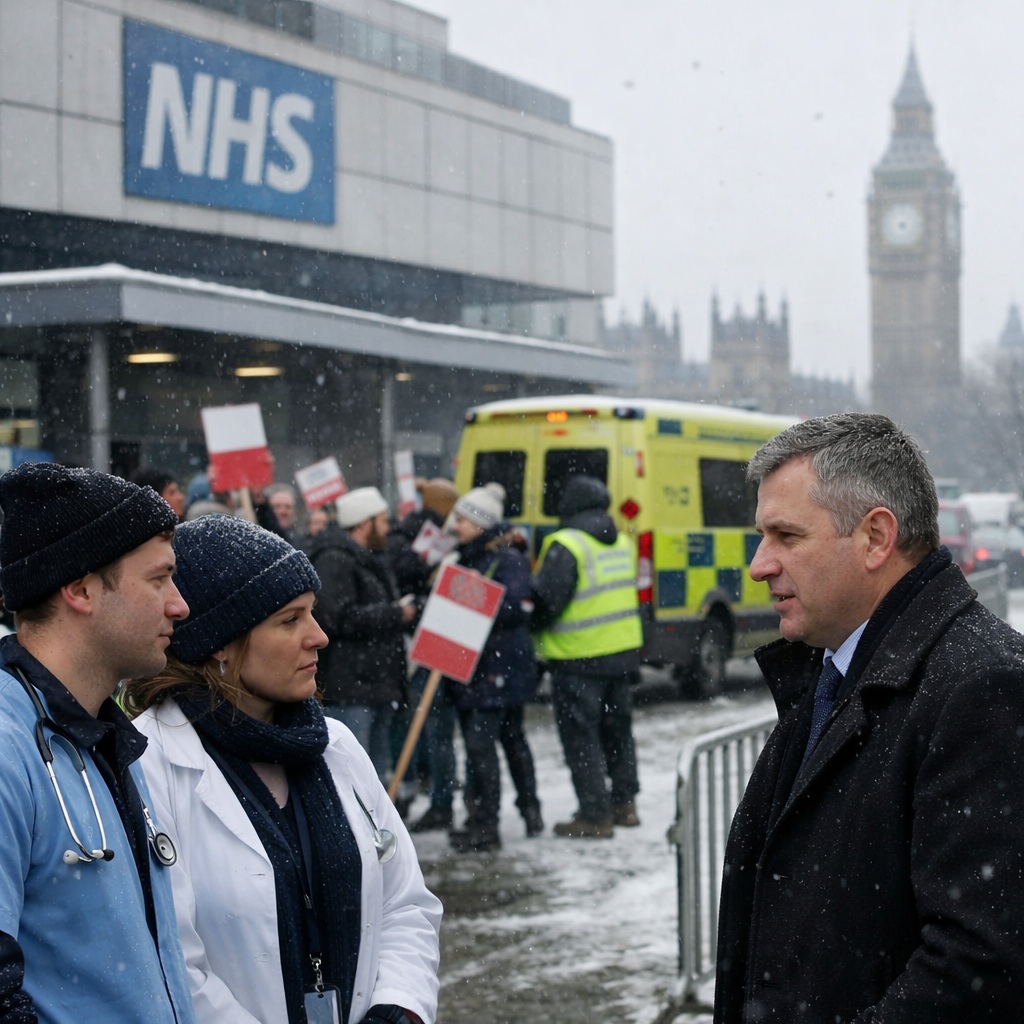
Winter pressures, political tension in Westminster, and wider European security concerns shape a critical moment for Britain’s National Health Service.
On Christmas Eve, Britain’s hospitals are once again under strain. Corridors are crowded, emergency departments are stretched, and ministers are keenly aware that the seasonal crisis in healthcare has become a political test as much as a medical one. Against this backdrop, the UK health minister has vowed to prevent a renewed wave of doctors’ strikes, signalling a renewed effort to stabilise the National Health Service and restore confidence after months of industrial unrest.
The pledge comes as memories of last winter’s stoppages remain fresh. Junior doctors and consultants had repeatedly walked out over pay, conditions, and staffing levels, disrupting routine care and adding to already lengthy waiting lists. Although temporary agreements brought a fragile calm, unions have warned that unresolved disputes could reignite action. This winter, the government is determined not to let history repeat itself.
In public statements, the health minister has emphasised dialogue over confrontation, promising “constructive engagement” with medical unions and a clearer long-term workforce plan. Privately, officials acknowledge that the political cost of renewed strikes would be high. The NHS remains one of Britain’s most trusted institutions, and any perception that the government is failing to protect it risks alienating voters across party lines.
Yet the challenge is not merely domestic. Britain’s healthcare debate is unfolding amid broader European political pressures that are shaping policy choices in Westminster. Economic uncertainty across the continent, concerns over energy security, and the evolving security landscape in Europe all feed into budgetary decisions at home. Defence spending commitments within NATO, for example, limit fiscal flexibility, intensifying competition between public services for funding.
In Parliament, tensions between Labour and the Conservatives have sharpened as winter deepens. The opposition has accused the government of complacency, arguing that staff shortages and morale problems are the inevitable result of years of underinvestment. Ministers counter that they are inheriting structural problems while trying to balance fiscal responsibility with urgent social needs. Health policy has become a focal point in this wider ideological clash, symbolising competing visions of the state’s role.
The NHS workforce lies at the heart of the dispute. Doctors describe exhaustion, eroded real wages, and a sense that their concerns are acknowledged rhetorically but not addressed in practice. The government’s strategy hinges on incremental pay adjustments, recruitment drives, and promises of reform. Whether these measures will be sufficient to avert strikes remains uncertain, particularly as inflationary pressures continue to affect household budgets.
Beyond Westminster, Europe’s geopolitical landscape casts a longer shadow. In EU and NATO circles, attention has increasingly turned northwards, to the Arctic and its strategic significance. The Arctic island of Greenland, though distant from Britain’s hospitals, features prominently in discussions about security, climate change, and great-power competition. Melting ice has opened new shipping routes and sharpened interest in natural resources, drawing the focus of European governments and alliances alike.
For London, these developments matter. As a key NATO member, the UK is expected to contribute to collective security efforts, even as it grapples with domestic challenges. Policymakers are acutely aware that international credibility depends not only on military strength but also on social resilience at home. A health system paralysed by strikes would undermine the image of stability that Britain seeks to project abroad.
As Christmas approaches, the government’s message is one of reassurance. Ministers insist that talks with doctors are ongoing and that contingency plans are in place to protect patients. Hospital managers, however, warn that goodwill alone cannot compensate for chronic staffing gaps. The coming weeks will test whether political promises can translate into tangible improvements on the ground.
For patients and staff alike, the stakes are immediate and personal. Avoiding renewed strikes would offer a respite during the most demanding period of the year. Failure, by contrast, would deepen public frustration and fuel political discord. On this winter’s edge, Britain’s health service once again reflects the broader pressures facing the country: stretched resources, contested priorities, and the challenge of navigating domestic needs in an increasingly complex European and global context.



 The Tower Post