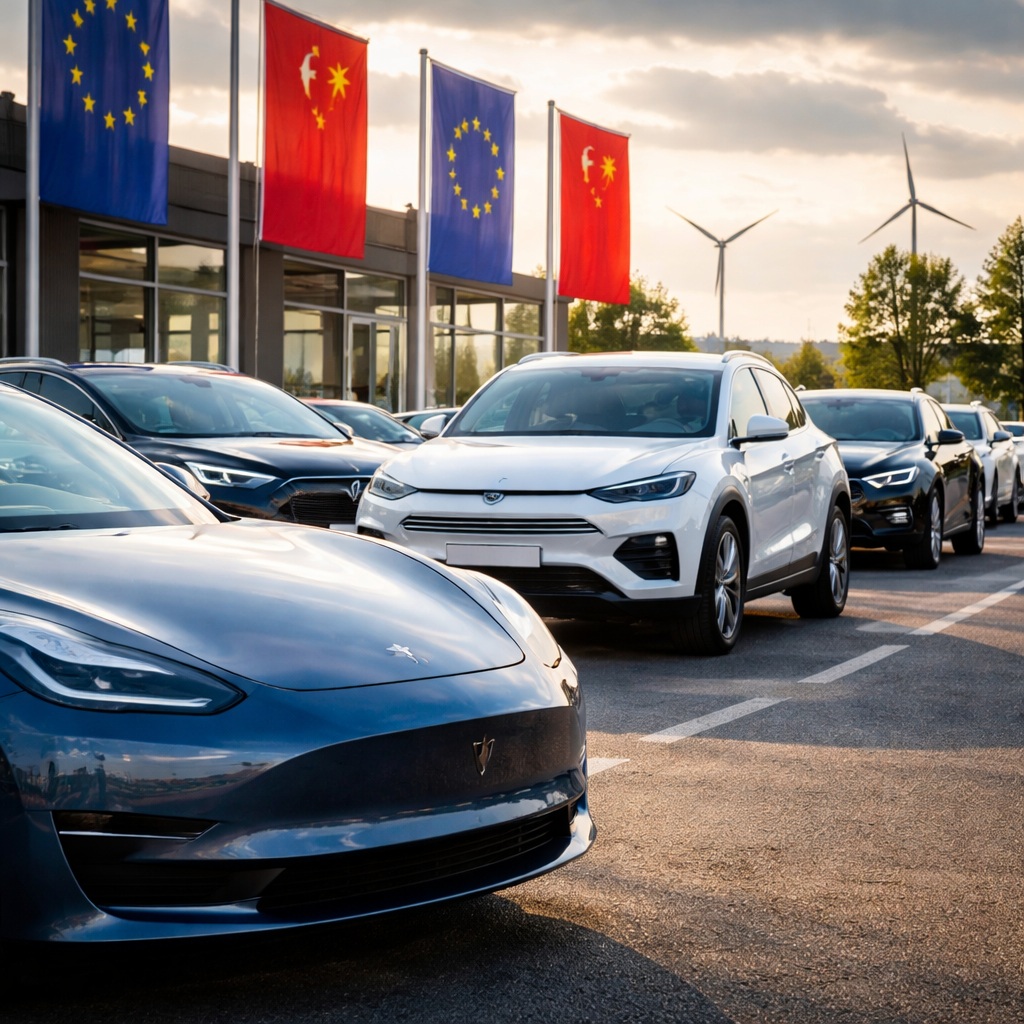
Tesla’s European registrations plunge 34% amid rising Chinese EV competition and shifting market dynamics.

Europe — As the holiday season settles over the continent, Europe’s electric vehicle market is undergoing a profound transformation. Once the undisputed leader of the region’s EV revolution, Tesla is now facing a sharp reversal of fortunes. New vehicle registrations for the American automaker across the European Union have fallen by roughly 34%, marking one of its steepest regional declines to date. The drop comes at a time when overall electric vehicle adoption continues to expand — but increasingly to the benefit of Tesla’s rivals, particularly fast‑rising Chinese manufacturers.
The figures illustrate a broader shift in competitive balance. While European consumers continue to embrace electrification, their choices are becoming more diverse. Where Tesla once dominated with a limited number of high‑profile models, buyers are now confronted with an expanding range of alternatives offering competitive pricing, varied body styles, and increasingly sophisticated technology.
A Market Growing — Without Tesla
The decline in Tesla’s registrations is not the result of a shrinking EV market. On the contrary, battery‑electric vehicles continue to account for a growing share of new car sales across the EU. Urban emissions restrictions, government incentives, and expanding charging infrastructure have reinforced the long‑term trajectory toward electrification.
What has changed is who benefits from that growth. Chinese manufacturers have emerged as the most dynamic force in the market, rapidly increasing their European presence. Brands such as BYD and MG have recorded triple‑digit growth rates in some countries, capturing consumers with vehicles that undercut Western rivals on price while matching or exceeding them on range, connectivity, and standard equipment.
Industry analysts note that Chinese automakers have benefited from years of intense domestic competition, which forced rapid innovation, cost discipline, and scale. As a result, they have entered Europe with mature products and flexible manufacturing strategies, allowing them to respond quickly to shifting demand.
Tesla’s Structural Headwinds
Tesla’s European slowdown reflects deeper structural challenges. The company’s product lineup remains relatively narrow compared with both Chinese newcomers and established European brands. While updates to existing models have improved efficiency and software capabilities, they have done little to fundamentally broaden Tesla’s appeal across diverse market segments.
Pricing has also become a delicate balancing act. Tesla has implemented multiple price adjustments in recent years, seeking to stimulate demand without eroding margins. However, repeated cuts have narrowed the gap with competitors that already operate with lower cost bases, particularly those producing vehicles in China.
In addition, consumer expectations have evolved. Early adopters were drawn to Tesla’s minimalist interiors, over‑the‑air software updates, and charging ecosystem. Today’s buyers increasingly prioritize build quality, cabin refinement, localized service networks, and brand reassurance — areas where both European legacy brands and Chinese entrants have invested heavily.
The Rise of Chinese EV Brands
Chinese automakers’ success in Europe is no longer limited to niche segments. Their vehicles now span compact city cars, family sedans, and SUVs, many tailored specifically to European tastes. Design studios in Europe, multilingual infotainment systems, and region‑specific safety features have helped ease concerns about unfamiliar brands.
Equally important is pricing strategy. In an environment shaped by inflation and cautious consumer spending, value has become a decisive factor. Chinese EVs frequently offer longer driving range and richer standard specifications at prices thousands of euros below comparable Western models, reshaping perceptions of what constitutes good value in the electric era.
Policy and Political Undercurrents
The rapid advance of Chinese EVs has not gone unnoticed by policymakers. European governments and institutions are debating how to balance open markets with industrial competitiveness. Discussions around tariffs, subsidies, and local manufacturing requirements have intensified, reflecting concerns over supply chains, employment, and strategic autonomy.
At the same time, European automakers are accelerating their own EV strategies. Volkswagen, Renault, and BMW have expanded electric lineups, invested in battery production, and sought partnerships to close cost gaps. The competition now unfolding is not simply between individual brands, but between industrial ecosystems.
A Defining Moment for Tesla
For Tesla, Europe’s shifting landscape represents a defining test. The company retains strong brand recognition, a loyal customer base, and a reputation for technological leadership. Yet the market it once helped create is now far more crowded, price‑sensitive, and unforgiving.
Whether Tesla can regain momentum will depend on its ability to innovate beyond incremental updates, diversify its product range, and adapt to local expectations. New models, refreshed designs, or localized production strategies could help restore competitiveness — but time is no longer on its side.
Looking Ahead
As the year draws to a close, Europe’s EV market stands at a crossroads. Tesla’s sales slide underscores how quickly leadership can change in a sector driven by scale, speed, and cost efficiency. For consumers, intensified competition is delivering more choice and lower prices. For manufacturers, the battle for Europe’s electric future has entered a decisive and uncertain phase — one that will shape the industry for years to come.




 The Tower Post