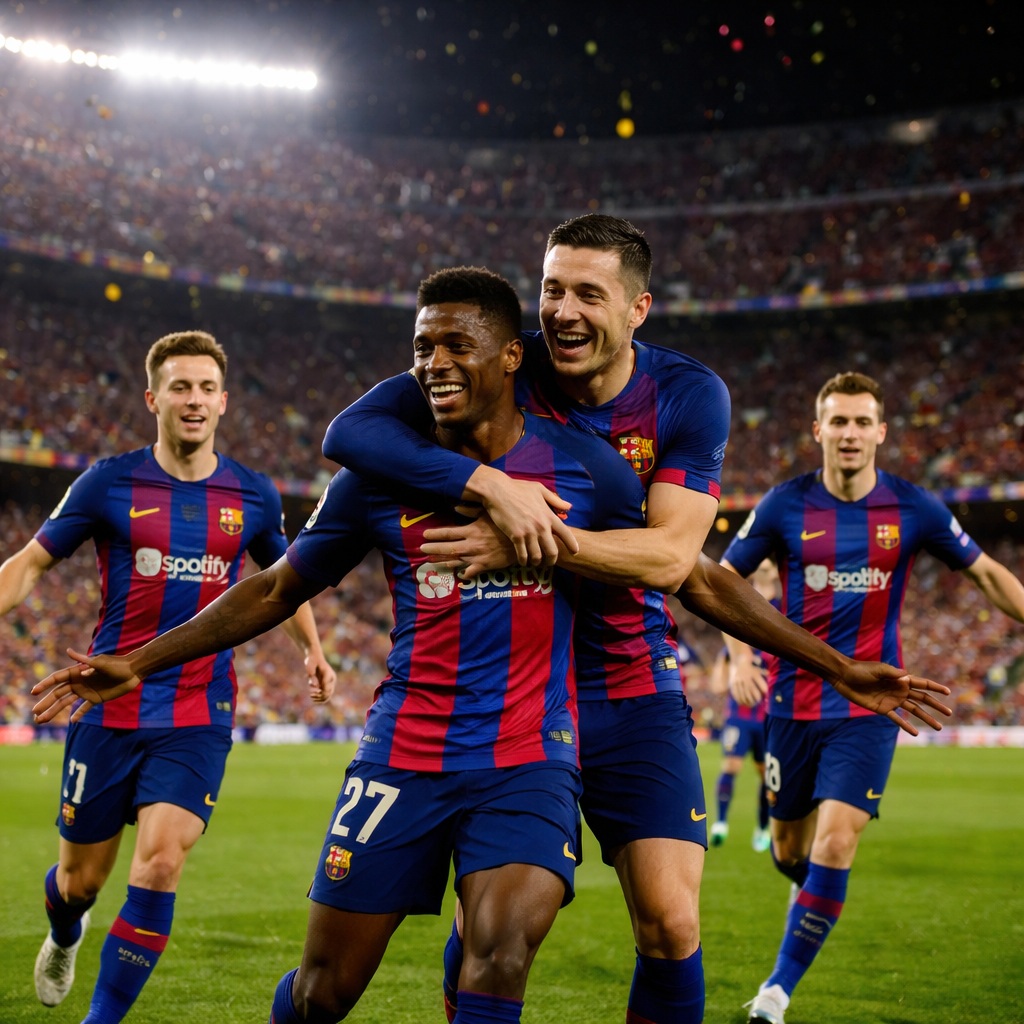
An unbeaten habit in front of goal and carefully targeted transfers underline a club balancing tradition, urgency, and long-term planning.
Barcelona end the year with a familiar yet newly sharpened feeling around the club: inevitability. Goals have arrived every week, in every league outing, regardless of venue or opponent. As the season slows into its winter rhythm, the Catalan side have quietly matched a scoring sequence last seen in the early decades of the club’s professional history, reinforcing the idea that attacking identity here is not a phase but a constant.
Across the calendar year, Barcelona have found the net in every domestic league match. The achievement places the current squad alongside a storied generation from the 1940s, when the club’s attacking verve helped shape its reputation long before modern tactics, analytics, or global broadcasting. That parallel has not gone unnoticed inside the club, where history is less a museum piece than a reference point.
The modern version of this streak has been built on adaptability. Barcelona no longer rely on a single attacking blueprint. At times the play is patient and positional, at others fast and vertical. Goals have come from structured possession, quick transitions, and moments of individual inspiration. Importantly, they have also arrived when rhythm was lacking, underlining a maturity that had sometimes been absent in recent seasons.
The coaching staff have emphasized balance throughout the campaign. Defensive structure has been treated not as a constraint but as a launchpad. The result is a team that can absorb pressure and still produce chances, often late in matches when opponents begin to fade. That resilience has turned narrow margins into reliable victories and has kept the scoring run intact through congested periods of the schedule.
Within the dressing room, the streak is discussed cautiously. Players acknowledge it, but few are willing to dwell on it. The message from the technical area has been consistent: goals are a consequence, not an objective in isolation. The objective remains control, performance, and points. Yet the numbers, even when not spoken aloud, have created a sense of collective responsibility. Every missed chance now feels temporary; another opportunity is always expected to come.
Beyond the pitch, the club’s activity in the transfer market has mirrored this pragmatic optimism. Financial realities remain part of everyday conversation at Barcelona, but so does opportunity. Recent windows have been approached with precision rather than spectacle. Recruitment has focused on players who fit immediate tactical needs while retaining resale value and developmental upside.
Incoming moves have been shaped by versatility. Profiles capable of operating in multiple roles have been prioritized, reflecting a season in which squad rotation has been essential. At the same time, departures have been handled with a clear eye on sustainability. Reducing wage commitments has gone hand in hand with protecting the competitive level of the squad, a balance that has often eluded the club in the past decade.
Youth development continues to underpin the strategy. Several academy graduates have become regular contributors, not as symbolic gestures but as functional parts of the rotation. Their presence has added intensity and familiarity to Barcelona’s play, reinforcing connections between lines and maintaining tempo during demanding stretches of the campaign.
The atmosphere around the stadium as the year closes reflects cautious confidence. Supporters recognize progress without declaring conclusions. There is an understanding that consistency, not isolated runs, defines success at this level. Still, the sense that Barcelona are rediscovering a dependable attacking rhythm has brought renewed belief.
As attention turns toward the second half of the season, expectations are sharpening. The scoring streak has raised standards externally and internally. Opponents arrive knowing that containment alone is unlikely to be enough. For Barcelona, the challenge will be sustaining hunger while managing workload, injuries, and the inevitable tactical adjustments rivals will attempt.
Closing the year with goals in every league match is not presented as a trophy, but it is a statement. It suggests a team aligned with its identity and a club learning to operate within its means without surrendering ambition. In that balance between past and present, Barcelona step into the new year not with guarantees, but with momentum.



 The Tower Post