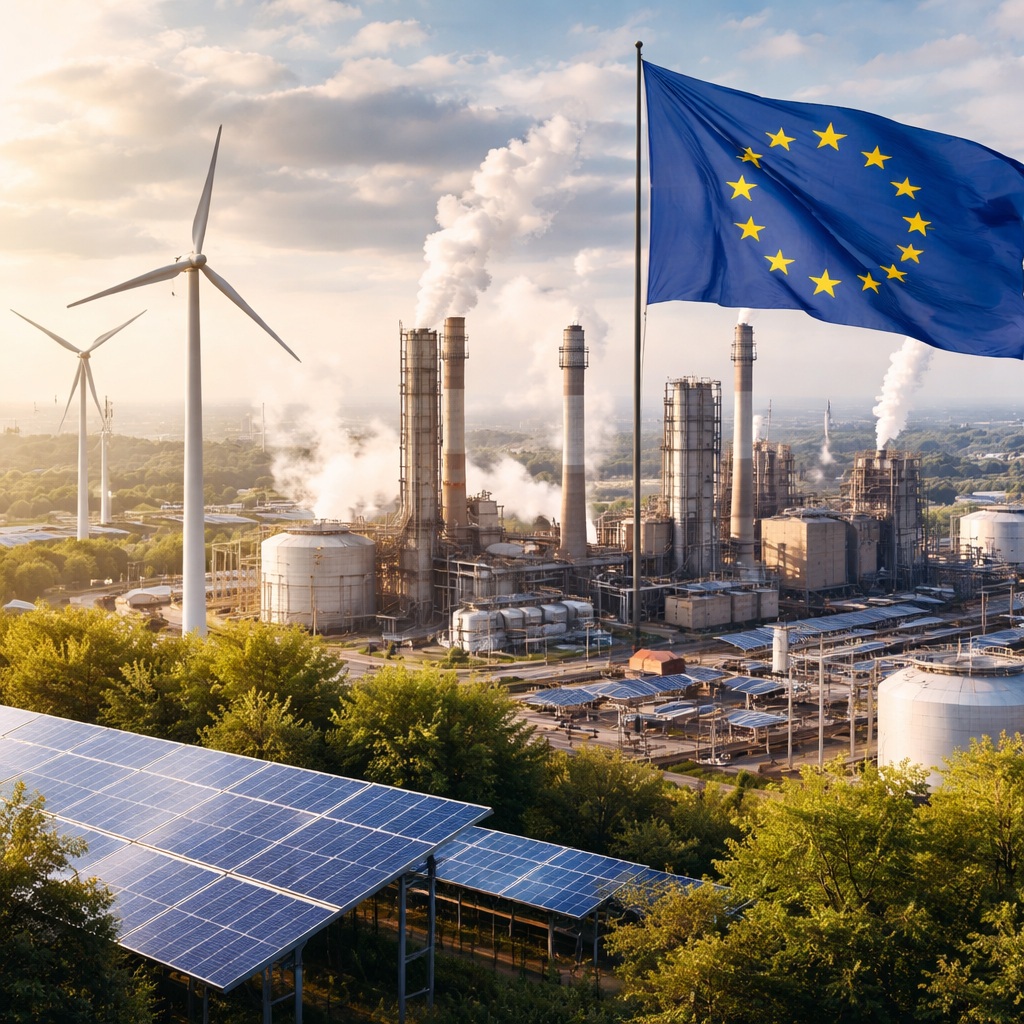
The European Union has moved to reinforce the economic flank of its climate policy, widening compensation mechanisms for industries facing higher electricity costs under emissions regulations.

The updated framework, introduced as the year draws to a close, reflects a growing concern in Brussels: that ambitious climate rules, if left unbalanced, could push production and jobs beyond Europe’s borders.
At the heart of the reform is an expansion of state-aid guidelines that allow governments to compensate energy‑intensive industries for indirect costs stemming from carbon pricing. These costs, largely passed on through electricity prices, have long been cited by manufacturers as a competitive disadvantage compared with producers in regions with looser climate rules.
Under the new approach, eligibility has been broadened to include additional sectors considered strategically important and emissions‑exposed. Industries such as organic chemicals, ceramics, and battery manufacturing are now more clearly within scope, alongside traditional heavyweights like steel and aluminum. The aim is to reflect the changing structure of Europe’s industrial base, particularly as clean‑tech supply chains become central to the bloc’s green transition.
European Commission officials frame the move as a pragmatic adjustment rather than a retreat from climate ambition. The EU’s emissions trading system remains the cornerstone of its decarbonization strategy, but policymakers acknowledge that market signals alone can create uneven pressures across regions and sectors. Compensation, they argue, is a way to keep production anchored in Europe while companies invest in cleaner processes.
Carbon leakage—the relocation of carbon‑intensive production to jurisdictions with weaker environmental standards—has long haunted climate policymakers. If factories simply move abroad, global emissions may rise rather than fall, undermining the purpose of stringent EU rules. The expanded compensation scheme is designed to address this risk during a period of industrial transformation.
The timing is significant. European industry is grappling with high energy prices, geopolitical uncertainty, and fierce competition from subsidized manufacturing hubs elsewhere. Battery makers, for example, sit at the crossroads of climate policy and industrial strategy, supplying electric vehicles and energy storage while consuming large amounts of power. By extending aid to such sectors, the EU signals that climate leadership must be matched with industrial resilience.
Critics, however, warn of potential downsides. Environmental groups caution that compensation must not become a blanket subsidy that dulls incentives to cut emissions. They argue that aid should be tightly linked to efficiency improvements and decarbonization plans, ensuring public money accelerates, rather than delays, the shift to cleaner production.
Commission guidelines attempt to address these concerns by setting conditions on aid intensity and requiring member states to monitor how funds are used. Support is framed as transitional, meant to buy time for industries to adapt technologies and energy sources, not to lock in carbon‑heavy models.
As the EU looks ahead, the broadened compensation regime underscores a central tension in climate policy: how to decarbonize rapidly without hollowing out the industrial base. By widening the safety net for exposed sectors, Brussels is betting that climate ambition and economic stability can move forward together—keeping factories, jobs, and emissions reductions within Europe’s borders.