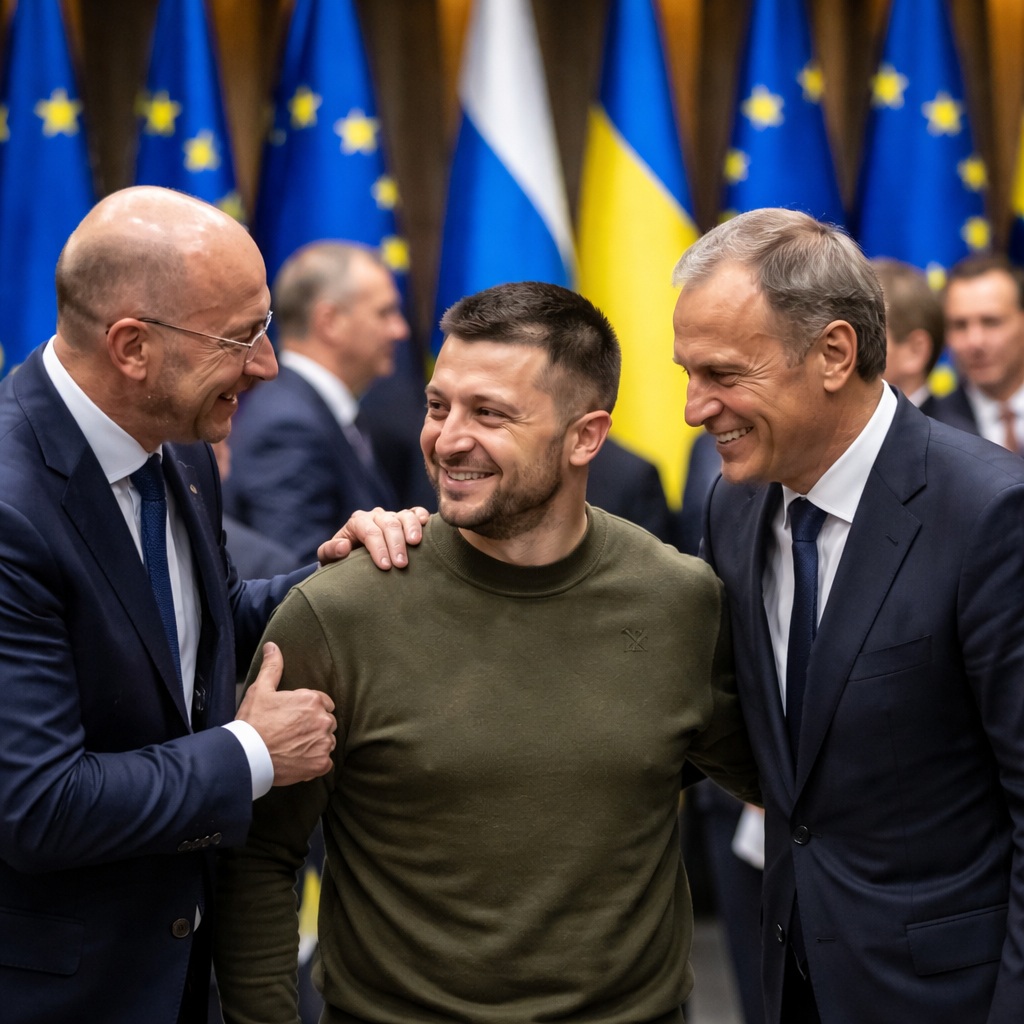
Ukrainian president welcomes landmark European aid package, urges bolder financial steps to weaken Moscow’s war machine

Kyiv — Ukrainian President Volodymyr Zelenskyy has urged European leaders to move beyond symbolic measures and deploy frozen Russian sovereign assets to further weaken Moscow’s ability to sustain its war effort. His appeal comes as European capitals close out a turbulent year marked by military stalemate, political strain, and renewed debates over the limits of Western support for Ukraine.
Zelenskyy’s call coincided with a major breakthrough in Brussels, where European Union leaders agreed on a large-scale loan package aimed at reinforcing Ukraine’s economic stability and wartime resilience. The Ukrainian leader welcomed the deal as a critical demonstration of European unity, warning that any sign of hesitation would be seized upon by Moscow.
“Frozen Russian assets should not remain frozen indefinitely,” Zelenskyy said in remarks released by his office. “They are the financial legacy of aggression and must be used to restore justice and security.”
Frozen assets, unresolved decisions
Since the early stages of Russia’s full-scale invasion, Western governments have immobilized vast amounts of Russian central bank reserves and other sovereign holdings. A significant portion of those assets is located within EU jurisdictions, placing Europe at the center of an increasingly urgent debate over their future use.
So far, European institutions have limited themselves to redirecting profits generated by the frozen funds toward Ukraine’s defense and recovery. Full confiscation of the assets themselves remains controversial, with several member states citing legal risks and concerns about undermining confidence in the global financial system.
Zelenskyy has grown increasingly outspoken on the issue, arguing that incremental steps no longer reflect the scale of the war or the damage inflicted on Ukraine. According to officials in Kyiv, using the assets directly would not only provide immediate resources but also send an unmistakable signal that wars of aggression carry permanent economic consequences.
Ukrainian diplomats say Moscow closely monitors debates in European capitals and interprets prolonged hesitation as strategic weakness rather than caution.
A financial lifeline from Europe
Against this backdrop, the newly agreed EU loan package represents one of the most substantial financial commitments made to Ukraine since the conflict began. The funds are intended to support Ukraine’s budget, ensure the continued functioning of state institutions, and help offset the destruction of infrastructure caused by repeated attacks.
Zelenskyy described the agreement as more than a financial arrangement, calling it proof that Europe remains politically invested in Ukraine’s survival. He emphasized that economic stability directly affects battlefield endurance, civilian morale, and Kyiv’s position in any future diplomatic process.
European officials echoed that assessment, stressing that sustained financial backing strengthens Ukraine’s negotiating leverage while reinforcing the credibility of the EU’s long-term strategy toward Russia.
Managing fatigue and resolve
As the war stretches on, political fatigue has become an increasingly visible factor across Europe. Domestic pressures, elections, and budgetary constraints have complicated consensus-building among member states. Yet the decision to approve the loan package suggests that strategic considerations continue to outweigh short-term political costs.
Several EU diplomats privately acknowledged that maintaining unity is now as important as supplying weapons. A failure to deliver tangible support, one official said, would risk emboldening Russia and eroding Europe’s own standing as a geopolitical actor.
Zelenskyy has repeatedly warned that reducing support would not bring peace closer, but would instead prolong the conflict by allowing Russia to regroup and adapt.
The road ahead
The question of frozen Russian assets is expected to dominate European legal and political discussions in the months ahead. Experts are exploring mechanisms that could withstand court challenges while aligning with international law. For Ukraine, the timeline is pressing, as reconstruction needs grow even while the fighting continues.
As winter deepens and the conflict enters another uncertain phase, the choices made in European capitals will shape not only Ukraine’s resilience, but also the broader security order on the continent.
Zelenskyy’s message to Europe is unambiguous: unity must translate into action. Whether that action will extend to the full use of frozen Russian assets may prove one of the defining tests of Europe’s commitment in the period ahead.