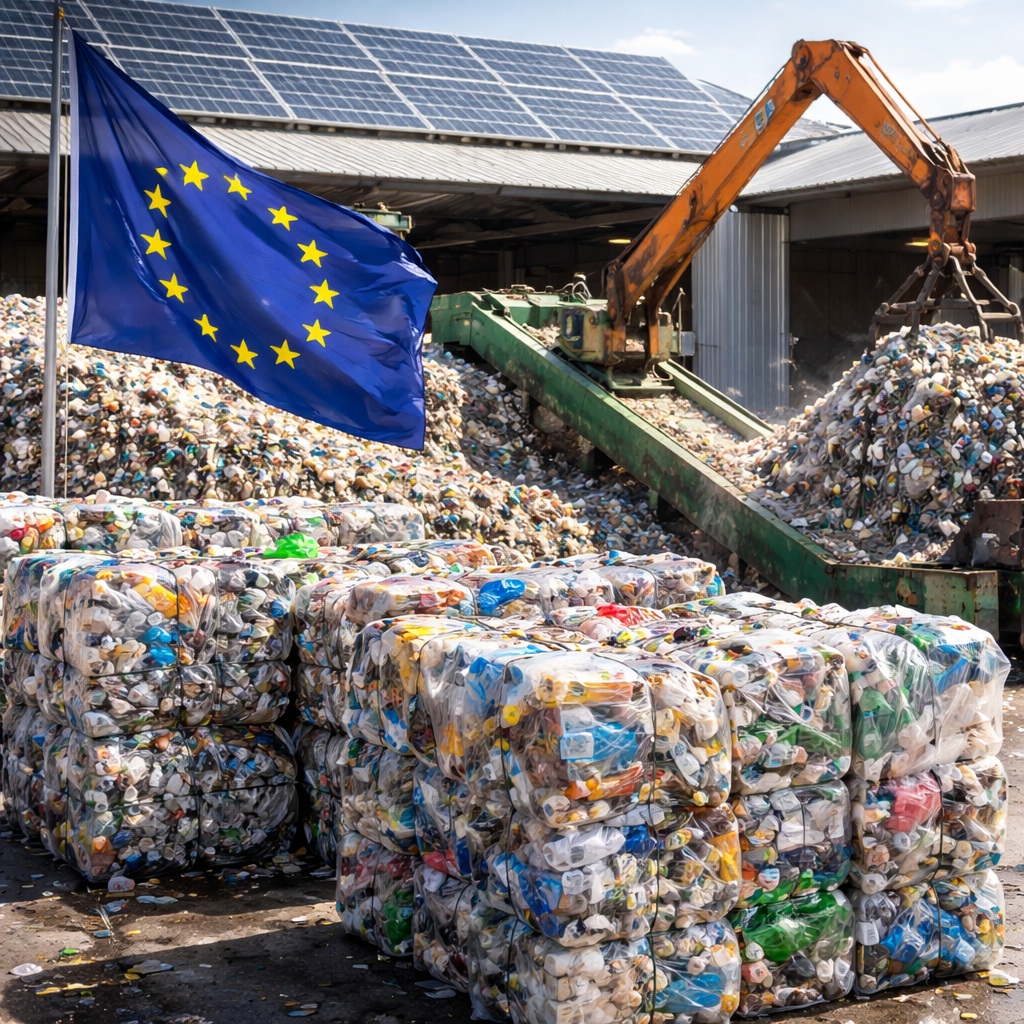
Pilot actions aim to strengthen the Single Market while positioning sustainability as a pillar of European competitiveness
Brussels — The European Commission has unveiled a new set of pilot actions designed to accelerate Europe’s transition toward a circular economy, placing plastic recycling at the center of its strategy. The initiative reflects a growing effort to align environmental ambition with industrial competitiveness, as policymakers seek to ensure that sustainability becomes a driver rather than a constraint for economic growth.
The measures focus on optimizing how plastics are collected, sorted, and recycled across the European Union, while also addressing persistent fragmentation in the Single Market. Despite years of regulatory progress, plastic waste management in Europe remains uneven, with national systems operating at different levels of efficiency and scale. The Commission’s latest move aims to bridge those gaps by testing coordinated solutions that can later be expanded across member states.
At the heart of the initiative is the recognition that plastic recycling is not only an environmental necessity but also an economic opportunity. Recycled plastics are increasingly seen as strategic raw materials, capable of reducing Europe’s dependence on imported fossil-based resources and insulating manufacturers from volatile global supply chains. By improving the quality and availability of recycled plastic, the Commission hopes to support European industries ranging from packaging and construction to automotive and consumer goods.
The pilot actions announced by the Commission are intended to tackle long-standing bottlenecks in the recycling market. These include inconsistent standards for recycled materials, limited demand for secondary plastics, and insufficient integration between waste management systems and industrial production. By experimenting with common quality criteria, digital tracking tools, and closer cooperation between public authorities and private operators, the Commission aims to create a more predictable and attractive market for recycled plastics.
Strengthening the Single Market is a key pillar of the approach. While environmental regulation has often been handled at the national level, the Commission argues that circular economy solutions require cross-border scale to be effective. Plastic waste and recycled materials routinely move across borders, yet regulatory differences can slow down or even block these flows. The new measures seek to reduce administrative barriers and promote mutual recognition of recycling standards, allowing recycled plastics to circulate more freely within the EU.
The initiative also fits into the Commission’s broader competitiveness agenda. European industry is under increasing pressure from global rivals that benefit from lower energy costs and less stringent environmental rules. By investing in advanced recycling technologies and harmonized market rules, the Commission aims to give European companies a competitive edge in high-value, sustainable materials. Officials emphasize that leadership in circular economy solutions could become a defining strength of Europe’s industrial model.
Environmental organizations have broadly welcomed the announcement, noting that plastics remain one of the most challenging waste streams in Europe. While recycling rates have improved over the past decade, large volumes of plastic waste are still incinerated or exported outside the EU. Advocates argue that pilot projects must quickly translate into binding policies if the bloc is to meet its climate and pollution reduction goals.
Industry groups, meanwhile, have expressed cautious optimism. Many manufacturers support efforts to increase the supply of high-quality recycled plastics, which are often scarce or inconsistent in performance. However, they stress that regulatory clarity and economic incentives will be crucial to ensure that recycled materials can compete with virgin plastics on both price and reliability.
The Commission has signaled that lessons learned from the pilot actions will feed into future legislative and policy initiatives. If successful, the approach could inform updates to existing waste and product rules, as well as new measures designed to stimulate demand for recycled content. The emphasis on testing and scaling solutions reflects a pragmatic shift toward implementation, moving beyond strategy documents to concrete market interventions.
As Europe continues to navigate the twin transitions of green transformation and industrial renewal, the Commission’s latest announcement underscores a central message: circular economy policies are no longer peripheral environmental tools, but core components of economic strategy. By focusing on plastic recycling and the integrity of the Single Market, the EU is betting that sustainability and competitiveness can advance together, shaping a more resilient and resource-efficient European economy.


 The Tower Post