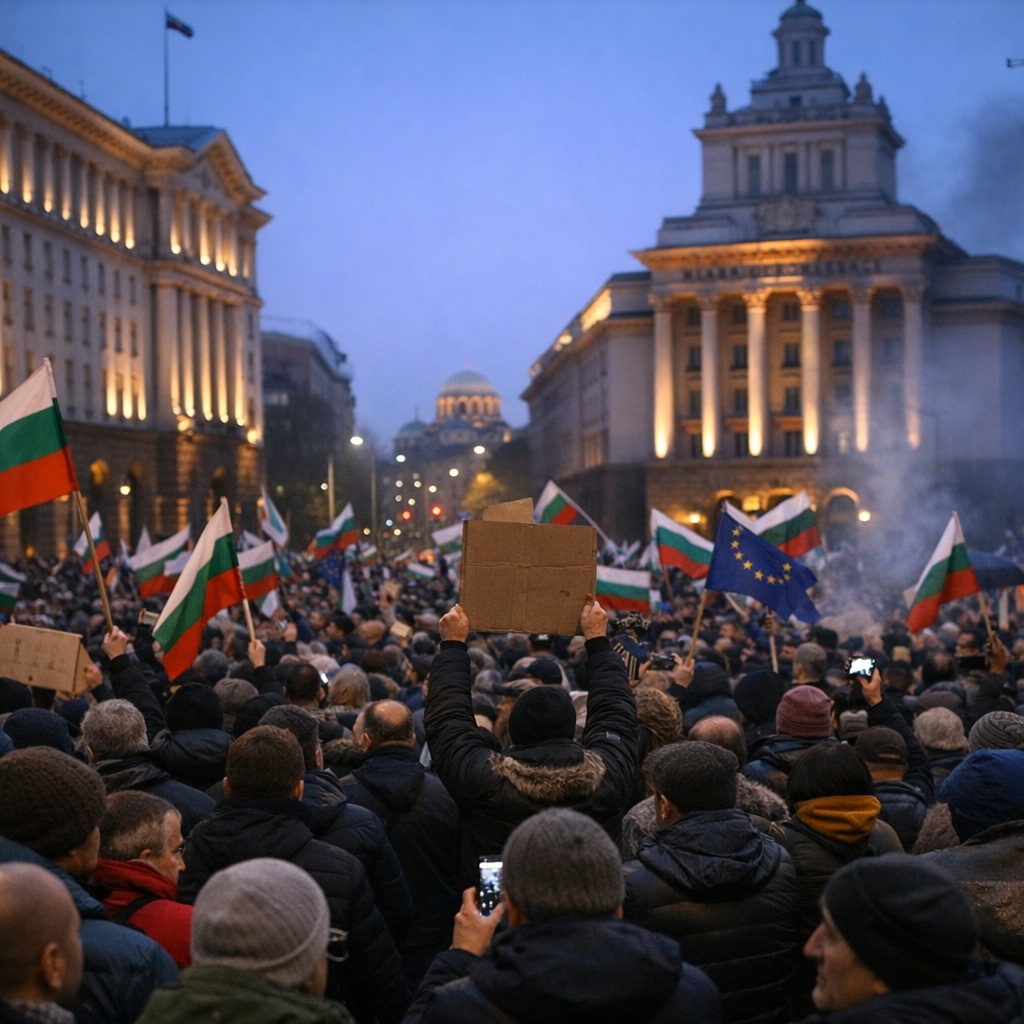
Mass demonstrations force a government resignation, test democratic institutions, and raise the stakes as Bulgaria prepares for euro adoption.
BULGARIA — Streets across Bulgaria have filled once again with chanting crowds, flags, and homemade placards as citizens demand clean elections, an independent judiciary, and an end to entrenched corruption. The demonstrations, centered in the capital but echoed nationwide, have grown into one of the most consequential civic mobilizations in recent years, underscoring a deep crisis of trust between the public and the political class.
What began as rallies against perceived electoral manipulation quickly escalated into a broader revolt against systemic graft. Protesters accuse political elites of capturing state institutions, weakening checks and balances, and using public funds to entrench their power. The movement’s core message is simple and repeated relentlessly: without fair elections and a judiciary free from political pressure, no reform can be credible.
At the heart of the protests is frustration with a cycle of short-lived governments and repeated elections that have failed to produce lasting stability. Many Bulgarians say each new cabinet promises reform but ultimately preserves the same networks of influence. That sense of stagnation has now tipped into anger, particularly among younger voters and urban professionals who see their future constrained by corruption and emigration.
Tensions peaked when demonstrators mobilized against controversial budget proposals, arguing that public spending decisions were being made without transparency or accountability. The pressure proved decisive. After days of sustained protests and mounting political paralysis, the government stepped down, plunging the country into renewed uncertainty. While opposition parties welcomed the resignation as a victory for civic pressure, they offered few concrete assurances about what would follow.
The protests have unfolded largely peacefully, though confrontations with police and sporadic arrests have added to the sense of volatility. Civil society groups and legal associations have taken a prominent role, organizing marches, monitoring police conduct, and calling for international attention. Their demands extend beyond any single government: they seek structural safeguards to prevent political interference in courts, prosecutors’ offices, and electoral commissions.
For many demonstrators, the issue is not ideology but accountability. Crowds include voters from across the political spectrum, united by the belief that corruption has hollowed out democratic institutions. “We are not here for one party or another,” one protester said at a rally in the capital. “We are here because the rules no longer apply equally.”
The unrest comes at a sensitive moment for Bulgaria’s European ambitions. The country is preparing to adopt the euro, a milestone that requires fiscal discipline, political stability, and public confidence in state institutions. European partners have long praised Bulgaria’s macroeconomic indicators while expressing concern about rule-of-law shortcomings. The current turmoil risks reinforcing doubts about whether reforms are deep enough to sustain eurozone membership.
Analysts note that the protests could cut both ways for Bulgaria’s standing in Europe. On one hand, sustained civic pressure demonstrates a vibrant public commitment to democratic norms. On the other, repeated government collapses and contested elections may signal institutional fragility. Much will depend on whether political leaders can translate public demands into credible reforms rather than cosmetic changes.
The judiciary has become a particular flashpoint. Protesters argue that prosecutors wield excessive power with insufficient oversight, enabling selective justice and political bargaining. Calls for constitutional amendments and external monitoring have grown louder, reflecting a belief that domestic remedies alone have failed. Legal experts warn that without broad consensus, such reforms risk becoming another arena for partisan conflict.
Outside the capital, demonstrations have taken on a more local character, focusing on corruption in municipalities, public procurement, and regional administrations. This decentralization has given the movement resilience, making it harder for authorities to dismiss protests as the work of a narrow urban elite. It has also highlighted how deeply corruption is perceived to penetrate everyday governance.
As winter deepens, organizers face the challenge of sustaining momentum without clear political interlocutors. Some advocate for new civic platforms or independent candidates, while others caution that formalizing the movement too quickly could fracture its unity. For now, protest leaders insist their role is to pressure, not to govern.
The coming weeks will test whether Bulgaria’s political system can absorb this shock and emerge more accountable. Early elections appear likely, but many voters fear another inconclusive result. Without reforms to electoral oversight and campaign financing, they argue, new ballots may simply reproduce old patterns.
Yet despite fatigue and uncertainty, the protests have injected a rare sense of agency into public life. Citizens who once viewed politics with resignation now speak of reclaiming the state from entrenched interests. Whether that energy leads to lasting change remains uncertain, but its impact is already undeniable.
As Bulgaria stands at a crossroads between continued instability and meaningful reform, the message from the streets is clear: legitimacy must be earned through transparency, fairness, and the rule of law. With euro adoption on the horizon and international scrutiny intensifying, the pressure on leaders to respond has rarely been greater.


 The Tower Post