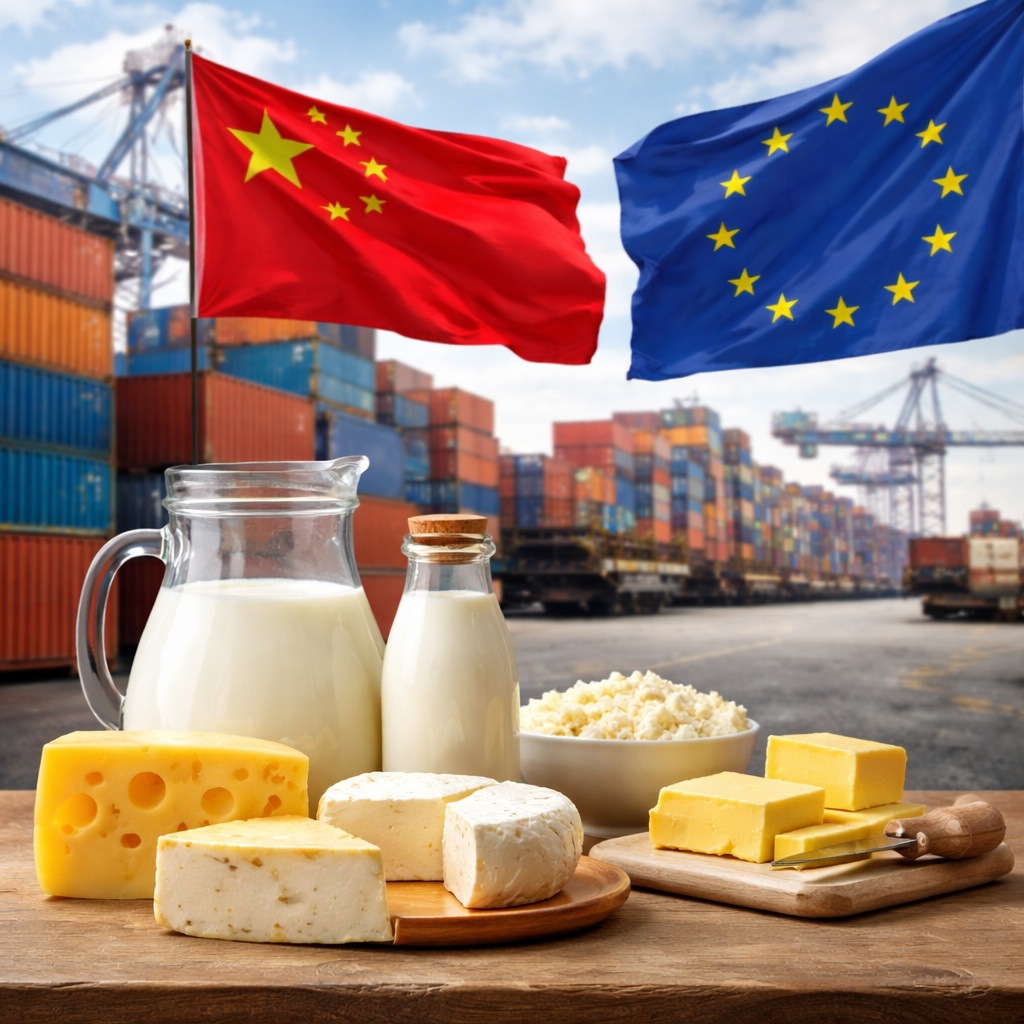
Beijing’s move to impose steep temporary duties on European cheese, milk powders, and butter signals a widening economic rift with Brussels, deepening an already fraught trade relationship.

Beijing has moved to broaden its trade confrontation with the European Union by announcing provisional tariffs of up to 42.7 percent on selected European dairy products, a decision that has sent ripples through global agricultural markets and sharpened diplomatic tensions between two of the world’s largest trading powers.
The duties, which target a range of dairy exports including cheese, milk powders, and butter, mark a significant escalation in a dispute that has increasingly spilled beyond its original focus on industrial goods. While Chinese authorities have framed the measures as the outcome of an anti-dumping investigation, the timing and scope of the tariffs are widely interpreted in Brussels as retaliation for recent European actions aimed at Chinese electric vehicle manufacturers.
For European dairy producers, the announcement lands at a sensitive moment. China has become a crucial outlet for surplus production in several EU member states, particularly as domestic demand across Europe remains subdued by high living costs and shifting consumer habits. Industry groups warn that even provisional duties could disrupt long-standing supply chains, depress farm-gate prices, and exacerbate financial strain on farmers already grappling with volatile energy and feed costs.
Chinese officials insist the move is grounded in trade rules and due process. According to statements released in Beijing, investigators found evidence that certain European dairy products were being sold in the Chinese market at unfairly low prices, causing material injury to domestic producers. Provisional tariffs, they argue, are a standard safeguard while the investigation continues.
Yet in Brussels, the decision is viewed through a broader geopolitical lens. EU policymakers see the dairy tariffs as part of a pattern in which trade instruments are increasingly used to exert pressure in response to political or strategic disagreements. The dispute over electric vehicles, in which the EU has accused Chinese manufacturers of benefiting from state subsidies that distort competition, has become a flashpoint in this evolving rivalry.
The dairy sector’s inclusion underscores how far the conflict has spread. What began as a clash over green technology and industrial policy is now touching agriculture, a domain traditionally treated with caution due to its social and political sensitivity on both sides. European officials privately acknowledge concern that further sectors could be drawn in if the standoff continues.
Beyond the immediate commercial impact, the episode highlights the fragile state of EU–China relations. Diplomatic engagement has intensified in recent weeks, with both sides publicly calling for dialogue while simultaneously preparing defensive trade measures. Analysts note that trust has eroded, making it harder to resolve disputes quietly through technical channels.
For China, the tariffs also reflect domestic pressures. Supporting local dairy producers has become a priority as consumption growth slows and competition intensifies. By acting against foreign imports, Beijing can signal responsiveness to domestic industry concerns while also demonstrating leverage in its broader economic contest with Europe.
European leaders, meanwhile, face a delicate balancing act. They are under pressure to defend strategic industries and uphold trade rules, yet wary of provoking a cycle of retaliation that could harm exporters across the bloc. Several member states with strong agricultural sectors are urging the European Commission to seek a negotiated solution before provisional measures harden into permanent barriers.
The dispute unfolds against a backdrop of wider geopolitical friction, including disagreements over technology, security, and global governance. Trade, once a stabilizing pillar of the EU–China relationship, is increasingly becoming another arena of competition.
As the provisional tariffs take effect, attention now turns to whether cooler heads can prevail. Both Brussels and Beijing have signaled openness to talks, but neither appears ready to concede ground on the underlying issues. For dairy farmers and exporters caught in the middle, the coming months may prove decisive in determining whether this latest escalation becomes a lasting feature of the global trade landscape or a temporary spike in an already volatile relationship.