Brussels Signals Unity and Respect for Self‑Determination in Arctic Governance

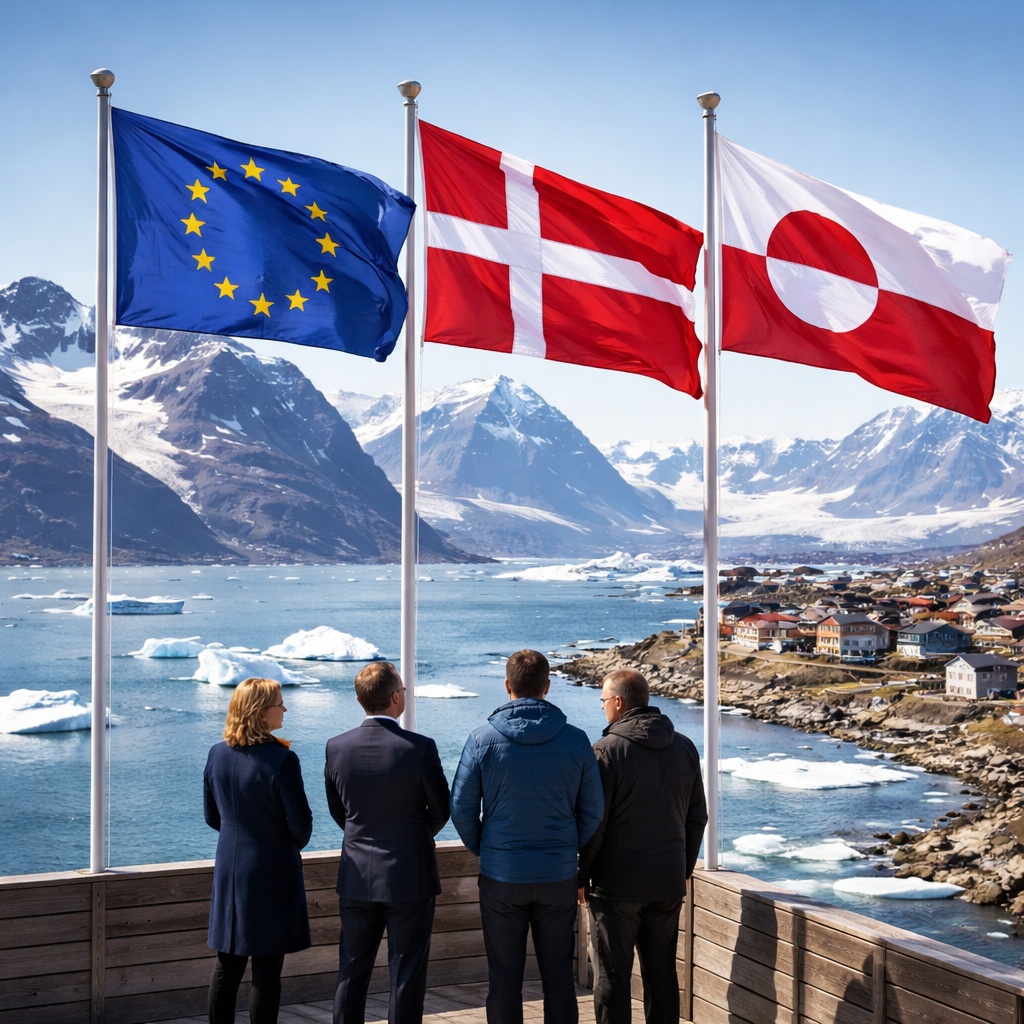
As geopolitical attention increasingly turns toward the Arctic, the European Union has moved to firmly restate its position on the political status and internal governance of Greenland, underscoring that such decisions belong exclusively to the peoples of Greenland and Denmark. The statement, delivered by EU foreign policy chief Kaja Kallas, reflects a broader effort by Brussels to reinforce unity, respect for territorial autonomy, and adherence to international norms at a time of heightened diplomatic sensitivity.
Speaking on behalf of the Union, Kallas emphasized that Greenland’s future—whether in its current autonomous arrangement or any evolution thereof—must remain a matter of democratic choice exercised internally, without pressure or commentary from external actors. Her remarks were widely interpreted as a response to recent statements from outside Europe that were perceived by Copenhagen and Nuuk as intrusive or politically provocative.
“The European Union stands fully with Denmark and Greenland,” Kallas said, stressing that internal self‑determination is a cornerstone of European values as well as international law. “Only the Danish and Greenlandic peoples can decide on Greenland’s political status and governance.”
A Delicate Arctic Moment
The reaffirmation comes at a moment when Greenland’s strategic importance has rarely been more pronounced. Rich in critical minerals, positioned along emerging Arctic shipping routes, and central to climate research, the vast island has attracted growing global interest. While Greenland enjoys extensive self‑rule within the Kingdom of Denmark, questions surrounding autonomy, independence, and external engagement have long been handled through careful internal dialogue.
EU officials were keen to underline that the bloc’s position is not new, but rather a restatement of principles that have guided European policy for decades. What has changed, however, is the intensity of global attention on the Arctic and the frequency with which external commentary risks unsettling long‑standing political balances.
Diplomats in Brussels noted that even well‑intentioned remarks from non‑European actors can carry disproportionate weight when they touch on sovereignty or constitutional arrangements. In that context, the EU’s public show of solidarity was designed both to reassure Denmark and Greenland and to send a clear signal internationally that such matters are not open for outside debate.
Unity Among the Twenty‑Seven
The message from Brussels also served an internal purpose: reinforcing cohesion among the EU’s twenty‑seven member states. Respect for territorial integrity and internal self‑determination remains a sensitive issue across Europe, given the continent’s diverse political histories and regional identities. By speaking with one voice on Greenland, EU leaders aimed to demonstrate consistency and credibility in foreign policy.
Denmark, a long‑standing EU member, welcomed the statement as an important reaffirmation of trust and partnership. Greenland, while not part of the EU, maintains close ties through association agreements and cooperation on climate, fisheries, and research. For officials in Nuuk, the emphasis on local democratic choice resonated strongly, particularly as Greenland continues to balance economic development with cultural preservation and environmental stewardship.
Beyond Europe, the statement was also seen as part of a broader EU effort to position itself as a stabilizing actor in global affairs. By anchoring its response in principles rather than personalities, Brussels avoided escalation while making its boundaries clear.
Looking Ahead
Analysts suggest that similar statements may become more common as the Arctic grows in strategic relevance and as global competition for resources and influence intensifies. For the EU, maintaining a clear, principled stance is likely to be essential in navigating these pressures without undermining regional stability.
For now, the Union’s message is unambiguous: Greenland’s path forward will be determined in Nuuk and Copenhagen, not elsewhere. In reiterating this position, the EU has sought to calm diplomatic waters while reaffirming its commitment to autonomy, democracy, and mutual respect—values it considers non‑negotiable as the Arctic enters a new and closely watched chapter.