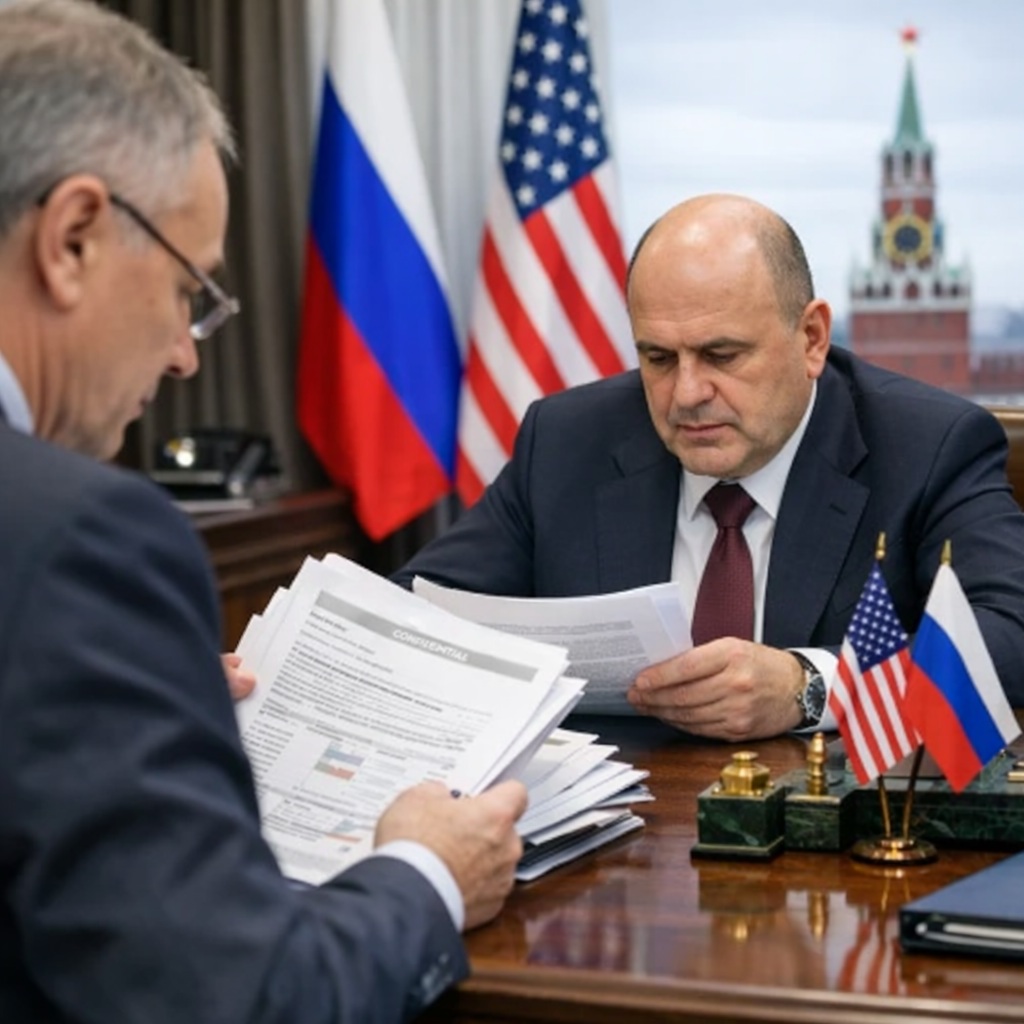
The Kremlin confirms it is studying American documents outlining a potential framework for ending the war, signaling cautious engagement amid intensified international diplomacy and deep strategic mistrust.

Russia has acknowledged receiving and reviewing documents from the United States outlining proposals for a potential peace settlement in the war in Ukraine, a move that underscores a renewed—if tentative—phase of diplomatic engagement as the conflict approaches another winter with no decisive military resolution in sight.
Speaking to reporters, the Kremlin confirmed that U.S. materials had been transmitted through diplomatic channels and were now under analysis by relevant Russian institutions. The statement was measured and deliberately noncommittal, reflecting Moscow’s long-standing insistence that any political settlement must address what it calls the “root causes” of the conflict, including security guarantees and the future status of contested territories.
The disclosure comes amid a noticeable uptick in behind-the-scenes diplomatic activity involving Washington, European capitals, and a range of non-Western intermediaries. While public positions remain sharply opposed, officials across several governments have hinted that exploratory discussions are taking place, driven by battlefield fatigue, economic strain, and uncertainty over the long-term trajectory of the war.
For the United States, the transmission of peace-related documents signals an attempt to test whether Moscow is prepared to engage beyond rhetoric. American officials have not publicly detailed the contents of the proposals, but people familiar with the matter describe them as a broad framework rather than a final plan—one that sketches possible principles, sequencing, and verification mechanisms rather than fixed outcomes.
The Kremlin, for its part, has been careful to frame its review as a technical and political assessment rather than an endorsement of talks. Presidential spokesman Dmitry Peskov emphasized that studying documents does not imply agreement, noting that Russia has seen “many initiatives” over the course of the conflict that ultimately failed to account for Moscow’s core demands.
Those demands remain largely unchanged. Russian officials continue to insist on binding security arrangements that would limit NATO’s presence near Russia’s borders, recognition of what Moscow describes as “new territorial realities,” and the lifting of Western sanctions. These conditions are unacceptable to Kyiv and its allies, who maintain that Ukraine’s sovereignty and territorial integrity are non-negotiable and that sanctions relief can only follow a full withdrawal of Russian forces.
Still, analysts say the mere acknowledgment of U.S. documents marks a subtle shift in tone. “Moscow could have ignored or dismissed the initiative outright,” said a senior European diplomat. “Instead, it chose to say it is reviewing it. That keeps the door ajar, even if only slightly.”
The diplomatic maneuvering unfolds against a backdrop of grinding military stalemate. Front lines have shifted marginally, but neither side has achieved a breakthrough capable of decisively changing the course of the war. Casualties continue to mount, and both Russia and Ukraine face growing challenges in sustaining manpower, equipment, and public support.
Ukraine’s leadership has reacted cautiously to reports of U.S.-Russia exchanges. Officials in Kyiv have reiterated that any peace process must be transparent and inclusive, warning against negotiations conducted over Ukraine’s head. President Volodymyr Zelenskyy has consistently argued that previous attempts at compromise only emboldened Moscow and that lasting peace requires accountability and security guarantees for Ukraine.
Western governments echo that concern, even as they quietly explore diplomatic off-ramps. European officials say there is no unified peace plan at this stage, but rather a convergence of exploratory efforts aimed at understanding where red lines lie and whether any overlap exists. The U.S. documents sent to Moscow are seen as part of that broader probing exercise.
Non-Western actors have also intensified their engagement. Countries in Asia, the Middle East, and the Global South—many of which have sought to maintain balanced relations with both Russia and the West—have positioned themselves as potential facilitators. Their involvement reflects frustration with the war’s global economic impact, from energy markets to food security, and a desire to prevent further escalation.
Within Russia, the Kremlin must balance any diplomatic overtures with domestic political considerations. State media continues to frame the war as an existential struggle against Western pressure, leaving limited room for compromise without a narrative of strategic gain. Analysts note that acknowledging U.S. proposals could help Moscow portray itself as reasonable and open to dialogue, particularly to international audiences beyond Europe and North America.
In Washington, the initiative is equally fraught. Any perception of conceding too much to Russia risks backlash from lawmakers and allies who fear setting a dangerous precedent. At the same time, there is growing recognition that the war’s open-ended nature carries its own political and strategic costs.
For now, both sides appear engaged in a careful dance: signaling openness without commitment, exploring possibilities without revealing bottom lines. The Kremlin’s confirmation that it is reviewing U.S. documents fits squarely into that pattern.
Whether the current diplomatic flurry leads to substantive negotiations remains uncertain. Previous peace efforts have faltered on fundamental disagreements over territory, security, and trust. Yet the fact that channels remain open—even quietly—suggests that, as the year draws to a close, the search for a political path out of the conflict has not been abandoned.
As winter deepens and the war grinds on, the documents under review in Moscow may amount to little more than another footnote in a long diplomatic saga. But in a conflict defined by hardened positions, even cautious engagement carries significance, offering a glimpse—however faint—of a future beyond the battlefield.