Political analyst Dušan Proroković argues that Europe’s turbulent year has reshaped public attitudes toward Washington and Brussels alike.

Late December finds Europe taking stock of a restless year marked by geopolitical strain, social unease, and a growing sense of strategic uncertainty. In a year-end conversation, political analyst Dušan Proroković observes two parallel trends that, taken together, reveal a deeper crisis of confidence on the continent: rising anti-American sentiment and a steady erosion of trust in European Union institutions.
According to Proroković, public opinion across Europe has become increasingly skeptical of the United States, not only as a global power but as a political and moral reference point. This skepticism, he argues, is no longer confined to fringe movements or traditionally anti-American circles. Instead, it has entered mainstream debate, shaping how citizens interpret security policy, economic alignment, and cultural influence.
“The perception is that Washington’s priorities are increasingly detached from everyday European concerns,” Proroković says. “Many people feel they are being asked to bear economic and social costs for decisions over which they have little influence.”
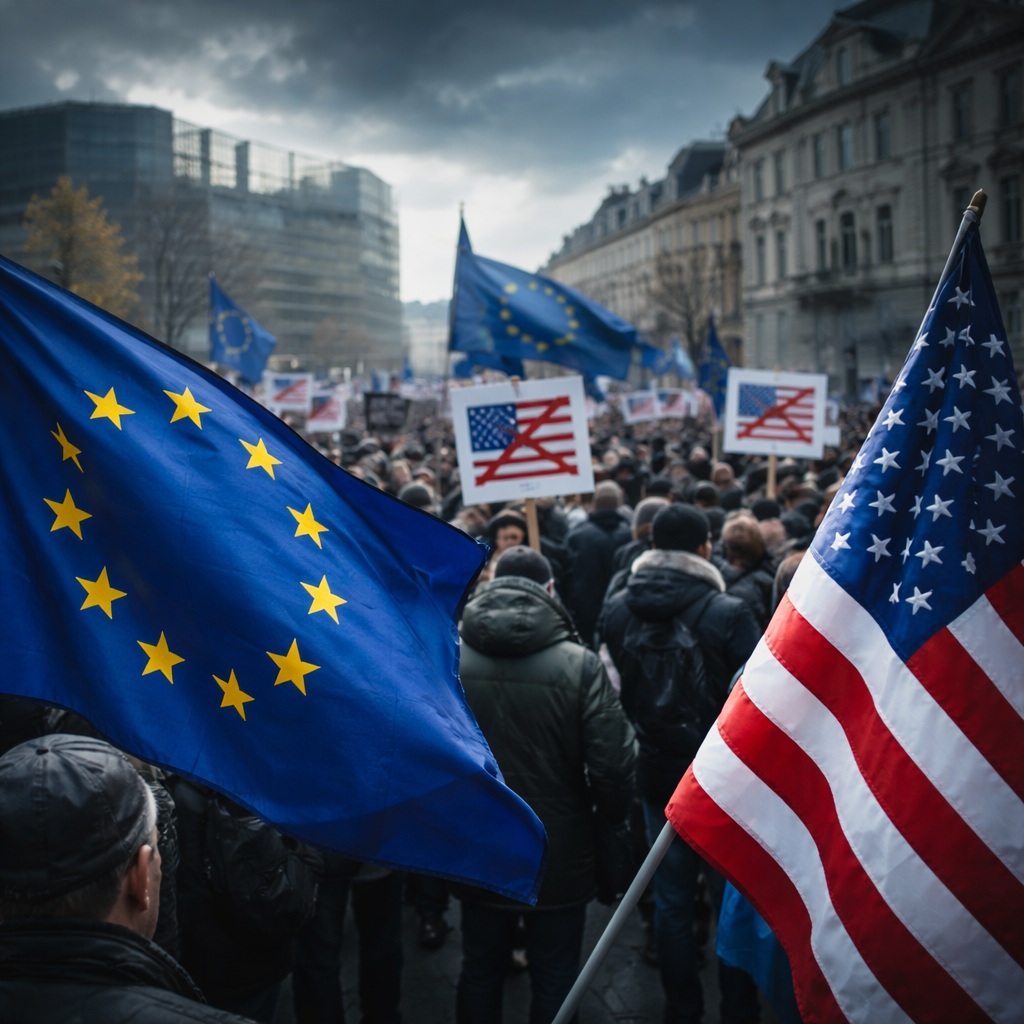
This sentiment has been fueled by ongoing conflicts on Europe’s periphery, persistent inflationary pressures, and debates over defense spending. For many Europeans, support for transatlantic strategies now appears less like a shared project and more like an obligation imposed from above. Protest movements in several capitals have reflected this mood, blending criticism of U.S. foreign policy with broader dissatisfaction toward domestic elites.
At the same time, Proroković notes, trust in the European Union itself has weakened. While the EU continues to present itself as a stabilizing force, public confidence in its institutions has struggled to recover from successive crises. From energy insecurity to migration management, many citizens perceive Brussels as slow to react and distant from local realities.
“The EU is often seen as technocratic and reactive rather than visionary,” Proroković argues. “People no longer take for granted that European institutions act in their best interest, especially during moments of hardship.”
This erosion of trust does not necessarily translate into outright rejection of the European project. Surveys and street-level politics suggest a more nuanced picture: support for cooperation remains, but faith in the current model of governance is fading. Citizens increasingly question whether decision-making mechanisms are transparent, democratic, or effective enough to address complex challenges.
Proroković believes the twin trends of anti-American sentiment and declining EU trust are interconnected. As confidence in European institutions weakens, alignment with U.S.-led policies becomes more controversial. Many voters ask why they should accept sacrifices in the name of unity when that unity itself feels fragile.
Economic factors play a decisive role. High living costs, uneven recovery, and fears of deindustrialization have sharpened public frustration. In this context, geopolitical loyalty is often reframed as economic vulnerability. For workers and small businesses, abstract notions of strategic partnership offer little comfort when energy bills rise and job security declines.
Cultural distance also matters. Proroković points out that American political polarization, social debates, and media narratives increasingly feel alien to European audiences. Rather than admiration, they provoke caution. The United States is still recognized as a powerful ally, but no longer as a model to emulate uncritically.
The media landscape has amplified these perceptions. Social platforms and alternative outlets circulate critical interpretations of transatlantic relations, sometimes exaggerating divisions but nonetheless resonating with existing doubts. Traditional pro-EU and pro-NATO messaging struggles to compete with emotionally charged narratives that emphasize loss of sovereignty and democratic deficit.
Looking ahead, Proroković warns against dismissing these sentiments as temporary or purely emotional. He sees them as symptoms of a structural imbalance between political decision-making and public expectations. If left unaddressed, they could reshape electoral outcomes and foreign policy orientations across Europe.
“Legitimacy is the key issue,” he says. “Without renewed trust, neither the EU nor its partnerships can function effectively.”
Rebuilding that trust, Proroković concludes, will require more than strategic communication. It demands tangible improvements in living standards, clearer accountability in EU governance, and a more balanced dialogue with allies. Otherwise, Europe risks entering the new year with a population increasingly detached from both Brussels and Washington, uncertain of where its interests truly lie.