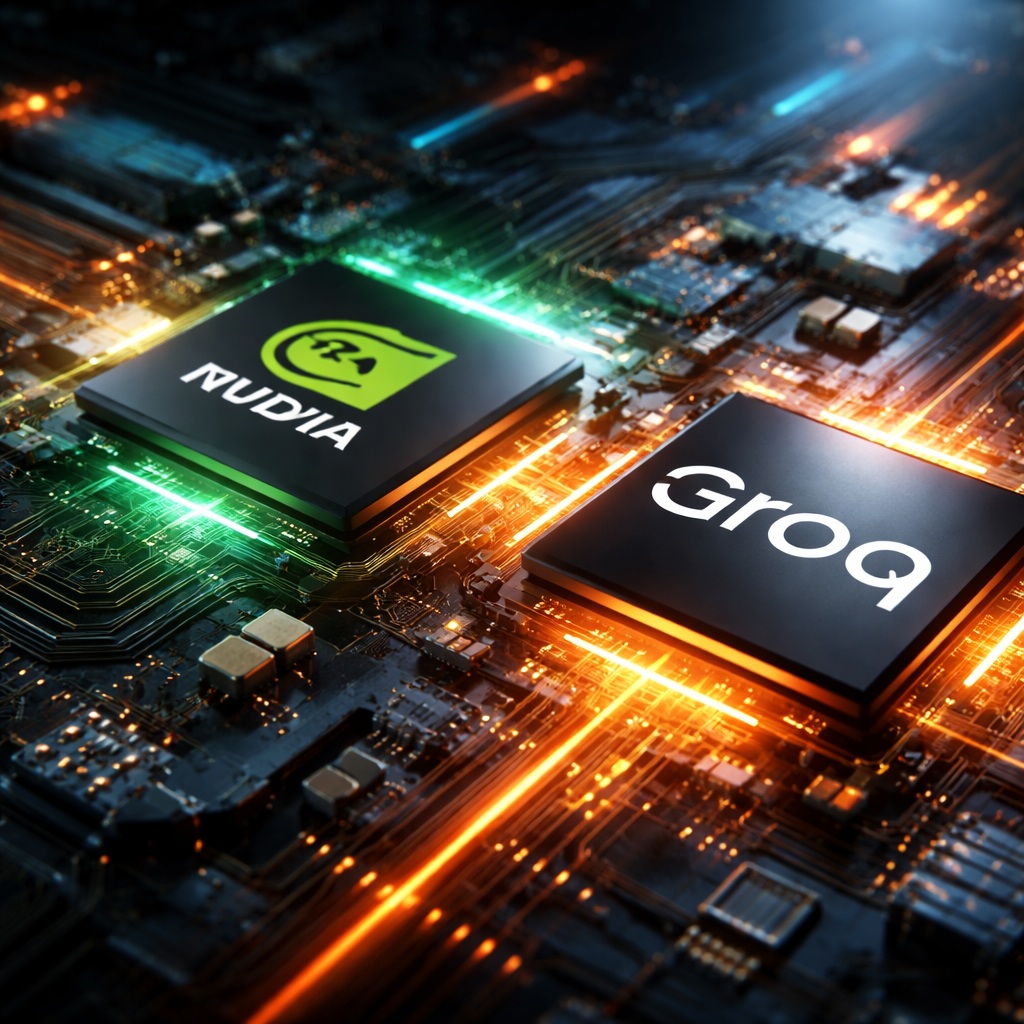
Licensing talks and a leadership hire underscore intensifying competition in next‑generation chips

By late December, the global race to define the future of artificial intelligence hardware has entered a new phase. Nvidia, the dominant force behind today’s AI accelerators, is moving to license technology from Groq, a younger rival known for its unconventional approach to chip design, while also seeking to bring Groq’s chief executive into its own leadership ranks.
According to people familiar with the discussions, the plan would mark a rare moment of convergence between competitors in one of the most fiercely contested corners of the technology industry. Rather than relying solely on its in‑house roadmap, Nvidia appears ready to selectively integrate external innovation as demand for faster, more efficient AI systems continues to surge.
Groq has carved out a niche by focusing on deterministic, low‑latency processing for AI inference, emphasizing predictable performance over brute‑force parallelism. That philosophy contrasts with Nvidia’s GPU‑centric model, which has become the default infrastructure for training and running large language models across data centers worldwide. Licensing Groq’s technology could allow Nvidia to broaden its portfolio, particularly in inference workloads where energy efficiency and response time are increasingly critical.
At the same time, Nvidia’s reported effort to recruit Groq’s CEO suggests that the move is about more than intellectual property. Leadership talent with experience building alternative architectures could help Nvidia adapt to a market that is no longer defined by a single dominant design. As hyperscale customers push for custom solutions and governments invest heavily in sovereign AI infrastructure, flexibility has become a strategic asset.
For Groq, the talks signal recognition of its technical credibility. While the company remains far smaller than its potential partner, its ideas have gained traction as enterprises look beyond traditional GPUs to meet rising computational costs. A licensing agreement would provide validation and resources, even as it reshapes Groq’s independence.
The broader context is an AI hardware market under unprecedented pressure. New entrants, custom silicon projects, and open‑source hardware initiatives are all challenging the status quo. Nvidia’s willingness to collaborate with a competitor highlights how rapidly the landscape is evolving, and how even market leaders must adapt to stay ahead.
Neither company has publicly confirmed the discussions. Still, the possibility of a deal reflects a pragmatic turn in the AI chip wars: innovation is accelerating so quickly that strategic partnerships may matter as much as rivalry. As the year draws to a close, the message from Silicon Valley is clear—control of the AI future will belong to those who can combine speed, talent, and architectural diversity.