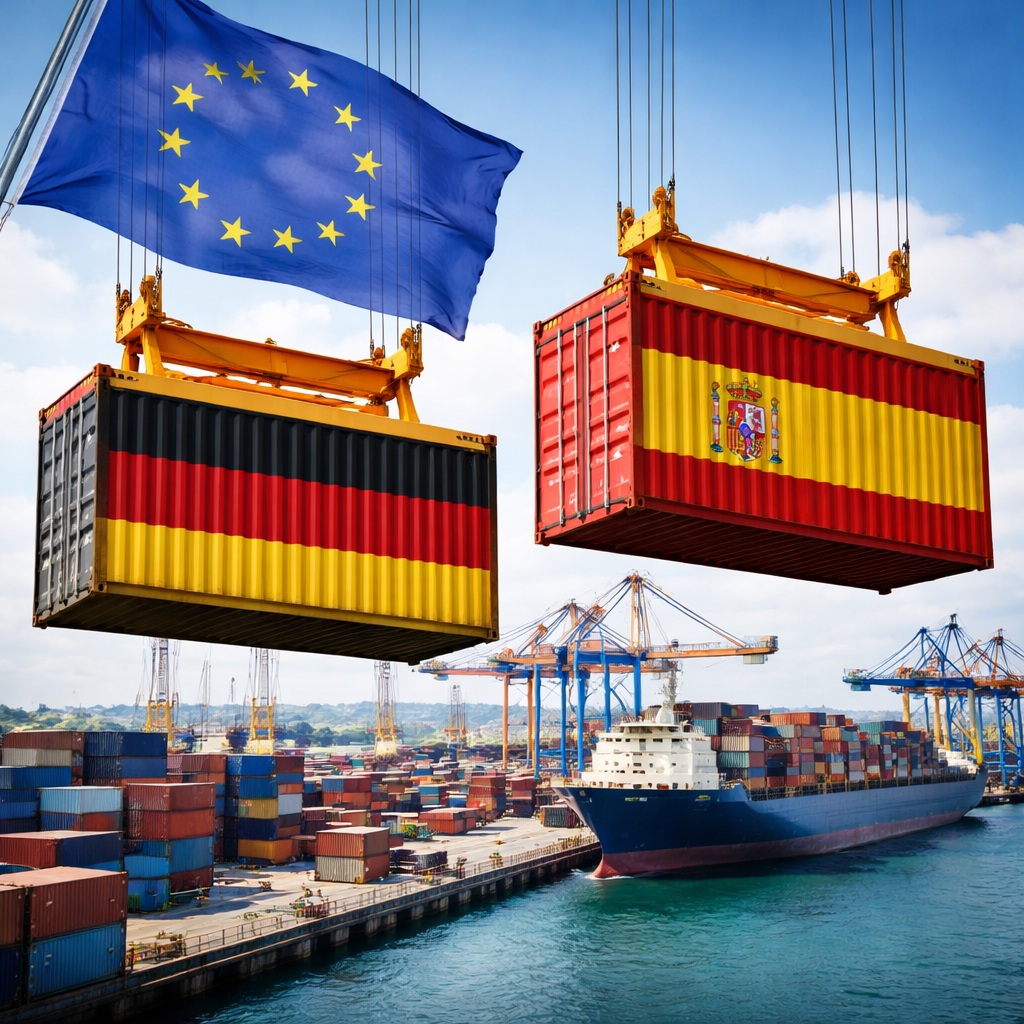
Rising Spanish consumption and resilient tourism are lifting bilateral trade at a time of cooling global demand.

Spain is poised to return to Germany’s list of top ten export destinations, marking a significant shift in European trade dynamics and underlining the renewed strength of intra-EU economic ties. If confirmed, the move would represent Spain’s first re-entry into the ranking since the aftermath of the global financial crisis, when shrinking demand across Southern Europe reshaped Germany’s export map.
The expected climb is being driven by a combination of robust domestic consumption in Spain and a tourism sector that has continued to outperform expectations. German exporters, particularly in automotive components, industrial machinery, chemicals, and consumer goods, are benefiting from steady orders as Spanish households spend more confidently and businesses invest to meet sustained visitor flows.
Industry analysts point to a forecast rise of roughly 8.5 percent in German exports to Spain, a notable acceleration compared with the broader slowdown affecting global trade. While demand from key non-European markets has softened amid geopolitical uncertainty and tighter financial conditions, trade within the European Union has shown greater resilience. Spain’s resurgence as a destination for German goods is increasingly seen as emblematic of this trend.
Germany’s export landscape has undergone gradual change over the past decade. Eastern Europe and the United States gained prominence, while Spain slipped down the rankings during years of fiscal adjustment and subdued growth. Today, the picture looks markedly different. Spain’s labor market has strengthened, wages have improved, and consumer confidence has been buoyed by a record-breaking tourism cycle that has spilled over into retail, transport, and services.
For German manufacturers, Spain offers both scale and proximity. Supply chains are deeply integrated, logistics costs remain comparatively low, and regulatory alignment within the single market continues to support trade flows. Automotive suppliers and capital goods producers, in particular, have found Spain a reliable market as the country upgrades infrastructure and industrial capacity.
The renewed momentum also reflects policy-driven factors. European recovery funding has supported investment in energy transition, digitalization, and transport networks across Spain, creating demand for German technology and equipment. At the same time, German firms have expanded their local presence, reinforcing commercial links that go beyond simple export transactions.
Economists note that Spain’s rise comes at a delicate moment for Germany’s export-dependent economy. With growth prospects clouded in parts of Asia and uncertainty lingering in transatlantic trade, stronger demand from European partners is increasingly important. Spain’s performance suggests that internal EU demand may cushion some of the external shocks facing exporters.
From Madrid’s perspective, the trend highlights a broader normalization after years of economic rebalancing. Stronger imports from Germany are a sign of investment and consumption confidence, even as Spanish firms continue to expand their own export footprint across Europe.
As the year draws to a close, the anticipated return of Spain to Germany’s top export partners list carries symbolic and practical weight. Symbolically, it underscores the recovery of a key euro area economy. Practically, it reinforces the idea that, in an uncertain global environment, Europe’s internal market remains a vital anchor for growth.
If current trends hold, Spain’s renewed position will not only reshape Germany’s export rankings but also stand as a reminder that the European Union’s deepest strength may lie in its ability to generate demand from within when the rest of the world slows.