As fighting grinds on in Kharkiv and Odesa, the Ukrainian president travels to Florida to press for guarantees, borders, and a near-final peace framework with the United States.

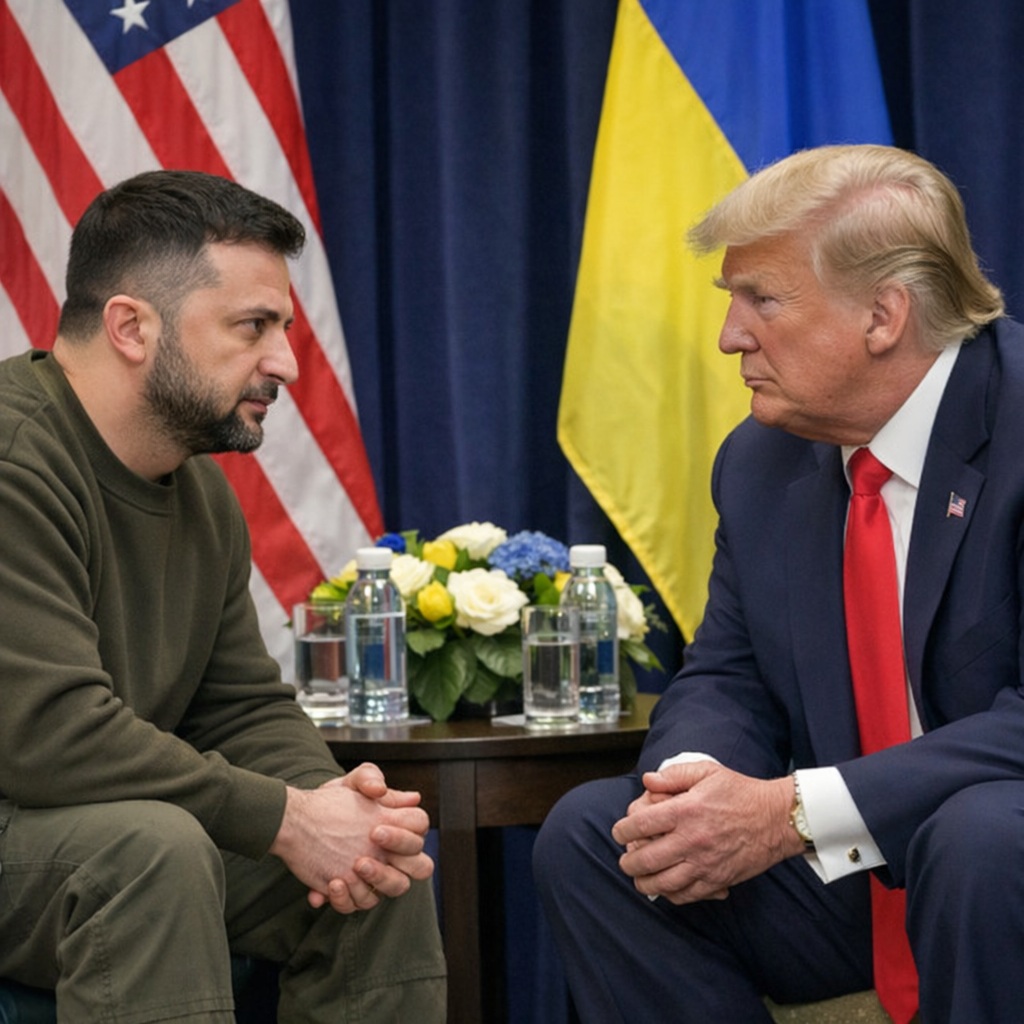
Ukrainian President Volodymyr Zelenskiy arrived in Florida for a closely watched meeting with U.S. President Donald Trump, bringing the war in Ukraine to the center of American and international diplomacy at a moment of fragile opportunity and persistent violence. The talks, framed by both sides as practical and outcome-driven, are expected to focus on territorial disputes, long-term security guarantees for Ukraine, and the contours of a peace framework that officials describe as “near-final” but still politically combustible.
The meeting comes as aggression continues on the ground. Ukrainian authorities reported renewed attacks on residential and infrastructure targets in the northeastern city of Kharkiv and the southern port of Odesa, underscoring the contrast between diplomatic maneuvering abroad and the grinding reality of war at home. For Kyiv, the juxtaposition is stark: diplomacy may be advancing, but the battlefield remains unforgiving.
According to officials familiar with the agenda, Zelenskiy’s priority is to lock in credible security guarantees that would deter future aggression and anchor Ukraine firmly within the Western security architecture. Territorial questions—among the most sensitive issues of the conflict—are also expected to feature prominently, with discussions centered on borders, sovereignty, and the conditions under which any adjustments might be recognized or rejected.
President Trump, hosting Zelenskiy at his Florida residence, has signaled a desire to push talks toward a concrete framework that could halt hostilities while limiting long-term U.S. commitments. Advisers describe the approach as transactional but pragmatic: stabilizing the conflict, reducing the risk of escalation, and defining a U.S. role that emphasizes leverage and enforcement rather than open-ended involvement.
The diplomatic choreography reflects broader shifts in the international landscape. After years of war fatigue across Europe and North America, there is growing pressure on leaders to show tangible progress. Yet expectations remain carefully managed. Neither side is presenting the Florida meeting as a breakthrough moment; instead, it is portrayed as a critical step in aligning positions before a wider diplomatic push involving European partners.
Territory remains the most explosive topic. Ukrainian officials continue to insist that sovereignty is non-negotiable, even as they acknowledge the complexity of translating that principle into a workable settlement. Any perception of concession risks domestic backlash in Ukraine, where public opinion has hardened after prolonged fighting and heavy civilian losses. Zelenskiy, whose leadership has been defined by wartime resolve, faces the challenge of demonstrating flexibility without appearing to compromise core national interests.
For the Trump administration, the territorial debate intersects with a broader recalibration of U.S. foreign policy. Trump has repeatedly argued that American support must deliver measurable outcomes and that security arrangements should be sustainable over time. In this context, security guarantees are being discussed not only as promises on paper, but as mechanisms—political, economic, and military—that could be activated if agreements are violated.
The continued attacks on Kharkiv and Odesa lend urgency to these discussions. In Kharkiv, emergency services reported damage to apartment buildings and energy infrastructure, reigniting concerns about winter resilience and civilian protection. In Odesa, a strategic hub for trade and shipping, strikes have disrupted port operations and added pressure to an economy already strained by years of conflict.
Western diplomats say these developments reinforce the argument that any peace framework must be robust and enforceable. A ceasefire without credible oversight, they warn, would risk freezing the conflict rather than resolving it. The Florida talks are therefore expected to address monitoring arrangements, response mechanisms, and the role of international partners in upholding any agreement.
Beyond immediate security concerns, Zelenskiy is also expected to raise reconstruction and economic stabilization. Ukraine’s recovery, officials say, cannot wait for a perfect peace. Investment guarantees, access to markets, and coordinated rebuilding plans are increasingly viewed as part of the security equation, reducing vulnerability by strengthening institutions and livelihoods.
The symbolism of the meeting has not gone unnoticed. A Ukrainian president seeking assurances in Florida, while missiles fall on Ukrainian cities, highlights the global nature of the conflict and the outsized role of U.S. leadership. It also reflects Trump’s preference for personalized diplomacy, where direct engagement is used to test boundaries and accelerate decision-making.
Critics, however, caution against overestimating what one meeting can achieve. Previous rounds of talks, both public and private, have shown how quickly momentum can stall when domestic politics and strategic mistrust intervene. In Ukraine, any hint of imposed solutions could inflame political tensions. In the United States, skepticism about long-term commitments abroad continues to shape the debate.
Still, officials on both sides suggest that the Florida meeting is designed to narrow differences rather than resolve them outright. By clarifying red lines, sequencing steps, and defining enforcement tools, they hope to create a framework that can be expanded and formalized in subsequent negotiations with allies and stakeholders.
As Zelenskiy and Trump sit down, the contrast between negotiation rooms and bomb shelters remains painfully clear. For Ukrainians in Kharkiv and Odesa, the outcome of distant talks may determine whether the coming months bring relief or renewed peril. For the broader international community, the meeting is a test of whether diplomacy can keep pace with a war that has reshaped security assumptions far beyond Ukraine’s borders.
The Florida talks may not deliver instant peace, but they represent a moment of decision. With a near-final framework on the table and violence continuing unabated, the choices made now could define the trajectory of the conflict—and the credibility of international guarantees—for years to come.