Russia unleashes a massive aerial assault on Ukraine’s capital and major cities, underscoring battlefield pressure ahead of high-stakes talks between Kyiv and Washington.

Russian missiles and waves of attack drones tore through the night skies over Kyiv and several other Ukrainian cities as residents rushed to shelters, the thunder of air defenses echoing across the capital. The barrage, among the heaviest in recent months, struck residential districts and critical infrastructure, killing and wounding civilians and plunging neighborhoods into darkness just as Ukraine’s leadership prepared for pivotal discussions with the United States on the future course of the war.
The timing was unmistakable. With negotiations looming over military aid, security guarantees, and the contours of any eventual settlement, Moscow signaled that it intends to arrive at the table from a position of force. Ukrainian officials said the assault involved hundreds of projectiles launched in coordinated waves designed to overwhelm air defenses, a familiar but still devastating tactic that has defined Russia’s long-range campaign.
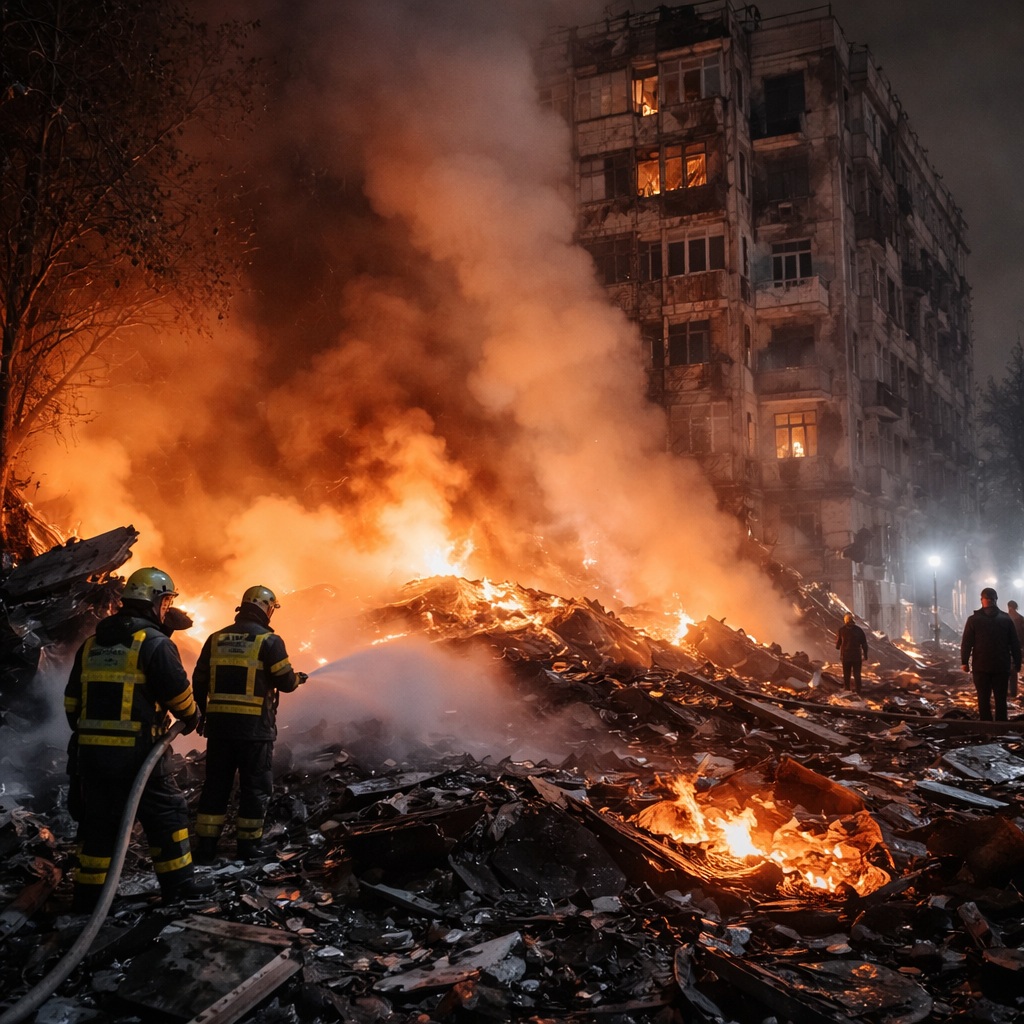
In Kyiv, emergency crews worked through the morning amid the smell of smoke and burning debris. Apartment blocks were scarred by shrapnel, windows blown out across entire streets. In one district, residents formed human chains to clear rubble while firefighters searched for survivors. Hospitals reported an influx of wounded, including children and elderly people injured by falling debris and shockwaves from nearby explosions.
President Volodymyr Zelenskyy condemned the attack as “terror by design,” arguing that Russia was deliberately escalating violence to extract concessions. “This is how Moscow speaks before negotiations,” he said in a video address, standing in front of a darkened government building after power outages swept parts of the capital. “They are not seeking peace; they are seeking leverage.”
Ukrainian military officials said air defenses intercepted a significant portion of the incoming missiles and drones, but acknowledged that the sheer volume made complete protection impossible. Analysts noted that Russia has adapted its strike packages, mixing faster ballistic missiles with slower drones to exhaust interceptors and expose gaps in coverage. The result has been a grinding war of attrition in the skies, mirroring the stalemate on the ground.
Beyond Kyiv, strikes were reported across central and southern regions, hitting energy facilities already strained by repeated attacks. Ukraine’s power grid operator imposed emergency shutdowns to prevent cascading failures, leaving millions without electricity or heating during winter conditions. Repair crews raced against time, but officials warned that repeated damage was eroding the system’s resilience.
The assault came as Ukrainian diplomats prepared for talks in Washington aimed at securing continued military and financial support. Those discussions are expected to focus on air defense systems, long-range strike capabilities, and assurances that Ukraine will not be left vulnerable if negotiations with Russia intensify. For Kyiv, the message from the night’s bombardment was stark: without sustained backing, civilian centers remain exposed.
In Washington, the attacks reinforced arguments among Ukraine’s supporters that any pause in assistance could have immediate and deadly consequences. U.S. officials, speaking on condition of anonymity, said the scale of the strikes underscored the urgency of bolstering Ukraine’s defenses while maintaining pressure on Moscow through sanctions and diplomatic isolation.
Russia, for its part, offered a different narrative. The Defense Ministry claimed its forces had targeted military and energy-related facilities, insisting that civilian damage was the result of Ukrainian air defenses. Such statements have become routine, even as independent observers and journalists document repeated hits on residential areas far from the front lines.
Strategically, the escalation appears designed to harden Russia’s bargaining position. By demonstrating its capacity to strike deep into Ukraine at will, Moscow seeks to remind both Kyiv and its Western partners of the costs of prolonging the conflict. At the same time, analysts caution that the approach carries risks. Intensified attacks on cities tend to stiffen Ukrainian resolve and deepen international support rather than weaken it.
For ordinary Ukrainians, the calculus is painfully immediate. “You learn to live with the sirens,” said Olena, a Kyiv resident who spent the night in a metro station with her two children. “But when the explosions are this close, you realize how fragile everything is. And then you hear about talks, and you wonder if anyone is really listening to what we are living through.”
As daylight returned, the capital bore the familiar signs of another night survived but not unscathed. Craters pocked roadways, and the skeletal remains of downed drones lay scattered in parks and courtyards. Life resumed in fits and starts, a testament to resilience forged over years of war.
Whether the latest barrage will shape the coming diplomatic exchanges remains uncertain. What is clear is that Russia intends to keep military pressure high even as the language of negotiations grows louder. For Ukraine and its allies, the challenge is to ensure that diplomacy is not conducted under the shadow of fear alone, but backed by the means to protect civilians and uphold sovereignty.
As winter deepens and talks approach, the skies over Kyiv have once again become a proving ground — not only for air defenses, but for the resolve of those who argue that peace cannot be built on the rubble of apartment blocks.