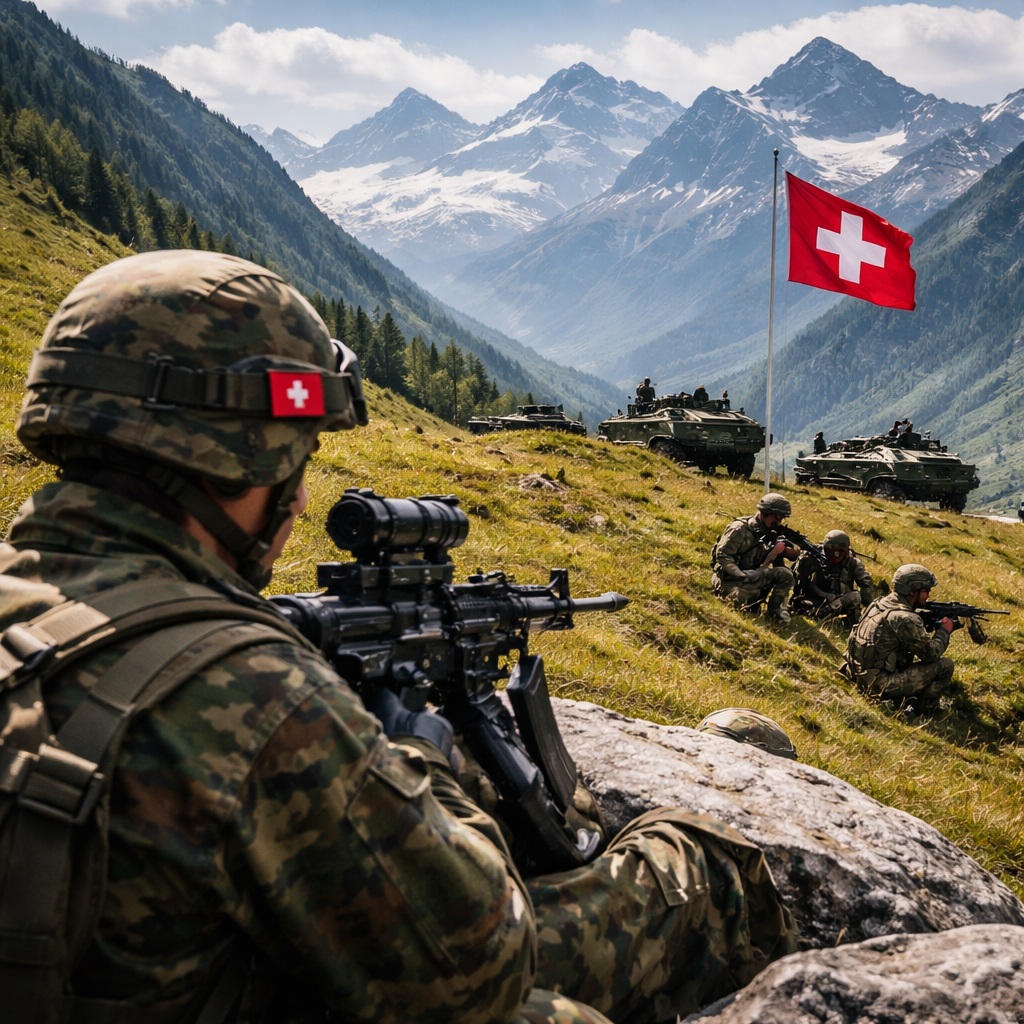
A rare admission from the country’s top military commander highlights how neutrality is being reshaped by Europe’s new security reality.
By late December 2025, Switzerland’s long‑standing image as a self‑reliant fortress at the heart of Europe has been publicly questioned by its own military leadership. The country’s army chief has warned that Switzerland would not be able to defend itself alone in the event of a large‑scale conflict, a statement that has reverberated far beyond Bern’s political circles.
The assessment marks one of the most candid acknowledgements in recent memory of the limits facing the Swiss Armed Forces. For decades, Switzerland’s defense doctrine has rested on armed neutrality, territorial defense, and the assumption that deterrence and preparedness could offset the country’s small size. The army chief’s remarks suggest that this model is under unprecedented strain.
According to senior military officials, the challenge is not a lack of professionalism or commitment among troops, but structural constraints. Switzerland fields a relatively small standing army supported by a militia system designed for rapid mobilization. While effective for crisis response and border protection, this structure struggles to sustain prolonged, high‑intensity operations against a technologically advanced adversary.
The warning comes amid a broader reassessment of security across Europe. Ongoing global conflicts, rising geopolitical competition, and the erosion of long‑standing arms control frameworks have forced even traditionally neutral states to rethink their assumptions. For Switzerland, located at the crossroads of major European transit routes and financial networks, instability beyond its borders can quickly become a domestic concern.
Military analysts note that modern warfare has shifted decisively toward domains where scale and integration matter: air defense, cyber operations, satellite intelligence, and long‑range precision systems. Maintaining credible capabilities in all these areas is costly, and for smaller states, increasingly unrealistic without cooperation. The army chief’s comments underline this reality, implicitly pointing to the need for closer coordination with European partners.
Politically, the statement has sparked debate about the future of Swiss neutrality. Supporters argue that acknowledging limitations does not weaken neutrality but modernizes it, aligning policy with reality. Critics fear a gradual erosion of independence, warning that reliance on external support could entangle Switzerland in conflicts it has historically sought to avoid.
Public opinion appears divided. Surveys and commentary suggest growing awareness that neutrality alone cannot shield the country from the ripple effects of war, cyberattacks, or economic coercion. At the same time, there remains strong attachment to the idea of Switzerland charting its own course, particularly in defense matters.
Government officials have responded cautiously, emphasizing that Switzerland remains committed to self‑defense while also deepening partnerships in training, intelligence sharing, and crisis management. No formal shift in doctrine has been announced, but the tone has clearly changed. Where once confidence dominated official messaging, there is now a note of urgency.
As the year draws to a close, the army chief’s warning stands as a symbol of Europe’s altered security landscape. For Switzerland, the challenge is to reconcile its traditions with a world in which security is increasingly collective. Whether this moment leads to incremental reforms or a more profound redefinition of neutrality will shape the country’s defense posture for years to come.

 The Tower Post