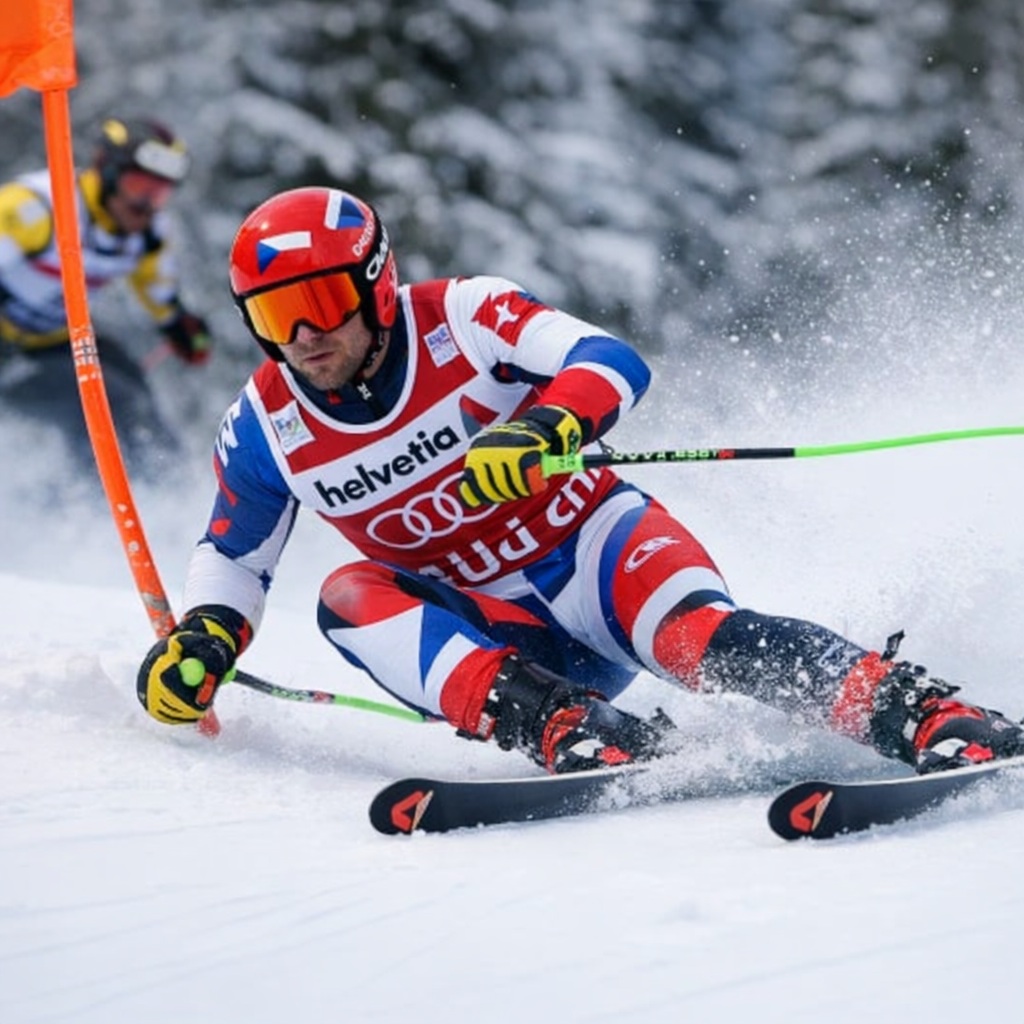
A stunning victory over Marco Odermatt signals a shift in Alpine skiing’s balance of power as Europe’s winter season builds toward the Olympics.

In the thin alpine air and under a sky heavy with expectation, Czech skier Kryštof Zabystran delivered one of the most unexpected moments of the World Cup season. Racing with fearless precision, he claimed his first-ever World Cup super-G victory, defeating overall favorite Marco Odermatt and securing a historic result for Czech alpine skiing.
The win was more than a personal milestone. It marked the first time a Czech male skier has triumphed in a World Cup super-G, a discipline long dominated by athletes from Switzerland, Austria, and Norway. On a course designed to reward power and experience, Zabystran’s performance stood out for its balance: aggressive where it mattered, composed where others faltered.
From the start gate, the race unfolded with the expected hierarchy. Top contenders posted fast but cautious times, aware that the demanding layout punished even the smallest mistake. Odermatt, widely regarded as the benchmark in speed disciplines, delivered a technically clean run that seemed sufficient for victory. For several minutes, his name sat confidently at the top of the leaderboard.
Then came Zabystran.
Starting later in the field, the Czech skier attacked the course with visible confidence, carrying speed through the gliding sections and holding a tight, disciplined line on the turns. He crossed the finish line to a moment of disbelief, his time eclipsing Odermatt’s by a narrow but decisive margin. The reaction in the finish area said it all: surprise, excitement, and the quiet realization that something significant had just happened.
For Czech skiing, the victory represents a breakthrough years in the making. Traditionally stronger in technical events and in women’s competitions, the nation has rarely featured at the very top of men’s speed disciplines. Zabystran’s success challenges that narrative and suggests a broader evolution within the country’s alpine program.
The result also adds intrigue to a season already rich in storylines. With the Winter Olympics approaching, national teams are fine-tuning strategies and athletes are seeking form at precisely the right moment. A surprise victory at this stage can have ripple effects, influencing selections, confidence levels, and even how rivals approach upcoming races.
For Odermatt, the defeat is unlikely to derail his campaign. His consistency remains unmatched, and his reaction at the finish reflected professionalism rather than frustration. Yet even for a dominant champion, being beaten by an emerging rival serves as a reminder of the sport’s unpredictability.
Zabystran’s triumph fits into a broader trend across European winter sports, where athletes from traditionally less dominant nations are beginning to challenge established powers. Improved training methods, data-driven preparation, and greater access to elite competition have narrowed the margins at the highest level.
Whether this victory marks the start of sustained success or remains a singular highlight will depend on what follows. Super-G is unforgiving, and maintaining top form requires not only talent but resilience. Still, the significance of this moment cannot be overstated. Czech flags waved proudly in the crowd, and messages of support flooded in from across the skiing world.
As the World Cup caravan moves on and attention gradually turns toward the Olympic stage, Zabystran has ensured that his name will be part of the conversation. In a sport built on hundredths of a second, one bold run was enough to rewrite history.




 The Tower Post