Tehran frames mounting pressure as total war with the United States, Israel, and Europe, deepening global unease at year’s end

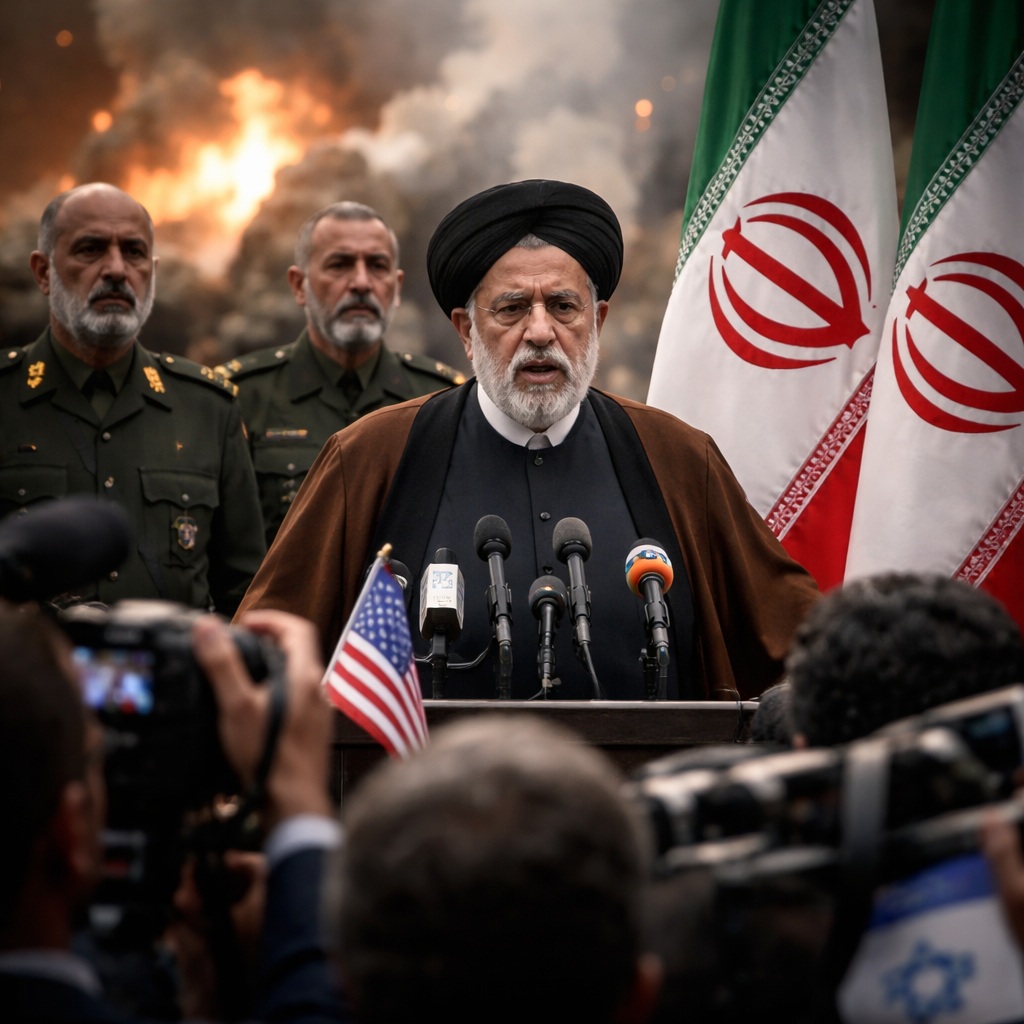
Late in the closing days of the year, Iran’s leadership sharply escalated its rhetoric toward the West, declaring what it described as a “full-scale confrontation” with the United States, Israel, and Europe. The statement, delivered by President Masoud Pezeshkian, framed Iran’s standoff with Western powers as an all-encompassing conflict extending beyond diplomacy into economic, political, and security domains.
The declaration marks one of the most explicit articulations yet of Tehran’s view that it is already engaged in a broad struggle with its adversaries. Iranian officials have increasingly portrayed sanctions, regional rivalries, and diplomatic isolation as elements of a coordinated campaign aimed at weakening the Islamic Republic. By labeling the situation a total war, the government appears to be signaling both resolve at home and defiance abroad.
Washington and Jerusalem were singled out as principal antagonists, with Europe grouped alongside them for what Iranian leaders describe as alignment with American pressure strategies. European capitals, which have often sought to balance criticism of Iran with continued diplomatic engagement, had not issued a public response by the time of publication. The absence of immediate reaction has done little to calm anxieties in a region already marked by volatility.
Iran’s confrontational posture comes amid a broader pattern of heightened tension across the Middle East. Ongoing conflicts, maritime incidents, and proxy dynamics have repeatedly drawn in regional and global powers. Analysts say Tehran’s language suggests an effort to consolidate domestic support by casting economic hardship and international scrutiny as the price of resistance.
For Western governments, the statement underscores the narrowing space for diplomacy. Efforts to revive dialogue on nuclear and regional issues have stalled, while sanctions regimes remain firmly in place. European officials, in particular, now face renewed questions about whether engagement can still serve as a stabilizing force or whether Iran’s leadership has shifted decisively toward confrontation.
The rhetoric also carries implications beyond the Middle East. Energy markets, already sensitive to geopolitical shocks, are watching closely for any sign that tensions could disrupt supply routes. Security planners in Europe and North America are assessing whether Iran’s words foreshadow concrete actions or are primarily intended as strategic messaging.
As the year draws to a close, Iran’s declaration adds to a sense of global unease. Whether described as war or confrontation, the standoff between Tehran and the West shows little sign of easing. With communication channels strained and trust in short supply, the coming period is likely to test the capacity of diplomacy to prevent words from hardening into irreversible realities.