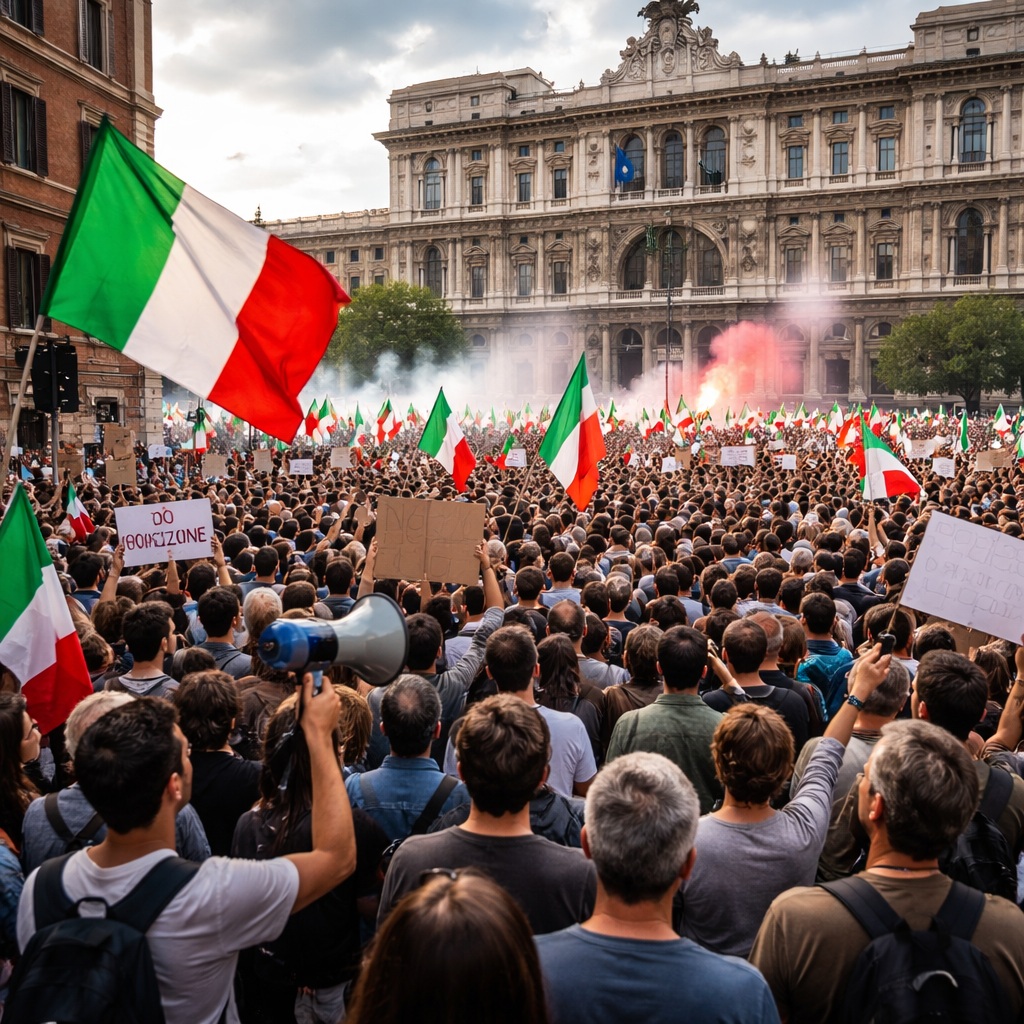
Government reforms curbing judicial oversight on public tendering ignite street protests and reignite debate over governance, accountability, and the rule of law.
As the year draws to a close, Italy finds itself once again at the center of a heated national debate over governance and democratic safeguards. The government’s recent move to scale back judicial oversight on public tendering has triggered waves of protest across major cities, exposing deep political and social divisions and raising renewed questions about the country’s commitment to transparency and the rule of law.
The reform, approved after months of internal negotiations and parliamentary pressure, narrows the scope under which courts can review public procurement decisions. Supporters within the governing coalition argue that the changes are necessary to speed up infrastructure projects, reduce bureaucratic paralysis, and ensure that public investment reaches the economy more quickly. Critics, however, see the shift as a dangerous weakening of institutional checks at a time when Italy is already struggling with public trust in political decision-making.
Demonstrations have spread from regional capitals to the streets of Rome, where thousands gathered in recent days carrying banners calling for “legal accountability” and “defense of public integrity.” Trade unions, civil society groups, and student organizations have joined opposition parties in condemning what they describe as a structural rollback of judicial safeguards designed to prevent corruption and favoritism in public contracts.
At the heart of the controversy is the balance between efficiency and oversight. Italy has long been criticized for slow administrative procedures that delay major public works, from transportation networks to urban redevelopment. Government officials insist that judicial scrutiny, while essential in principle, has often resulted in excessive litigation, deterring investment and leaving projects stalled for years. By limiting the circumstances under which courts can intervene, ministers say, the state can finally deliver long-promised reforms and meet economic expectations.
Yet magistrates and legal scholars warn that the reform risks undermining one of the pillars of Italy’s postwar institutional architecture. Judicial review of public tendering has historically served as a barrier against abuse of power, particularly in a system where political influence and economic interests frequently intersect. Reducing that oversight, they argue, may create gray zones where irregularities are harder to detect and correct.
The protests reflect broader unease about the direction of governance reforms. For many demonstrators, the tendering reform is not an isolated measure but part of a wider political trajectory that emphasizes executive discretion over institutional balance. Opposition leaders accuse the government of framing efficiency as a pretext to marginalize independent scrutiny, while downplaying the long-term risks to democratic accountability.
Within the judiciary itself, reactions have been unusually outspoken. Several judicial associations have issued statements expressing concern that the reform could expose judges to political pressure by narrowing their mandate in sensitive economic matters. While the government has rejected these claims as alarmist, the unusually public nature of the dispute underscores the depth of institutional tension.
International observers are watching closely. Italy, as a founding member of the European Union, is bound by commitments to uphold transparency, competition, and the rule of law in public spending. Legal experts note that procurement rules are not merely a domestic matter but a cornerstone of European governance, especially when public funds and cross-border companies are involved. Any perception that judicial safeguards are being weakened could invite scrutiny from European institutions and financial partners.
Government officials counter that the reform remains fully compatible with European standards and does not eliminate judicial oversight altogether. Instead, they argue, it clarifies competences and reduces uncertainty by limiting the grounds for appeal. According to this view, clearer rules will ultimately benefit both public administrations and private companies, creating a more predictable environment for investment.
Public opinion, however, appears divided. Surveys published by national media suggest that while many Italians are frustrated by administrative delays and unfinished public works, there is also widespread skepticism toward political assurances. Years of corruption scandals and judicial investigations have left a legacy of mistrust, making any reduction in oversight particularly sensitive.
The debate has also reopened historical fault lines in Italian politics. The judiciary has long played a prominent role in public life, sometimes clashing with governments over high-profile investigations. For supporters of the reform, limiting judicial intervention is seen as a way to restore political primacy and prevent what they describe as “governing by court ruling.” For opponents, the judiciary remains an essential counterweight in a system prone to concentration of power.
As protests continue and parliamentary committees prepare further hearings, the issue shows no sign of fading from the public agenda. Analysts predict that the tendering reform could become a defining test of the government’s credibility on institutional reform, shaping alliances and opposition strategies well into the new year.
Beyond the immediate political fallout, the controversy highlights a deeper question facing Italy: how to modernize the state without eroding the safeguards that underpin democratic governance. Striking that balance has challenged successive governments, and the current turmoil suggests that easy solutions remain elusive.
For now, the streets, the courts, and the parliament remain locked in a tense dialogue. Whether the reform will deliver the promised efficiency gains or deepen institutional mistrust is uncertain. What is clear is that Italy’s debate over judicial oversight and public accountability has once again moved from technical legal language into the heart of public life, where its consequences will be measured not only in contracts signed or projects completed, but in confidence earned or lost.




 The Tower Post