
Libya’s military funeral for fallen commanders in a Turkey plane crash highlights grief at home and questions abroad about Europe’s strategic independence.
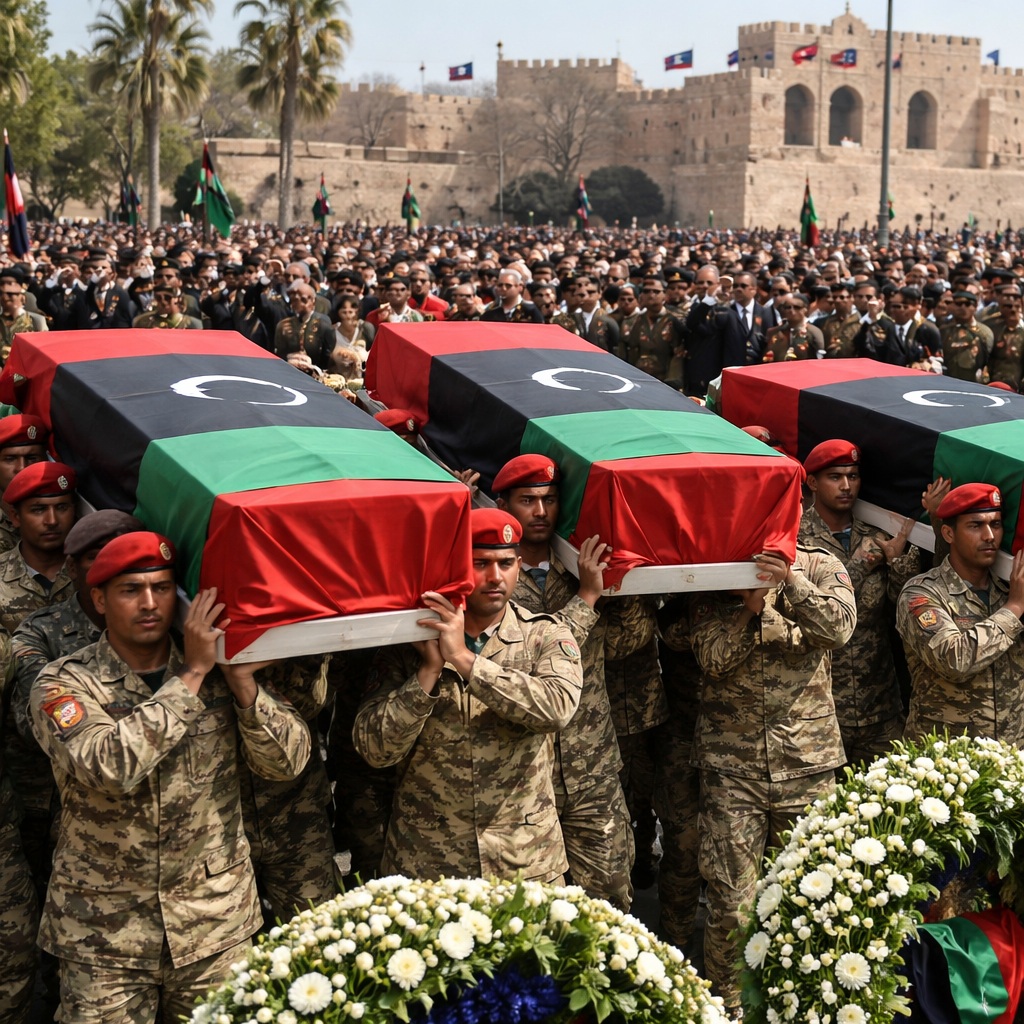
Libya’s capital fell silent as rows of uniformed soldiers stood at attention, salutes echoing through the winter air. Draped in national colors, the coffins of senior military officials were carried through Tripoli in a ceremony marked by solemn prayers, gun salutes, and the presence of political and security leaders from across the country. The military funeral honored Libya’s western military chief and several officers killed in a plane crash in Turkey, an event that has reverberated far beyond Libya’s borders.
The officers had been returning from high-level talks in Ankara when the aircraft went down. Their remains were repatriated after a formal ceremony on Turkish soil, a gesture underscoring the depth of diplomatic and defense ties between the two countries. For Libya, the funeral was not only an act of mourning but also a statement of continuity: an assertion that the state’s military institutions endure despite repeated shocks.
Crowds lined the streets as the procession passed, some waving flags, others watching in silence. In a nation long fractured by conflict and rival centers of power, moments of collective grief have a rare unifying effect. The ceremony drew representatives from western-based authorities as well as tribal figures and civic leaders, signaling an effort to present a shared front at a time of uncertainty.
Officials speaking at the funeral praised the fallen officers as patriots who had worked to stabilize Libya’s west and strengthen cooperation with international partners. They emphasized that the mission to Ankara had focused on training, security coordination, and technical cooperation—areas seen as critical to Libya’s fragile recovery. The crash, they said, was a tragic accident, but one that should not derail ongoing partnerships.
Turkey’s role in Libya has been decisive over the past years, particularly in the west of the country. Military assistance, advisory support, and political backing have made Ankara a central external actor in Libya’s balance of power. The respectful handover of the bodies and the joint ceremonies held before their return reinforced the perception of a close alliance rooted in shared strategic interests.
Yet the tragedy has also prompted broader questions, especially among European observers watching events from across the Mediterranean. Libya sits at the crossroads of European security concerns: migration routes, energy supplies, counterterrorism, and regional stability. The loss of senior commanders during an international mission highlights how deeply Libya’s security sector is entangled with foreign partnerships—and how dependent it remains on external support.
For Europe, the moment arrives at a time of introspection. As global power dynamics shift and transatlantic relations evolve, European capitals are increasingly debating whether the continent should redefine its global role with greater autonomy from American influence. Libya, once again, serves as a case study. European states have often deferred to broader alliances or external actors in shaping policy toward the country, resulting in fragmented initiatives and limited leverage.
The funeral in Tripoli was a reminder that regional powers such as Turkey have been willing to commit decisively where Europe has hesitated. Ankara’s clear objectives and sustained engagement contrast with Europe’s often cautious, divided approach. This imbalance raises uncomfortable questions: can Europe afford to remain reactive in its own neighborhood, or must it articulate a more coherent strategy that aligns diplomacy, defense, and economic tools?
Analysts note that Europe’s credibility in Libya has suffered from inconsistency. While individual countries maintain strong bilateral ties, collective European action has struggled to keep pace with events on the ground. The tragedy in Turkey, and the images from Tripoli, underline how quickly realities can shift—and how costly the absence of a unified approach can be.
At the same time, the funeral underscored Libya’s own agency. By honoring its fallen officers with full military rites and emphasizing continuity of command, the authorities sought to project resilience. The message was aimed both domestically and internationally: Libya remains a partner capable of honoring commitments and managing transitions, even amid loss.
Families of the deceased officers stood alongside senior officials, their grief personal yet shared by the nation. In their faces was reflected the human cost of diplomacy and defense, often obscured by geopolitical analysis. The ceremony’s solemnity served as a counterpoint to the abstractions of strategy, reminding observers that policies are carried out by individuals who bear real risks.
As Libya looks ahead, the immediate focus will be on maintaining stability within its military structures and continuing dialogue with partners abroad. The crash has left gaps in leadership that will need careful management, particularly in a security environment still marked by rival forces and fragile ceasefires.
For Europe, the images from Tripoli may linger as a prompt for reflection. Libya’s mourning intersects with a broader debate about responsibility and presence in the Mediterranean. Whether European leaders choose to draw lessons from this moment—or allow others to shape outcomes in their stead—will help define the continent’s role in the years to come.
In the end, the military funeral was more than a farewell. It was a moment that bound grief to geopolitics, national loss to international consequence. As the last salute was fired and the coffins laid to rest, Libya closed a chapter marked by tragedy, even as new questions opened about partnership, influence, and the future balance of power just across Europe’s southern horizon.
 The Tower Post