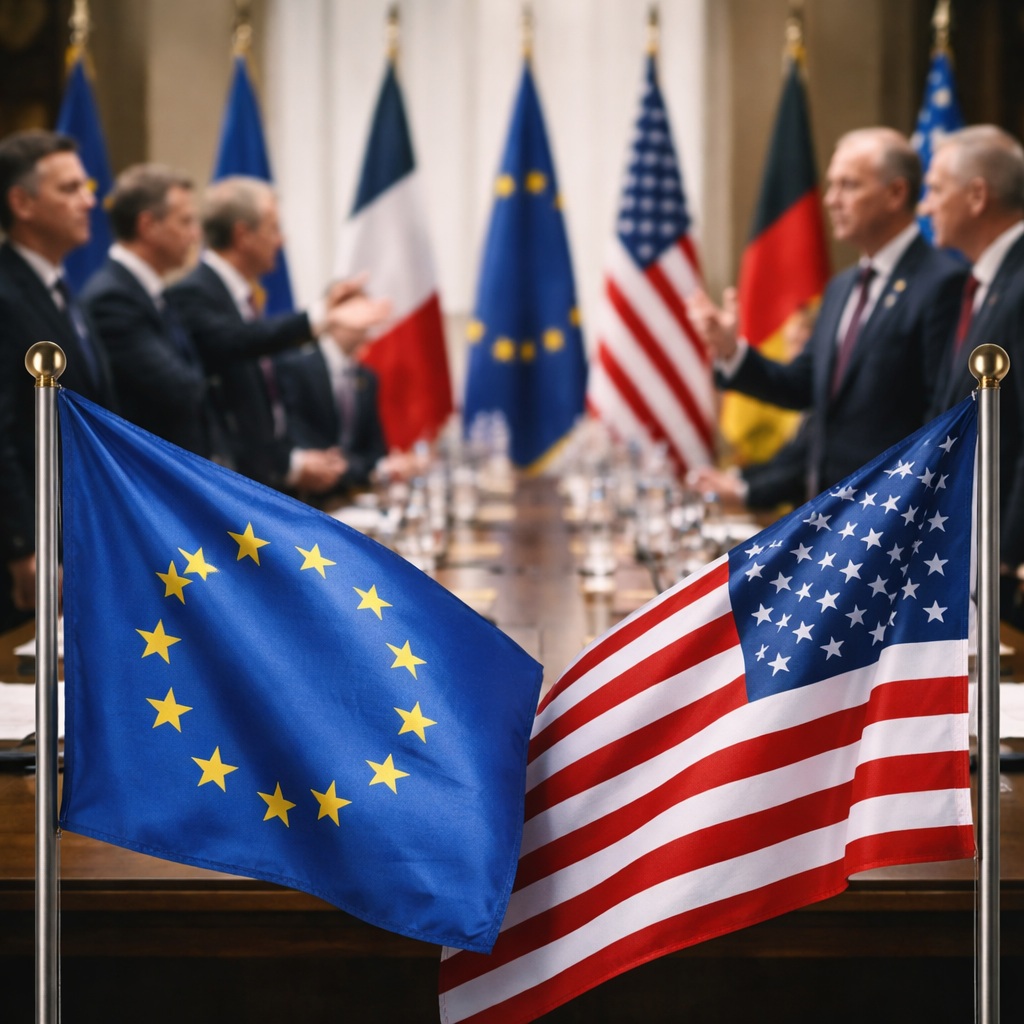
Brussels condemns U.S. visa bans on European officials tackling online hate, exposing widening rifts in a partnership once defined by shared rules.
As the year closes, a familiar alliance is facing an unfamiliar kind of strain. The European Union has issued a sharp rebuke of the United States after Washington imposed visa restrictions on European officials involved in enforcing rules against online hate and disinformation. The dispute, publicly condemned by France and Germany and echoed in Brussels, has revealed growing friction between two partners that have long framed their relationship around common democratic values.
At the center of the row are U.S. visa bans applied to a small group of European regulators and policy officials. While Washington has avoided detailed public explanations, European diplomats say the measures target individuals connected to enforcement actions against U.S.-based technology companies under new EU digital rules. For European leaders, the move crosses a line, transforming a policy disagreement into a diplomatic signal.
The European Commission reacted by calling the restrictions unjustified and counterproductive. Officials in Brussels argue that regulating online hate speech, extremist content, and disinformation is not an ideological crusade but a legal obligation rooted in European law. “These are public servants implementing democratically adopted rules,” one senior EU official said, describing the visa bans as an attempt to exert pressure beyond normal diplomatic channels.
France and Germany, the bloc’s two most influential member states, were particularly vocal. Paris described the U.S. decision as an unfriendly act against European sovereignty, while Berlin warned that politicizing travel rights risks undermining trust at a time when cooperation is badly needed. Both governments stressed that the officials affected were acting within their mandates, not targeting American citizens but setting standards for platforms operating in Europe.
The dispute highlights a deeper tension that has been building for years: diverging approaches to free expression and platform responsibility. In Europe, lawmakers have increasingly embraced the idea that governments must actively curb harmful online content, especially hate speech and coordinated disinformation campaigns. The United States, by contrast, remains anchored to a more absolutist interpretation of free speech, wary of state intervention and skeptical of regulations that could restrict expression or burden U.S. firms.
These differences have been manageable in the past, often relegated to technical negotiations and regulatory dialogues. This time, however, the escalation to visa bans has elevated the issue to a symbolic level. For European officials, the message appears to be that enforcing EU law could carry personal consequences, even when actions are taken at home.
Washington has framed its position as a defense of fundamental freedoms and of American economic interests. U.S. officials argue that certain European measures risk overreach, potentially chilling speech and discriminating against foreign companies. By targeting individuals rather than institutions, they signal displeasure without launching a broader trade or legal confrontation.
Yet that very tactic has alarmed European capitals. Diplomats warn that personal sanctions blur the line between policy disagreement and coercion. “If regulators fear retaliation for doing their jobs, the integrity of our legal systems is at stake,” a German official said privately. The concern is not only about the current case but about the precedent it sets for future transatlantic disputes.
The timing adds to the unease. The transatlantic relationship has been under pressure from multiple directions, from trade frictions to differing industrial policies and approaches to China. While cooperation on security and defense remains strong, especially in support of Ukraine, economic and regulatory tensions have multiplied. The visa dispute feeds into a broader narrative of mistrust, even as leaders on both sides insist the partnership remains indispensable.
Public opinion also looms in the background. European leaders face voters increasingly concerned about online toxicity, election interference, and the power of large technology platforms. Backing down under U.S. pressure could be politically costly. In the United States, skepticism toward foreign regulation of American companies plays well with lawmakers wary of ceding influence to Brussels.
Despite the harsh words, both sides are signaling a desire to prevent further escalation. EU officials emphasize that they are not seeking retaliation but clarification and dialogue. Some have floated the idea of reviving stalled transatlantic talks on digital governance, hoping to establish clearer guardrails and avoid future confrontations. Washington, for its part, has left the door open to consultations, even as it defends its right to control entry into the country.
The episode underscores a reality that has become harder to ignore: the transatlantic bond, while resilient, is no longer frictionless. Shared values do not automatically translate into shared policies, especially in fast-moving domains like digital regulation. As Europe asserts itself as a global rule-setter and the United States guards its constitutional traditions and corporate interests, clashes are likely to recur.
For now, the visa bans remain a relatively limited measure, affecting a handful of officials rather than entire institutions. But their symbolic weight is heavy. They suggest that disagreements once handled quietly can now spill into the personal and political realm, testing the patience and assumptions on both sides of the Atlantic.
As the year draws to a close, diplomats in Brussels, Paris, Berlin, and Washington are left to manage the fallout. Whether the dispute becomes a footnote or a turning point will depend on the willingness of both sides to reconcile principle with pragmatism. What is clear is that the rules of engagement in the transatlantic relationship are being renegotiated in real time, with digital policy as one of the most contested frontiers.



 The Tower Post